
The Pioneer anomaly blamed gravity for fourteen years: it was the probes' own heat
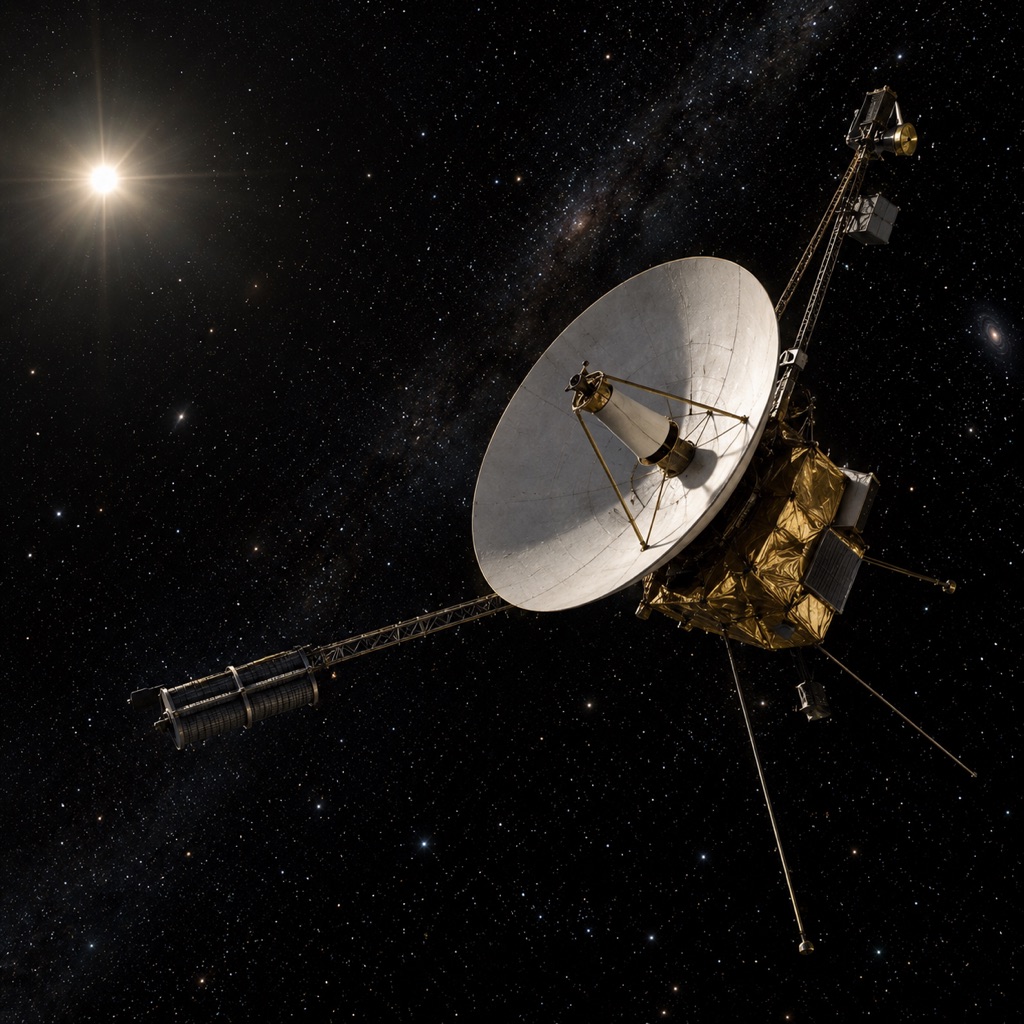
In 1998, two probes launched a quarter of a century earlier put the law of gravitation on trial. Pioneer 10, which left on March 2, 1972, and Pioneer 11, which left on April 5, 1973, were braking slightly too hard. Not by much: a little under a billionth of a meter per second squared, pointed toward the Sun. Enough, all the same, for the question to circulate for fourteen years in the fundamental physics journals: what if the inverse square law stopped being exact very far from the Sun, beyond twenty astronomical units or so.
The answer was the heat of the probes themselves. It was on the table as early as 1998, and it was set aside for a reason that looked solid.
What the Doppler data showed
The founding paper is signed by John D. Anderson, Philip A. Laing, Eunice L. Lau, Anthony S. Liu, Michael Martin Nieto and Slava G. Turyshev, spread across the Jet Propulsion Laboratory, the Aerospace Corporation, the consultancy Astrodynamic Sciences and Los Alamos. Posted to arXiv on August 28, 1998 and published in Physical Review Letters volume 81, pages 2858 to 2861, it announced an anomalous acceleration of roughly 8.5 times ten to the minus eight centimeters per second squared, pointed toward the Sun.
The detail matters more than the summary. The JPL orbit determination program gave (8.09 plus or minus 0.20) for Pioneer 10 and (8.56 plus or minus 0.15) for Pioneer 11, in those same units. A second code, CHASMP, developed at the Aerospace Corporation outside the JPL, produced (8.65 plus or minus 0.03) on the Pioneer 10 data. Two teams, two pieces of software, two fitting strategies, one residual of the same size.
Those error bars deserve to be read for what they are. They are formal fitting errors, and the two codes were not independent from end to end: the authors note that they share the same physical principles, the same planetary ephemeris and the same time and polar motion inputs, and that the search for common elements was still open. The small size of the CHASMP error in fact comes from its method, a least squares fit over the whole orbit, which was not looking for any variation with distance.
The long 2002 study, Physical Review D volume 65, article 082004, fixed the value that became canonical: 8.74 plus or minus 1.33 times ten to the minus ten meters per second squared. That bar, forty times wider than the tightest of the 1998 formal errors, is the first realistic uncertainty budget in the whole affair. It rested on roughly 19,403 Doppler points from Pioneer 10, from January 3, 1987 to July 22, 1998, between 40 and 70.5 astronomical units, and on 10,252 points from Pioneer 11, from January 5, 1987 to October 1, 1990, between 22.42 and 31.7.
None of this was improvised, and that is what made the anomaly credible.
The 1998 reasoning that cleared heat
The 1998 paper looks at thermal radiation explicitly. The probes are powered by plutonium 238 radioisotope thermoelectric generators, half life 87.74 years, which delivered 160 electrical watts at launch and slightly under 80 watts in 1997. The surplus power and the plutonium heat go out into space. The authors work out how much power would have to be directed to produce the anomaly, about 85 watts, and note that almost that much is available on board.
Then they dismiss the hypothesis in two steps. First an assumption: the radiation is presumed approximately isotropic. Then a falsification argument, which is the good one: if anisotropic heat caused the effect, the acceleration should decline over time, as the onboard power drops. And yet, they write, after 1980 no such decline was observed.
The test was sound. It was simply applied to data that were too short, with sensitivity that was too loose. J. I. Katz pointed this out as early as 1998: the announced constancy was only guaranteed to within 2 times ten to the minus eight over the 40 to 60 astronomical unit range, roughly 24 percent of the mean value, while the rejected heat had declined only about 6 percent over the same stretch. A bound at 24 percent cannot rule out a drop of 6 percent.
An immediate counterproposal, then fourteen years elsewhere
The community did not wait. J. I. Katz submitted a comment on September 24, 1998, published in 1999 in Physical Review Letters volume 83, page 1892, attributing the effect to the recoil of waste heat from the generators, scattered off the back of the high gain antenna. Edward M. Murphy submitted on October 5, 1998, page 1890 of the same volume, a text pointing at the passive radiators placed on the side facing away from the Sun. Louis K. Scheffer, whose first posting dates from July 2001, published in 2003, in Physical Review D volume 67, article 084021, a model reproducing the acceleration from 5 to 71 astronomical units to within 10 percent.
These texts did not close the file, because the 2002 study examined them one by one and rejected them. Against Katz: only about 2.5 percent of the generator surface faces the antenna, which leaves just 4 watts of directed power, that is an estimated bias of minus 0.55 plus or minus 0.55 times ten to the minus eight centimeters per second squared, roughly 6 percent of the anomaly, and the authors themselves treat that figure as an upper bound. Against Murphy and Scheffer: the heat from the central compartment is not constant, it falls from about 73 to 57 watts during the measurement period, which sits badly with a constant anomaly.
And above all, the same argument as in 1998 comes back: if the mechanism were thermal, the acceleration should have dropped by about 0.75 times ten to the minus eight centimeters per second squared over the 11.5 years of Pioneer 10 data. That drop was not visible in those data.
The rest of the literature went elsewhere. The review by Slava Turyshev and Viktor Toth, published in Living Reviews in Relativity volume 13, article 4, in 2010, devotes an entire chapter to the proposed mechanisms: modified gravity, MOND, dark matter trapped in the solar potential well, mechanisms of cosmological origin, all the way to a special relativity with three invariant scales.
Two numerical coincidences helped a great deal, and the same review takes the trouble to take them apart. The acceleration is roughly the speed of light times the Hubble constant, except that landing on the observed value demands a Hubble constant of about 95 plus or minus 14 kilometers per second per megaparsec, well above the 73.2 that the review gives as the accepted value at the time. And the Milky Way, approximated as a point mass at 8,000 parsecs with 4 times ten to the eleven solar masses, produces 8.75 times ten to the minus ten meters per second squared; except that this gravity also pulls on the Sun, against which the anomaly is measured, and the tidal residual left over is seven orders of magnitude too small.
The archives we nearly destroyed
The turning point is not theoretical. Until 2005, almost nothing was accessible to researchers, and a large part of the Pioneer archives held at NASA's Ames Research Center was scheduled for destruction for lack of budget. The recovery effort saved the project documents from 1966 to 2003: drawings, manufacturing reports, test results, calibrations.
In parallel, an effort launched at the JPL in June 2005 targeted the entire Doppler record of the mission, close to thirty years for Pioneer 10 and twenty years for Pioneer 11, against the 11.5 and 3.75 years used in 2002. The task proved harder than expected: obsolete formats, missing files, corrupted files. Transferring what was still readable onto modern media was finished in November 2009. The raw telemetry, for its part, comes to about 40 gigabytes.
It is these two seams, and not any new observation, that settled the affair.
The model that closed the file
First result: with the long data, the decline shows up. Turyshev, Toth, Jordan Ellis and Craig B. Markwardt submitted on July 14, 2011 a paper published in Physical Review Letters volume 107, article 081103. The usable arcs go from 11.5 to 23.1 years for Pioneer 10 and from 3.75 to 10.75 years for Pioneer 11. The data favor an acceleration declining by roughly 2 times ten to the minus eleven meters per second squared per year, with better than 10 percent improvement in the residuals over a constant acceleration. The authors stay careful, they call the gain marginal and leave rigorous quantification to later work. But the falsification test set up in 1998 had just changed sides.
Second result: the thermal model. Slava Turyshev, Viktor Toth, Gary Kinsella, Siu-Chun Lee, Shing M. Lok and Jordan Ellis submitted on April 11, 2012 a paper titled Support for the thermal origin of the Pioneer anomaly, published in Physical Review Letters volume 108, article 241101.
The work is engineering, not physics. No computer aided design file exists for a craft drawn forty years earlier; the model was built by keying in the vertex coordinates of every surface from the recovered drawings. It has about 3,300 surface elements, 3,700 nodes and 8,700 linear conductors, and it includes the fourteen louver assemblies of the thermal control system, twelve with two blades and two with three. Generator power is computed from 2,578.179 watts on July 1, 1972 and the half life of plutonium. Flight telemetry supplies the boundary conditions.
The check is the part that counts. Modeled generator thermal power lands within 1 percent of the known value, fin root temperatures within 2 kelvins, and the root mean square deviation over six platform sensors is 5.1 percent, across eleven distances evaluated between 3 and 80 astronomical units.
Very little was needed. On the 251.883 kilograms taken for Pioneer 10, the anomaly amounts to a force of about 0.22 micronewtons, that is the recoil of a collimated photon beam of roughly 66 watts. Halfway through the measurement period, the generators were still dissipating more than 2 kilowatts. An effective anisotropy on the order of 3 percent was enough to explain the whole thing.
The thermal model gives efficiency coefficients of 0.0104 for generator heat and 0.406 for electrical heat. The Doppler analysis, carried out independently, minimizes its residuals at 0.0144 and 0.480. The computed recoil force comes to about 80 percent of the one estimated from the Doppler, and the one sigma error ellipses overlap. The authors' conclusion, framed for Pioneer 10: at the present level of knowledge of the spacecraft and its trajectory, no statistically significant anomalous acceleration remains. Pioneer 11 was not treated at the same level of detail, spot checks having turned up no surprises.
The dominant uncertainty is nothing exotic. Within a total budget of 26.3 percent, possible degradation of the generator paint accounts on its own for 25 percent, against 8.1 percent for every other source combined: three thousandths of an inch of zirconia in a sodium silicate binder, roughly a quarter of whose surface faced the Sun, and whose aging under solar radiation nobody had ever measured.
Why the popular version held up so long
Three things kept the anomaly alive. The measurement was good, obtained by two separate codes on tens of thousands of points. The published figure for the thermal contribution, about 6 percent, carried the authority of a peer reviewed error budget, while its own authors offered it as an upper bound. And the only test able to decide, the decline over time, called for a data set twice as long as the one that existed then.
The Pioneer anomaly was solved by no telescope, no accelerator and no theory. It was solved by finally modeling the instrument itself properly, from drawings that a budget cut had nearly sent to the dumpster. The 2012 authors put it plainly: the anomalous acceleration of these craft is consistent with known physics.