
Voyager 1: One Light-Day From Home
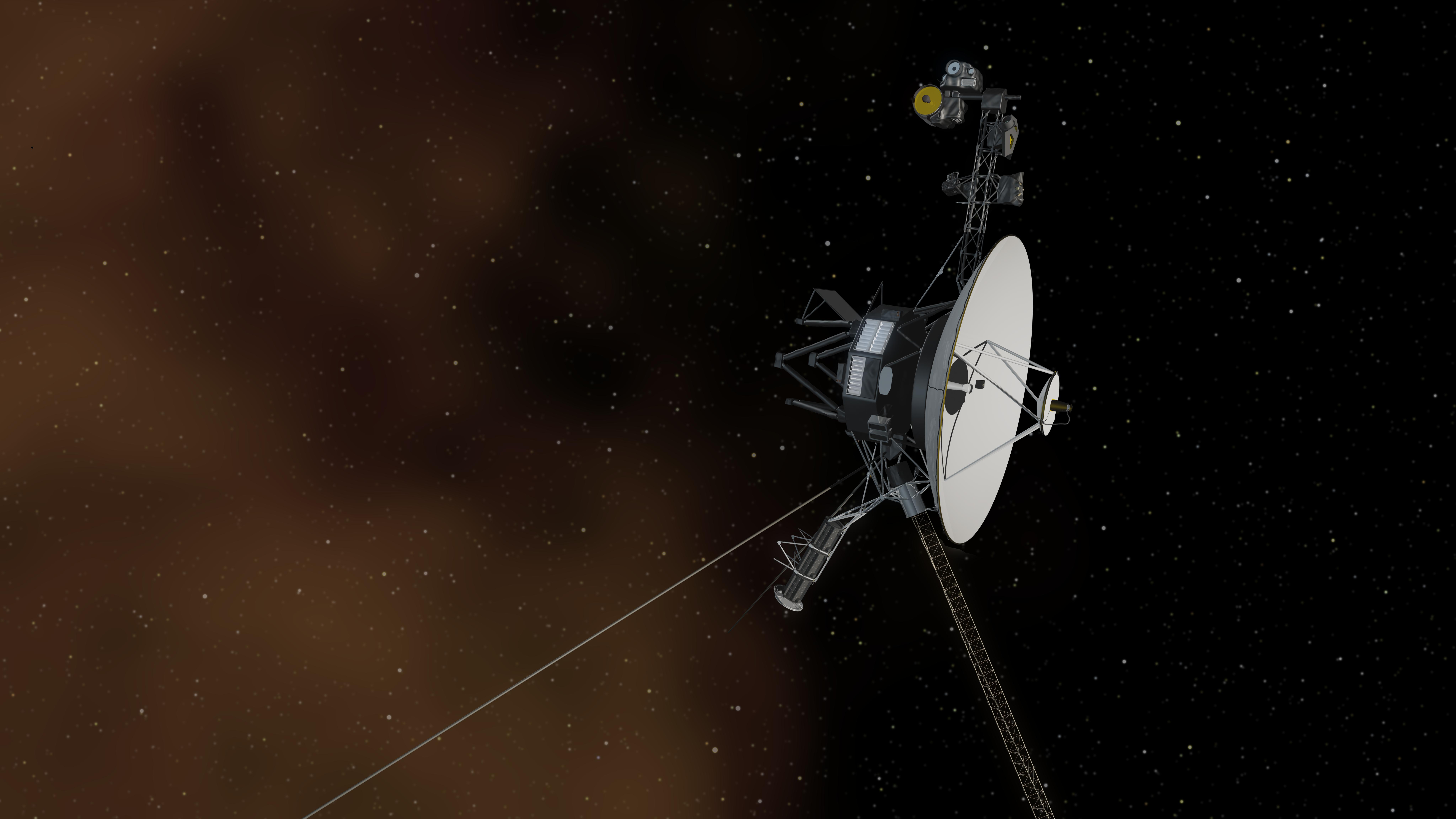
Somewhere out past the planets, in a darkness so complete it has no real name, a small machine the size of a subcompact car is still keeping a faint heartbeat. It launched in 1977, before most of the people who now operate it were born. It carries an eight-track-era computer with less memory than a birthday card that plays a tune. And in November 2026, it will quietly cross a line no human-made object has ever crossed: it will become so far from home that its own voice, traveling at the speed of light, takes a full day to reach us.
That machine is Voyager 1. And the line it's about to cross is one light-day.
A full day, at the speed of light
We're used to light being instant. Flip a switch, the room is bright. But light has a speed limit — about 300,000 kilometers per second — and over big enough distances, even that starts to feel slow.
In early 2026, Voyager 1 sits roughly 172 astronomical units from Earth — about 25.8 billion kilometers, where one AU is the Earth–Sun distance. Far enough that a radio command sent today already takes around 23 hours to arrive. On November 18, 2026, that gap reaches exactly 24 hours: a full light-day, roughly 25.9 billion kilometers.
The human consequence is strangely poetic. An engineer who says "good morning, Voyager" on a Monday won't hear it answer until Wednesday. Every conversation with the spacecraft is now a two-day round trip, a postcard exchange across an ocean of vacuum. There is no such thing as a quick chat anymore.
A 1970s machine, still working
What makes this almost unbelievable is the hardware. Voyager 1 was built with 1970s technology — its computers are spectacularly underpowered by any modern measure, its data recorder used magnetic tape, and its main job was supposed to last about four years: a grand tour of Jupiter and Saturn.
Nearly five decades later, it's still phoning home. Power comes from a radioisotope thermoelectric generator, a brick of plutonium that turns its own radioactive heat into electricity. It loses about 4 watts every year, an unstoppable slow fade. To stretch what's left, NASA keeps switching instruments off one by one. In April 2026 they powered down another one, leaving just two science instruments still listening to the space around it.
Engineers have had to perform miracles from 25 billion kilometers away — including coaxing the craft to switch to a set of thrusters that hadn't fired in years, sending the fix and then waiting most of two days just to learn whether it worked.
A message in a bottle, bolted to the side
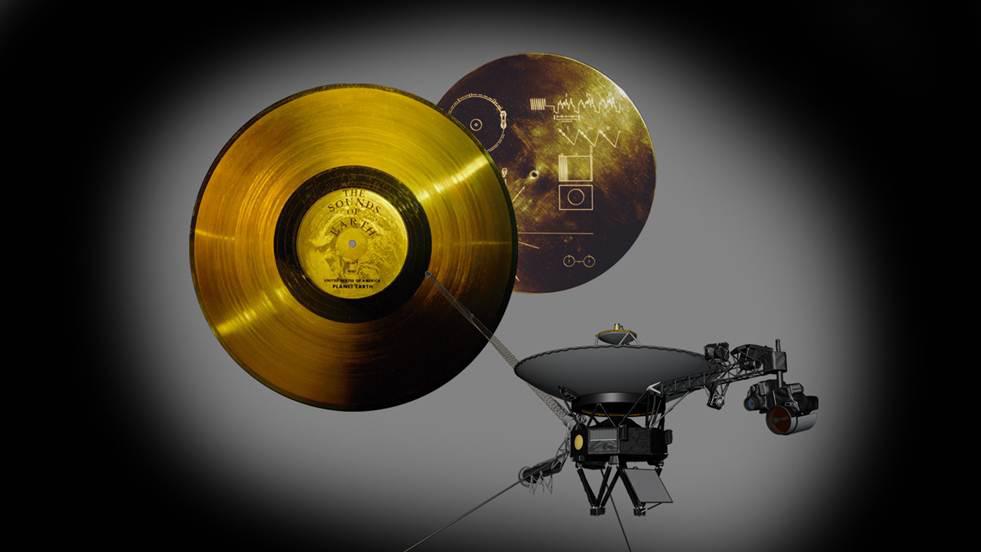
Strapped to Voyager 1 is the strangest cargo ever launched: the Golden Record. It's a gold-plated copper phonograph disc, complete with a stylus and pictogram instructions for how to play it — a 1977 guess at what an alien might need to decode us.
On it: greetings in 55 languages, the sound of a kiss, a mother's first words to her baby, whale song, thunder, Chuck Berry, Bach, and 115 encoded images of life on Earth. It was assembled in a hurry by a team led by Carl Sagan, who understood that it was less a serious bet on contact and more a portrait of humanity, sealed for deep time. The record's surface is designed to survive for a billion years.
Nobody expects anyone to ever find it. That was never quite the point.
The slow goodbye
Voyager 1 won't talk forever. As the plutonium cools, the lights are going out one circuit at a time. NASA estimates it may have enough power to send back faint engineering data until around 2036 — and by then it will also be drifting beyond the reach of the giant antennas of the Deep Space Network. After that, silence.
But the craft itself won't stop. It will keep coasting outward at over 60,000 kilometers per hour, no longer talking, no longer listening, carrying its golden message past stars that won't even be born for ages.
So here's the kicker. When that final signal fades sometime in the 2030s, the last thing we'll ever hear from Voyager 1 will already be a full day old before it arrives — a goodbye sent from a machine that, by the time we read it, will have been alone in the dark for a day longer still.