
The world's first webcam ran for two years before it reached the Web
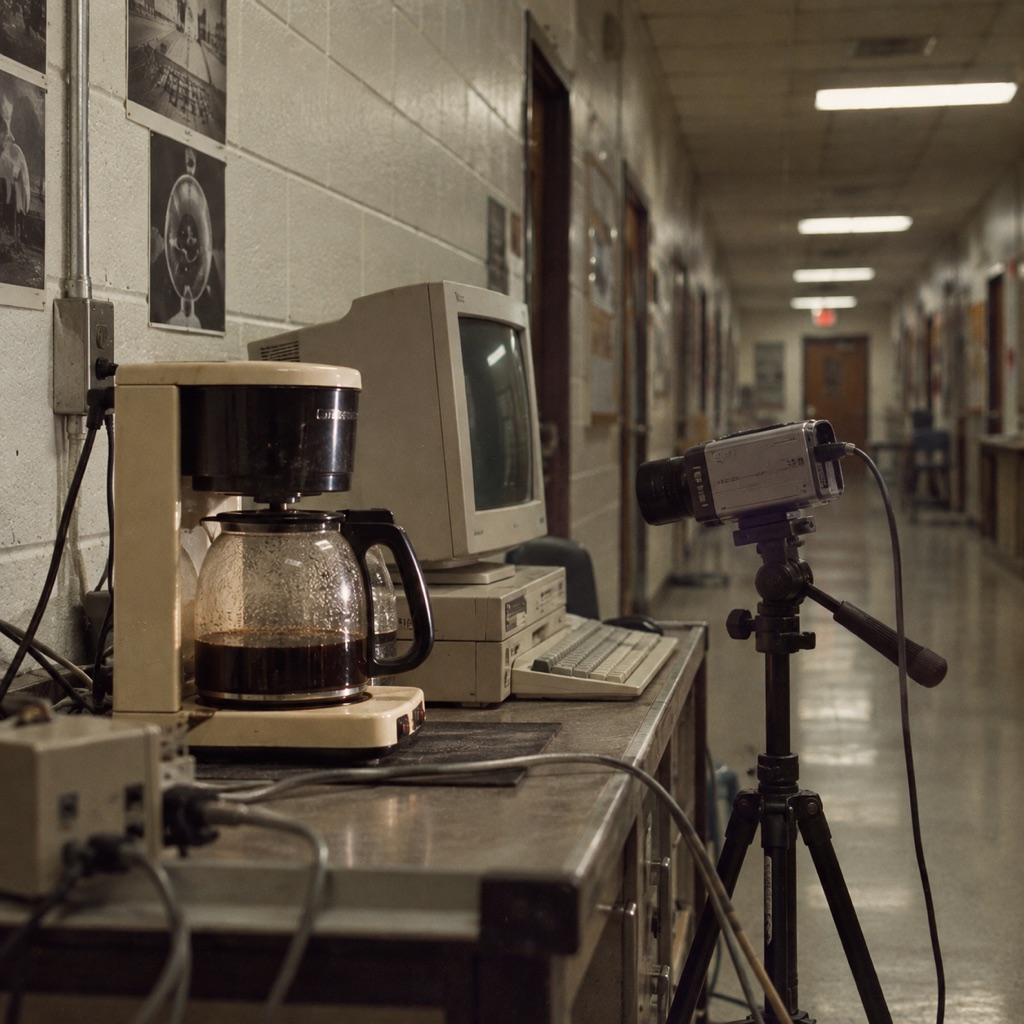
It gets described everywhere as the world's first webcam. The claim is right in substance and wrong in the details, and the details tell a better story than the legend does. The Cambridge rig was built in late 1991, on a laboratory's local network, at a time when web browsers could display nothing but text. It only became a webcam two years later, when two people other than the ones usually credited hooked it up to the World Wide Web. In between there is a newspaper column, an HTML tag and a browser beta.
Fifteen researchers, one coffee pot, seven floors
The University of Cambridge Computer Laboratory was housed at the time in the Arup Building, on the New Museums Site. Some fifteen researchers from the Systems Group shared a single filter coffee machine, set up in the corridor just outside a room known as the Trojan Room. Quentin Stafford-Fraser puts it bluntly in the biography he would publish in May 1995: "being poor, impoverished academics, we only had one coffee filter machine between us". One pot fills a few cups and no more, and the building runs to seven floors. Anyone working two or three flights away would make the trip only to find it empty, drained by the night owls of the Trojan Room.
The fix took a day of tinkering, "a day or so". A video camera was clamped to a laboratory stand and pointed at the machine. Cables ran under the floor to a video capture card installed in one of the test racks in the Trojan Room. Paul Jardetzky wrote the server, which grabbed frames at regular intervals. Stafford-Fraser wrote the client, which showed an icon-sized thumbnail in the corner of everyone's screen. The program was called XCoffee.
XCoffee, 768 by 576, in greyscale
The specifications of the 1991 rig are known precisely because an outside witness wrote them down on the spot. Bob Metcalfe, co-inventor of Ethernet at Xerox PARC, was staying at the laboratory at the time, to the point of signing from a cl.cam.ac.uk address. He gave XCoffee his "LAN Notes" column in Communications Week of 27 January 1992, under the title "Hacking a New ATM-RPC-Ethernet Coffee Pot Server". It is the first published trace of the system. He describes 8-bit monochrome images of 768 by 576 pixels, captured from a rack-mounted 68020 server with a frame grabber, carried by ATM remote procedure calls over Ethernet, then displayed through MIT's X Window System, which sends only shrunken versions to the screens. The camera cost next to nothing: the laboratory, Metcalfe writes, is littered with cheap video cameras left over from its Pandora project, and the two authors requisitioned one that was sitting idle.
Metcalfe notes the mismatch, with a hint of amusement: "Since XCoffee requires low-resolution still pictures every few seconds, even Ethernet is gross overkill", and he adds that RS232 would do the job. The laboratory's ATM rings and switches ran up to 500 megabits per second. They had not been installed for this, and the column says so: XCoffee draws on that luxury environment only because the environment happens to be lying around.
The picture refreshes about three times a minute, which is enough, Stafford-Fraser would write, because the pot fills slowly. It is greyscale, which is also enough, "because so was the coffee". In the same column, Metcalfe reports that the two authors are already thinking about what comes next: adding colour, watching the tea room queue, the printer paper trays, the sandwich van in the car park. The 1995 biography would give names to two of those ideas, XSandwichVan and XPrinterOutputTray, and note that they never got past the conversation stage: the old frame grabber gave up the ghost, and its authors moved on to other things.
The Web could not display an image yet
This is where the popular version goes off the rails. In 1991 and 1992, XCoffee was not on the Web, for a simple reason Stafford-Fraser states himself: browsers could not display images. The system ran on the laboratory's in-house protocols, on top of its own ATM stack, on hardware built on site. You needed the X client and the right network to see the coffee pot.
The unlock came from elsewhere, and can be dated to the day. On 25 February 1993, on the www-talk mailing list, Marc Andreessen proposed a new optional HTML tag: "I'd like to propose a new, optional HTML tag: IMG", with a single mandatory argument, SRC="url". On 14 March 1993, on the same list, he announced beta version 0.10 of NCSA Mosaic for X, whose first line of new features reads "Support for <IMG> tag: inlined images in HTML documents". The Web could display an image.
At the laboratory, Daniel Gordon and Martyn Johnson drew the conclusion. Gordon modified the server so that it would answer HTTP requests, and together they wired the whole thing to the Web. The timeline kept by Stafford-Fraser places the operation in November 1993; the Heinz Nixdorf MuseumsForum, which holds the object today, gives 22 November 1993, and the arithmetic works out: the laboratory's farewell page would credit the machine with seven years and nine months of service before it was switched off on 22 August 2001. The hardware changed along the way: a frame grabber in an Acorn Archimedes now captured one image per second, JPEG-encoded by the machine itself, with the web server fetching it over MSRPC2, the in-house remote procedure call mechanism. The original page states it without fanfare: "The online coffee pot actually predates our World Wide Web server by some time."
The coffee pot reached the American general press right afterwards. On 8 December 1993, John Markoff devoted a New York Times article to the new Mosaic browser, "A Free and Simple Computer Link", and listed what a single click could now bring up: a NASA weather film shot over the Pacific, a Clinton speech archived at the University of Missouri, a music selection from MTV, and then "a small digital snapshot reveals whether a certain coffee pot in a computer science laboratory at Cambridge University in England is empty or full".
Famous for being famous
The counter climbs fast. On 11 November 1994, BBC Radio Cambridgeshire came to report on site; the laboratory hooked a radio up to one of its workstations to relay the broadcast over its own network, and recorded the lot. Around 1996, the image passed a million views. In May 1998, according to a timeline that puts a question mark on the month itself, it passed two million. In March 2001, the Guardian offered an estimate of 2.4 million viewers worldwide.
On 1 April 1998, Larry Masinter published RFC 2324, which defines the Hyper Text Coffee Pot Control Protocol. It is an April Fool, but a documented one: the text cites in its references the Gordon and Johnson page and the Stafford-Fraser biography, from which it copies a paragraph, and coins along the way the error code "418 I'm a teapot", still alive in web culture. Its acknowledgements list among its inspirations the Prancing Pony, the Carnegie Mellon Coke machine, the internet toaster and the Cambridge coffee pot; its bibliography even announces a "Hyper Text Sandwich Van Monitoring Protocol, Version 3.2" credited to Stafford-Fraser and listed as "in preparation".
Asked why the thing was such a success, the man himself gives the most honest answer available, in Communications of the ACM of July 2001: "because journalists keep contacting us to ask that sort of question. It became famous for being famous."
Switching off as the last trick
On 7 March 2001, the Guardian ran the headline "Plug pulled on web's historic coffee pot"; the announcement, the article notes, had been made the day before. The laboratory was moving to the William Gates Building, west of Cambridge, and the Trojan Room would cease to exist. The next day, Spiegel Online published an interview with Stafford-Fraser under the title "Es ist Zeit, 'Tschüß' zu sagen". His argument is not a technical one: you could buy a new camera and plug it into a PC, but if the machine has been replaced, and the camera too, and if most of the people have gone, it would no longer be the same thing. The one constant in the story, he says, was that the coffee pot really was in the Trojan Room.
The laboratory held out to the end. At 10:54 on Wednesday 22 August 2001, the camera captured its last image. It is hard to read: you can make out the fingers of Daniel Gordon, Martyn Johnson and Quentin Stafford-Fraser resting on the power switch of the Acorn Archimedes, which had produced the pictures for seven years and nine months. The page documenting the operation thanks Ian Pratt and the other occupants of the Trojan Room, who kept the system alive while the laboratory was being packed up around them, and allows itself an ironic forecast about the coming fashion for webcams filming their own shutdown.
In his July 2001 article, Stafford-Fraser draws the lesson: putting content on the Web is no longer news, and no organisation gets newspaper columns any more for opening a server. "You want to know the secret of getting attention these days? Switch it off." Announcing the end, he writes, earned him the front page of the Times of London and that of the Washington Post, which gave him its front page of 1 April 2001.
What is on show in Paderborn is not the 1991 coffee pot
One last correction, and the one most often missed. The object that was sold is not the 1991 machine. A coffee pot under that kind of regime does not last ten years; Stafford-Fraser reckons the 2001 one is the grandson or great-grandson of the original. What went up for auction on eBay in August 2001, in aid of the new building's future coffee equipment, is the pot that served the longest: a Krups ProAroma 305, serial number 31.085.
The auction was won on 11 August 2001 by Spiegel Online, for 3,350 pounds sterling, with the Fresenius group as sponsor. The machine left for Hamburg along with the camera, the grinder and other archive pieces. Krups repaired it, it makes coffee again, and since October 2016 it has been on permanent loan at the Heinz Nixdorf MuseumsForum in Paderborn, in a case on the wall given over to the internet, on the second floor. A camera films it continuously, of course.
As for the Arup Building, it now houses the university's zoology museum and is called the David Attenborough Building. The Trojan Room disappeared with the move, exactly as Stafford-Fraser had said it would.