
The Word “Bug” Was Already Seventy Years Old When That Moth Got Taped In
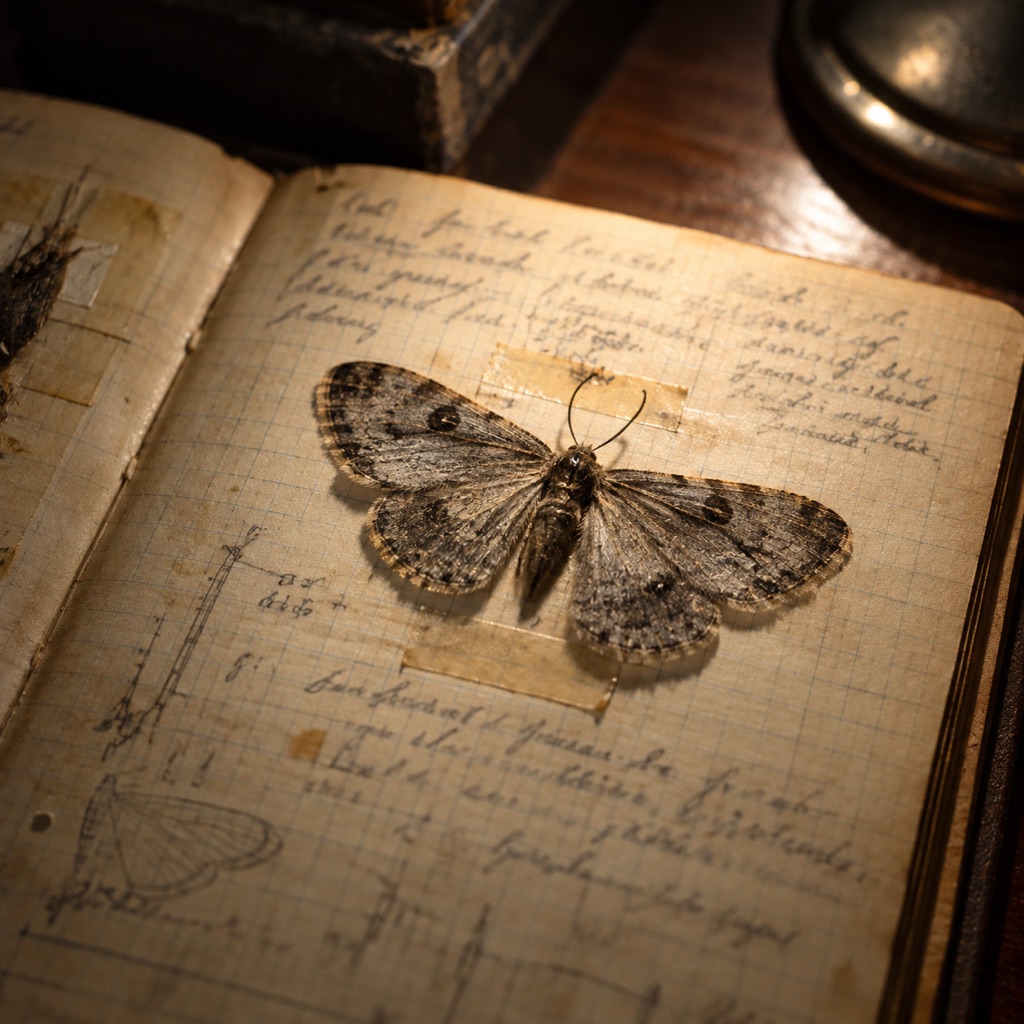
The National Museum of American History, in Washington, keeps a logbook measuring 48.4 centimeters by 29.5, an inch and a half thick. Its catalog record carries the number 1994.0191.01 and an unusual list of materials: adhesive tape, paper, cloth, ink, and "biologicals". That last word covers a dead moth, taped to a page beside a handwritten line: "First actual case of bug being found."
The object has circulated for decades as the birth certificate of the word "bug", of its offshoot "debug", and as Grace Hopper's finest hour. The line written on the page reads the other way round. "First actual case" implies earlier cases that were not actual. The joke only lands if "bug" already means an abstract defect to whoever is holding the pen. In 1947 it had meant exactly that for about seventy years, and the word had been sitting in a technical dictionary since 1892.
Three institutions, two dates, one moth
The museum catalogs the object as "Log Book With Computer Bug", accession 1994.0191, record identifier nmah_334663. The credit line records a transfer from the Department of Defense, Navy, Naval Surface Warfare Center, Strategic and Space Systems. Date made: 1947. Place: Cambridge, Massachusetts. The object is not on display. Its record sums up the episode in a single dated sentence: in 1947, engineers working on the Mark II at Harvard found a moth trapped in a component.
The Naval History and Heritage Command holds the photograph of the page under catalog number NH 96566-KN, titled "The First 'Computer Bug'". Its caption is more precise than the museum record on one point, and contradicts it on another: "Moth found trapped between points at Relay # 70, Panel F, of the Mark II Aiken Relay Calculator while it was being tested at Harvard University, 9 September 1945." Relay 70, panel F, on a Mark II under test. And 1945.
The Computer History Museum, for its part, dates the incident to 9 September 1947. Three institutions, one insect, two years twenty-four months apart.
The Navy date is the most isolated of the three, and the worst supported. The caption itself says where it comes from: it ends with "In 1988, the log, with the moth still taped by the entry, was in the Naval Surface Warfare Center Computer Museum at Dahlgren, Virginia", and with a credit reading "Courtesy of the Naval Surface Warfare Center, Dahlgren, VA., 1988". So it is a text composed around a museum piece in 1988, forty years after the fact, not a contemporary record. Against it, the institution that holds the logbook itself gives 1947, and so do both Computer History Museum pages. Absent an archival document that settles the matter in public, 1945 looks less like a rival version than like an outlier copied from a photo caption.
What the museum actually says about Grace Hopper
The Smithsonian record is cautious exactly where the legend is emphatic: "This log book was probably not Hopper's." The museum adds that she and the rest of the Mark II team "helped popularize the use of the term computer bug and the related phrase 'debug'". Popularize, not coin. The two bibliographic references the museum places under its own record are a text by Hopper herself, "The First Bug", published in the Annals of the History of Computing in 1981, and an article by P. A. Kidwell that appeared in 1998 in the IEEE Annals of the History of Computing under a title that doubles as a warning: "Stalking the Elusive Computer Bug".
The Computer History Museum, meanwhile, does not tell the same story from one page of its own site to the next. Its page devoted to 9 September says that "a team of computer scientists and engineers reported a moth caught between the relay contacts", that "one of the team members wrote in the log", and that Hopper "was present and made the incident famous later on in her many public lectures". Its timeline for 1947 hands her the act directly: "On September 9th, Grace Hopper records what she jokingly called the first actual computer bug." Two pages, two different hands for the same line of handwriting.
Hopper had every reason to be in the building. The biographical note that opens her oral history, recorded in December 1980 by Angeline Pantages and held by the Computer History Museum, recalls that she was sworn into the Navy Reserve in December 1943, that she was assigned in 1944 to the Bureau of Ordnance Computation Laboratory at Harvard to code the Mark I, and that in 1946, released from active duty, she joined the Harvard faculty as a research fellow in order to continue her work with Howard Aiken on the Mark II and Mark III. So she never left the place in between, and she says so herself when her interviewer assumes a 1946 departure: "No, 1949. I went to inactive duty in the Navy in 1946 and stayed under a three-year contract with Harvard, which was under the Navy contract." Her continuous presence in the laboratory says nothing about whose hand held the pen, and the institution that owns the object does not take that step.
Edison, the quadruplex, and the bug trap
The word does not come from a computing laboratory. It comes from telegraphy. In 1873, Thomas Edison was working on a quadruplex system meant to carry four simultaneous messages over a single wire, two in each direction. The circuit suffered from a false break in the signal, created by the polarity change of the diplex circuit's electromagnet when the current reversed. Edison rigged up an isolating circuit to cancel that break and filed a caveat in August 1873, a form of patent filing since abandoned. The name "bug trap" came only later: his historians write "what he later called a bug trap", and the word appears in his own hand only from 1876 onward.
The patent application that came out of it was filed on 1 September 1874. It was granted only on 9 August 1892, as number 480,567 under the title "Duplex Telegraph", after interference proceedings and appearances in court. Eighteen years between filing and grant.
The survey of these occurrences was published on 1 August 2013 in IEEE Spectrum by Alexander B. Magoun, a historian at the IEEE History Center, and Paul Israel, director and general editor of the Edison Papers at Rutgers. The word turns up in Edison's notebooks as early as July 1876. In March 1878 he wrote to the president of Western Union, William Orton: "You were partly correct, I did find a 'bug' in my apparatus, but it was not in the telephone proper. It was of the genus 'callbellum'. The insect appears to find conditions for its existence in all call apparatus of Telephones." The invented zoological genus is the call bell. It is a pun, which means it is a word the recipient is expected to know already.
In November of the same year, Edison wrote to Theodore Puskas a sentence that describes a trade rather than a breakdown: the difficulties arrive one after another, "This thing gives out and then that", and the "Bug" show up. He puts the word in quotation marks, and adds an aside for his correspondent: "as such little faults and difficulties are called". That aside belongs to a man translating shop-floor jargon, not to a man naming anything.
The dictionary is fifty-five years ahead of the moth
In 1888, William Maver, the future author of the standard American telegraphy manual, noted that quadruplex practitioners knew the system had a tendency "termed, not very elegantly perhaps, the 'bug.' It was first so called by Edison". In 1889, a British journalist reported that Edison had spent the previous two nights fixing "a bug" in his phonograph, and took the trouble to gloss the expression for his readers: "an expression for solving a difficulty, and implying that some imaginary insect has secreted itself inside and is causing all the trouble". By 1889, then, the imaginary insect was already a figure of speech that had to be explained in a note.
Three years later, the word entered a reference work. The Standard Electrical Dictionary by T. O'Conor Sloane, published in New York by George D. Hurst in 1892, carries the entry: "Bug. Any fault or trouble in the connections or working of electric apparatus." It is followed immediately by the entry "Bug Trap", defined as a circuit meant to overcome that fault, and by a note stating that both terms are said to have come out of quadruplex telegraphy. In 1895, the Standard Dictionary of the English Language, aimed at the general public rather than at engineers, gives "a fault in the working of a quadruplex system or in any electrical apparatus".
The term travels, too. Karl Zetzsche, in his Handbuch der Electrischen Telegraphie of 1890, describes Edison's circuit "mit Wanzenfalle", with a bedbug trap; three years later, Dinglers Polytechnisches Journal in turn refers to Edison's "Wanzen Falle". In 1913, the manual Elements of Telegraph Operating from the International Correspondence Schools still lists the "bug-trap remedy" among the fixes for small disturbances in a circuit. In 1921, the Transactions of the American Institute of Electrical Engineers devote long passages to it in an article on railway telegraphy and telephony.
So when a Mark II operator wrote "bug" in 1947, he was using a trade word three generations old, one that had passed through two dictionaries and a German translation.
Why the false version won
Three reasons, none of them a deliberate lie. The first two can be read in the documents. The third is a hypothesis, and nothing more.
The first is material. A dictionary entry from 1892 does not photograph. A moth taped into a logbook does. The Navy circulated the image of the page under a catalog number and a caption that already contains the whole story, including the claim that the operators "put out the word that they had debugged the machine, thus introducing the term debugging a computer program". A photo caption travels better than a catalog record.
The second is human. Hopper told the anecdote in her lectures, the Computer History Museum says as much in black and white, and she published it herself in 1981. A story ends up belonging to whoever tells it best, especially when that person becomes one of the best known figures in her field. Yet neither of the two institutions that hold the object and its photograph writes that she found the insect or held the pen.
The third cannot be demonstrated, only offered. A single dated origin, with an object to point at, seems to travel more easily than a seventy-year lexical drift that started in a telegraph circuit. The moth gives computing a primal scene on its own scale, with an insect and a machine.
That leaves the line itself, which never claimed to be anything else. It does not say "bug found". It says "first actual case of bug being found". All the work is done by the word "actual". This is not a birth certificate, it is a punchline, and its setup had been running since Edison's telegraph notebooks.