
The 10,000-hour rule is written nowhere in the study it rests on
In 2008, Malcolm Gladwell published Outliers and planted a number in general culture that has never left it: ten thousand hours. The formula is clean, memorable, and it comes with an explicit scientific warrant, a psychology study published fifteen years earlier. The problem is that this study states no 10,000-hour rule. It sets no threshold, issues no prescription, and the expression "10,000 hrs" appears in it exactly once, in the general discussion, inside a sentence that runs from page 393 to page 394 of a forty four page paper.
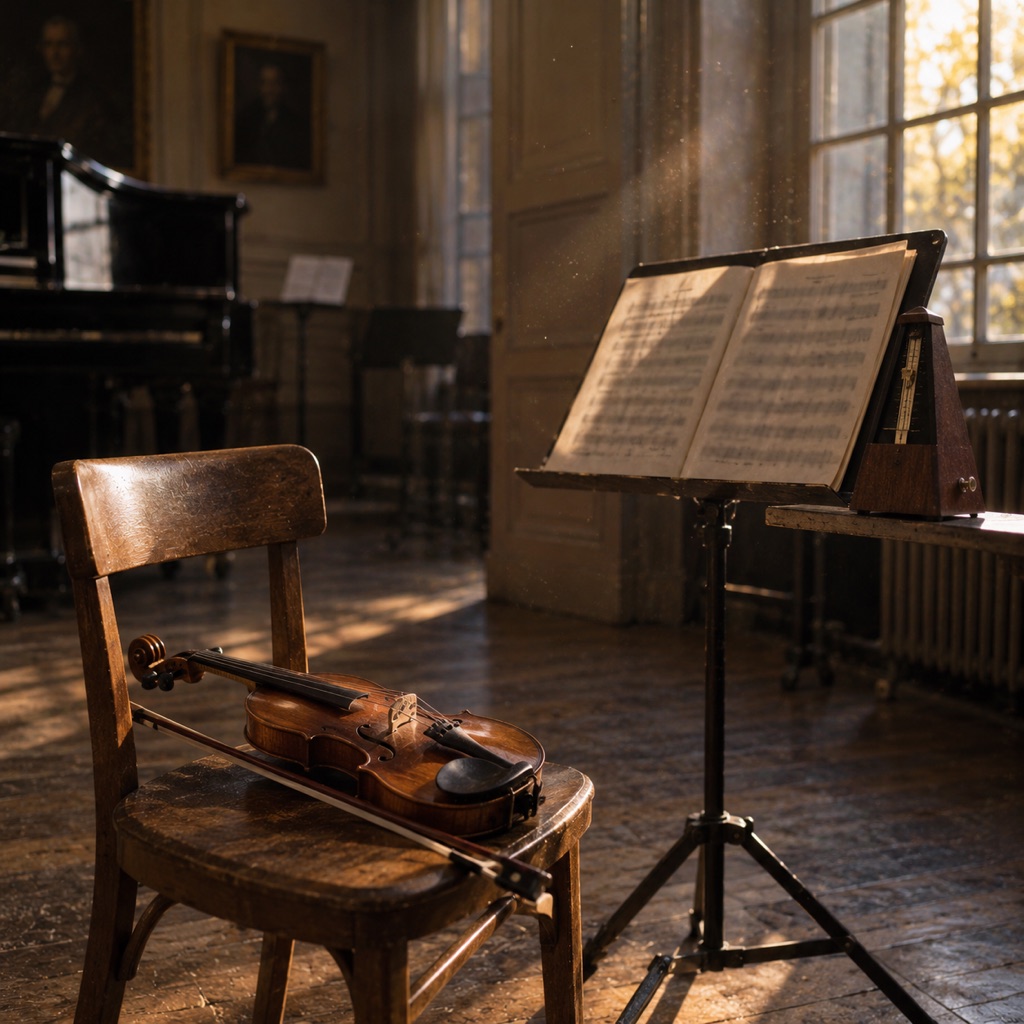
Thirty violin students in West Berlin
The paper is titled "The Role of Deliberate Practice in the Acquisition of Expert Performance." It is signed by K. Anders Ericsson, Ralf Th. Krampe and Clemens Tesch-Römer, and appeared in Psychological Review in 1993, volume 100, issue 3, pages 363 to 406.
The setup is modest. The professors at the Music Academy of West Berlin, the Hochschule der Künste, name the violin students with the potential for a career as an international soloist. Fourteen names come back. Three do not speak fluent German, one is pregnant: the remaining ten agree to take part, and the paper calls them "the best violinists." Ten other violinists from the same department, matched to that first group by sex and age, make up the "good" group. Ten students from the music education department, whose admission criteria the paper notes are lower, make up the "music teachers" group. Thirty students, then, in three groups of ten. A fourth group, ten middle-aged professional violinists from the Berlin Philharmonic Orchestra and the Radio Symphony Orchestra, serves as a point of comparison.
Each one estimates in an interview their average number of hours of solitary practice per week, for every year since they began. The students average 23.1 years old and started the violin around age 8: the measurement is therefore a retrospective, self-reported reconstruction covering some fifteen years of memory.
What the paper measures, and the age at which it measures it
The central result comes down to three numbers. By age 18, the best violinists have accumulated an average of 7,410 hours of practice alone, the good ones 5,301 hours, the future teachers 3,420 hours. Age 18 is chosen, the authors write, to keep the academy's own activities from blurring the comparison. The gap between the first two groups is declared significant, F(1, 27) = 4.59, p < .05, and from it the paper draws the sentence that made its reputation: there is "a complete correspondence between the skill level of the groups and their average accumulation of practice time alone with the violin."
That test deserves a look. The contrast involves only twenty violinists, but the denominator used is the one for the entire sample, 27 degrees of freedom. Macnamara and Maitra would flag this in 2019: the move lowers the F value needed to clear the threshold, and two separate F tests rather than a single analysis mechanically raise the odds of finding an effect.
Two other things are worth noting. The age first: 18, not 20. Then the numbers: not one of them comes close to 10,000. The value that went around the world is nowhere in the text. It is in Figure 9, an accumulation curve drawn out to age 20, where the average of the "best" group passes just above ten thousand hours. It is an average read off a graph, for ten people, at an age the text never analyzes statistically.
The only threshold the 1993 paper actually adopts is a different number, and it does not even belong to its authors: the "10-year rule" of Simon and Chase (1973), drawn from the observation that nobody had reached the level of chess grandmaster "with less than about a decade's intense preparation with the game." The abstract of the 1993 paper speaks of extended intense practice "for a minimum of 10 years." Ten years, not ten thousand hours.
As for the expression "10,000 hrs," it shows up once, in the general discussion, in passing inside a sentence introducing the question of the physical characteristics of elite athletes: the distinction between what changes and what does not "may no longer be valid when the effects of more than 10,000 hrs of deliberate practice extended over more than a decade are examined." That is descriptive, and even cautious. It is not a prescription.
How an average became a threshold
Gladwell takes the value at age 20 and turns it into a law. Ericsson did not let it stand. On April 10, 2016, in a piece adapted from their book Peak and co-signed with Robert Pool, he wrote that the rule "is wrong in several ways."
Three objections, all of them checkable against the original data. First, "there is nothing special or magical about ten thousand hours": Gladwell could just as easily have cited the roughly 7,400 hours reached by age 18, but he preferred the total at 20 because it was a round number. And at 18 as at 20, the two authors add, these students were still a long way from being master violinists. Next, 10,000 hours at age 20 was an average, and Gladwell wrongly claimed that every violinist in the group had passed it: half of the ten had not reached it at that age. Finally, the rule erases the very thing that made the concept interesting, the quality of the practice. Ericsson and Pool take here the example Gladwell hands them, the Beatles in Hamburg: they point to Tune In, Mark Lewisohn's biography published in 2013, which brings the total down to roughly 1,100 hours of playing, and above all they remind us that an hour on stage in front of an audience is not an hour of work aimed at your weaknesses. The theory was about the nature of the training; the rule kept only the counter.
88 studies, and percentages that suit nobody
In 2014, Brooke Macnamara, David Hambrick and Frederick Oswald published in Psychological Science a meta analysis covering every major domain where deliberate practice had been studied. Starting point: 9,331 potentially relevant articles. After filtering, 88 studies retained, 111 independent samples, 157 effect sizes, 11,135 participants.
Deliberate practice explains 26% of the variance in performance in games, 21% in music, 18% in sports, 4% in education and less than 1% in the professions. The authors' conclusion fits on one line: deliberate practice matters, but not as much as has been argued. Put another way, even in the domain most favorable to it, close to three quarters of the variance comes from somewhere else. Those values are the ones from the 2014 publication; the article was the subject of a corrigendum in 2018 in the same journal, volume 29, issue 7, pages 1202 to 1204, and the authors have cited 23% for music ever since.
The replication that does not find the result
On August 21, 2019, Brooke Macnamara and Megha Maitra published in Royal Society Open Science, volume 6, article 190327, a direct replication of the 1993 study. Hypotheses, methods and analyses were preregistered in detail on the Open Science Framework before any access to the data, and the journal accepted the manuscript on the strength of the protocol alone, in a version with no results and no discussion.
The setup follows the 1993 one with three acknowledged departures: the procedure is double blind, the analyses are matched to the experimental design, and a second measure is added, practice designed by a teacher. The ground changes too. The "best" and "good" groups come from the Cleveland Institute of Music, where twenty four students are nominated by the professors and thirteen agree to take part; the least accomplished group comes from the music department of Case Western Reserve University. Thirteen violinists per group instead of ten.
Cumulative hours of solitary practice by age 18: "best" group, 8,224 hours. "Good" group, 9,844 hours. Least accomplished group, 4,558 hours.
So the good ones post 1,620 hours more than the best. The gap is not statistically significant, t(24) = -0.93, p = .364, which rules out any conclusion that the relationship has reversed: what has to be read here is the disappearance of the relationship. The spreads say the same thing: among the best, individual totals run from 3,978 to 14,664 hours, among the good ones from 3,120 to 21,268. The authors write: "the majority of the best violinists had accumulated less practice alone than the average of the good violinists." And later: "we did not replicate Ericsson et al.'s major finding, the complete correspondence between the skill level of the groups and their average accumulation of practice time alone with the violin."
What survives: the overall group effect stays clear (chi square with 2 degrees of freedom equal to 13.90, p = .001), and the only pairwise comparison that clears the threshold sets the good ones against the least accomplished group, 9,844 hours against 4,558. What falls: practice no longer separates the elite from the very good average. It has to be said that the two studies do not slice the variance the same way: the 48% of 1993 comes from a contrast between the two best groups combined and the third, whereas the 26% of the replication covers all three groups together. The 2019 authors set that 26% alongside the 23% the meta analysis gives for music.
One last detail finishes off the idea of a threshold. By age 20, the "best" and "good" groups had both passed 10,000 hours on average. If the number marked a border, it would be crossed on both sides of the line it is supposed to draw.
Why the rule held anyway
The first reason is that 10,000 hours is a more useful object than a finding. It is a round number, actionable, and it converts into a schedule: three hours a day, every day, for a little over nine years. A group average with a confidence interval converts into nothing at all.
The second is that the rule says something the study does not say and that people want to hear: that expertise is for sale, and that the price is paid in hours. Ericsson and Pool point to exactly that slippage, while noting that Gladwell himself never put it that way. It was his readers who read the rule as a promise, when nothing in the original study licensed it.
The third is structural. 26% of variance explained is not a negligible amount, and the authors of the replication take care to say so. The problem was never that practice does not count. It is that an accurate finding about 26% tells badly, and a false finding about 100% tells beautifully. The 10,000-hour rule is what happens when a distribution is replaced by its most memorable point.