
Eleven synaesthetes, one Fisher-Price magnet set behind their colours
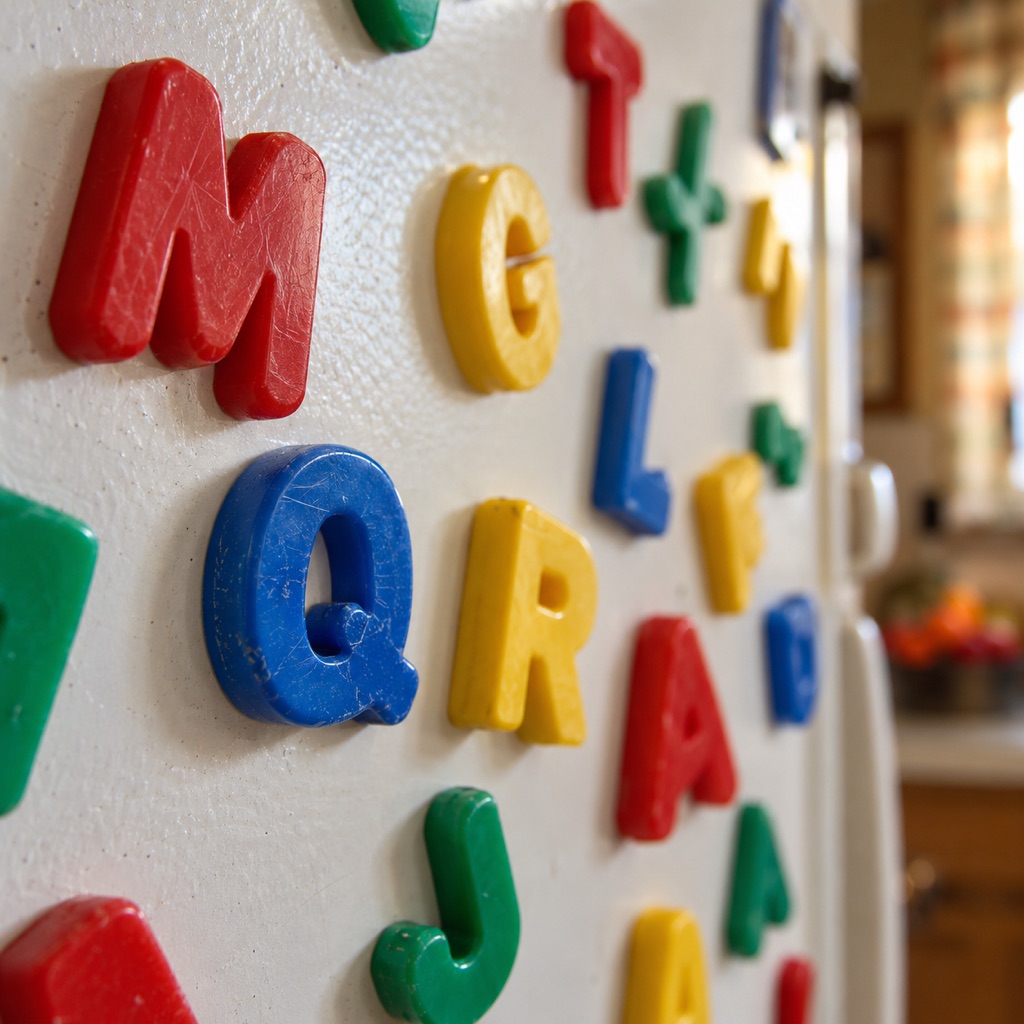
Some people see the letter A in red. Not figuratively, not as a poet's metaphor: the letter printed in black automatically triggers a colour, always the same one, and nothing can stop it. This is grapheme colour synaesthesia, one of the most common and most closely studied forms of the phenomenon. The dominant answer to the question of where it comes from fits into one word: wiring. A neural quirk, presented as heritable and involuntary, installed long before the child gets any say in the matter. The rival hypothesis, that the colours are learned, was already circulating in 1893 under the pen of M. W. Calkins in the American Journal of Psychology, before being filed away with the other dead ends.
In January 2013, two researchers from Stanford's psychology department published the palettes of eleven synaesthetes in Psychological Science. The palettes looked far too much alike. Four of those people still had, at home, the object that makes the resemblance a great deal less mysterious.
The default position: these colours are not learned
The suspicion that learning was involved had already been tested on a large scale. In 2005, Anina Rich, John Bradshaw and Jason Mattingley published in Cognition a questionnaire survey of 192 adult synaesthetes, including a subgroup of 150 for whom letters, digits and words induce colours. Nathan Witthoft and Jonathan Winawer sum up the part that concerns them: the reported colours were compared with those found in 46 Australian children's books and toys, and the comparison turned up "little evidence" for learning.
That phrase deserves a qualification that the legend has erased. Rich and her co-authors do not conclude against learning. On the contrary, they write that the development of this type of synaesthesia incorporates, in many cases, early learning experiences that everyone shares. What they find are population-level regularities. R calls up red in 36 percent of the sample, Y calls up yellow in 45 percent, D calls up brown in 47 percent, and comparable tendencies show up in non-synaesthetic controls who are simply asked to pair colours with letters. What the survey does not show is a specific object standing behind a specific palette.
On the other side, the first of the objections of principle catalogued by Witthoft and Winawer comes from Vilayanur Ramachandran and Edward Hubbard, in the Journal of Consciousness Studies in 2001: synaesthesia belongs to perception, not to memory. The 2013 article repeats the formulation word for word: synaesthesia is not "simply remembering a childhood magnet set that one played with". Isolated cases of learning did exist, all the same. Peter Hancock described in Cortex in 2006 a pair of monozygotic twins whose digit colour associations came from an identified puzzle, noting that neither twin reported the photisms typical of synaesthesia. In the same journal in the same year, Witthoft and Winawer published the case of a single person, designated AED, whose colours came from refrigerator magnets. Randolph Blake and his co-authors had already mentioned, in 2005, that one of their well-studied synaesthetes said she got her colours from a magnet set. Too few, and too scattered. These cases were written off as a red herring, or even as pseudo synaesthesia.
Eleven palettes too similar to be chance
Witthoft and Winawer assembled eleven grapheme colour synaesthetes, born in the United States between 1970 and 1985, five of them women. This is not a random sample, and the article does not pretend otherwise: six of them wrote to the authors after seeing their 2006 paper mentioned on the American Synesthesia Association website, another after a post on a mailing list in which he said his colours came from a childhood toy, another is himself a synaesthesia researcher, and yet another is a vision scientist the authors met at a conference. The study therefore says nothing about how common the phenomenon is in the general population.
Before anything else, the researchers had to establish that this really was synaesthesia. On the synesthete.org website, each participant is shown the 26 uppercase letters and the 10 digits, three times each in random order, and adjusts an RGB picker until the colour matches. Ten of the eleven used that tool, the eleventh used in-house software. Drawing RGB values at random produces a dispersion score of roughly 3.0, and the threshold that best separates synaesthetes from controls who are trying to be consistent sits at 1.0. The ten subjects who were tested average 0.517, the worst of them 0.66. On a timed congruency task, where each coloured letter stays on screen for one second and the participant has to say quickly whether the colour is the right one, all ten clear the 85 percent threshold treated as typical, the weakest at 90 percent, the average at 93.5 percent, with a mean response time of 1.2 seconds.
Then comes the second session, at least 54 days after the first, with more than a year between sessions for ten of the eleven and a maximum gap of 2,854 days. The mean circular correlation between the hues of the two sessions reaches 0.96, and some individual values pass 0.99. These people are not guessing. They return the same colour up to eight years later.
Which leaves the awkward fact: laid side by side, the eleven sets resemble one another, and each one shows a regular pattern that repeats along the alphabet.
Three toys, a single set of letters
Ten of the eleven subjects report having owned one of three toys sold widely by Fisher-Price between 1972 and 1989. Only one of them, S9, is an exception. Each of those toys contained a set of magnetic letters with the same colour code every time. The only toy the article identifies precisely is the School Days Play Desk, number 176: a plastic desk with a magnetic board, advertised for children aged 3 to 8, supplied with 35 magnetic letters and 10 magnetic digits. The collectors' catalogue thisoldtoy.com, which the authors cite in their bibliography, gives its production run as 1972 to 1990, one year longer than the range the text gives for the three toys.
Four of the synaesthetes still own their copy, S2, S3, S4 and S5, and they supplied the photographs published in the article. That is the part of the study no statistic can stand in for: the physical evidence is on the table. For the other six, identifying the toy rests on a childhood memory reported decades after the fact.
The authors rank the eleven palettes from closest to furthest from the letter set. The last one on the list, S11, still shows 14 matches out of 26. They put the probability of getting 14 or more matches out of 26 draws at less than 1 in 1 billion, and the probability of eleven sets all clearing that threshold at a figure lower still by a wide margin.
The digits act as a control test
The most elegant detail is that the three toys were not identical. Two of them also contained magnetic digits, with a colour code distinct from the one used for the letters but shared between the two toys. The third was a board of digits and arithmetic symbols.
Now, only four subjects explicitly remember having had coloured digits: S2, S3, S4 and S6. S2, S4 and S6 show 10, 8 and 6 matches respectively with the digit set. S3 supplied a photograph of his board and shows 5 matches out of 10 according to the body of the article, or 6 if you accept that his yellow zero comes from the yellow O of the letters. The caption of the corresponding figure claims one more in both cases, an internal inconsistency the authors never flag. The probability of reaching 5 or more matches out of 10 draws is estimated at less than 1 in 50,000. Most of the other subjects show 0 to 2.
One exception is worth citing, because it spoils the symmetry: S7 remembers no digit toy at all and still shows 4 matches. The authors judge it plausible, given his year of birth, that he had one of the toys without retaining any memory of it, which is an explanation rather than a proof. The control test therefore holds in the direction that matters: those who report having had the coloured digits carry the trace of them. It reads less cleanly in the other direction, since what fades is the memory, not the colour.
What the authors refuse to conclude
The article could have stopped there and turned into a headline. It does exactly the opposite. Witthoft and Winawer write that they are not arguing that the presence of the magnet set was sufficient to induce synaesthesia, while conceding that it may have raised the odds, and they note that they have met plenty of non-synaesthetes who owned the same toy. They also point out that most attempts to induce synaesthesia in adults through repeated association have failed, the earliest one they cite being E. L. Kelly's, published in 1934 in the Journal of Experimental Psychology, volume 17, number 3, under a title that gave the game away: an experimental attempt to produce artificial chromaesthesia by the technique of the conditioned response.
A third safeguard is subtler. Every palette keeps personal departures from the letter set, and those departures are not noise: when each subject's correlation with himself is compared with the correlation he gets with the other ten, the mean rank is 1.5 on a scale of 1 to 11, a rank of 1 meaning that the subject resembles himself more than he resembles any of the other ten. Each one recognises his own column in the figure. More striking still, those deviations land more than half the time on the majority choice of synaesthetes in general. Nine of the eleven make Y orange, like the letter set reproduced in the article; the other two make it yellow, like 45 percent of the synaesthetes in the Rich survey. The toy gave shape to something that was already there.
Why the "it is innate" version held up
The belief did not take hold through laziness. It took hold because the contrary evidence arrived one piece at a time, and a single case stays indistinguishable from a coincidence or a false memory. A pair of twins with no photisms, one lone participant, one lone account of refrigerator magnets: each time, suspending judgment was the reasonable move. The large 2005 survey, which could have settled the matter, compared reported colours with a corpus of books and toys, not with the objects each subject had actually held in his hands.
What the 2013 study changes is the number and the physical evidence. Eleven sets, one identified set of letters, four surviving copies, a control test on the digits. The real conclusion, even so, is not that synaesthesia is learned. It is finer than that: the content of the associations can come from the outside world, whereas the disposition to experience them as perceptions cannot. The authors propose describing synaesthesia as the automatic retrieval of abnormally precise and stable memories, and they add that external contingencies are not enough to produce it, since it probably depends on genetic factors. It is not "only" remembering, they write, but it is remembering all the same.
Play Desk number 176, for its part, went out of production in 1990. The colour chart it handed out still held, give or take a few departures, in eleven adults tested decades later.