
Moravec's Paradox: The Robot Beats You at Chess but Can't Fold Your Laundry
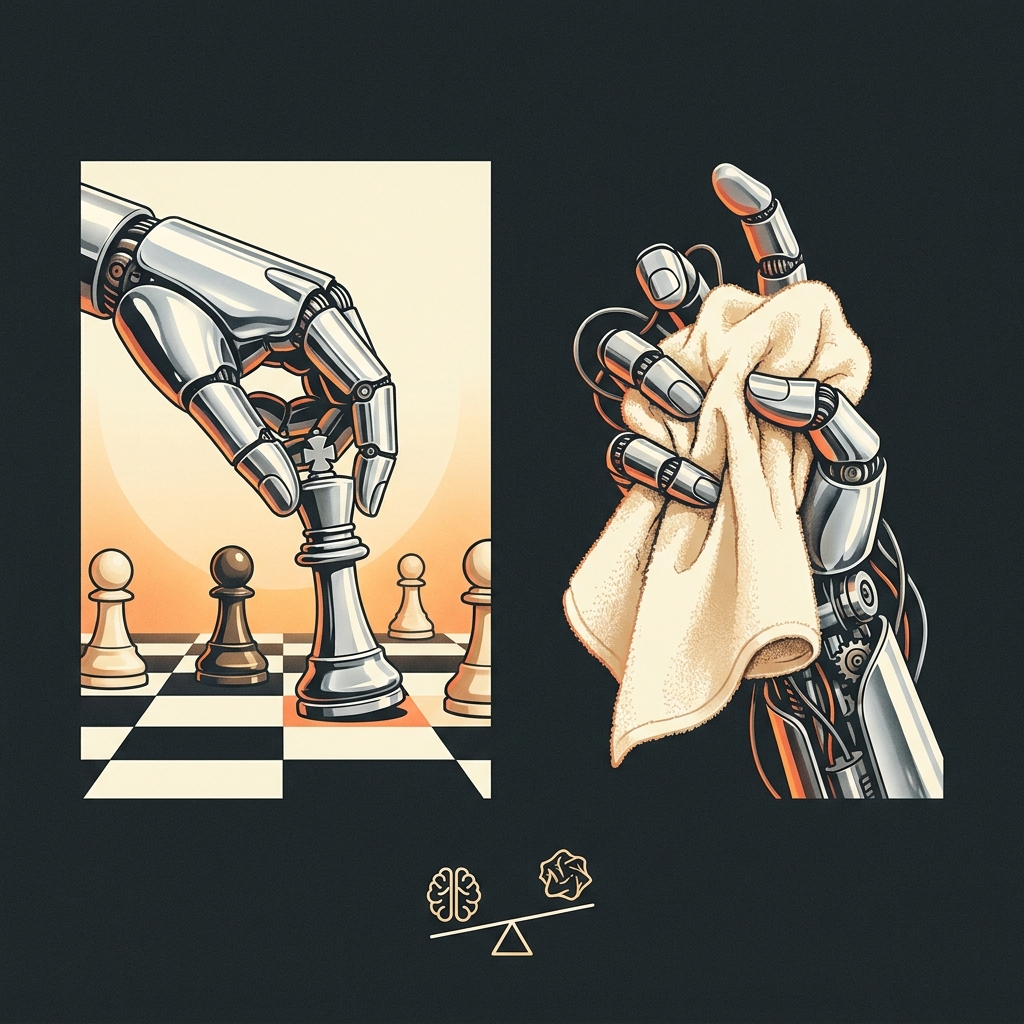
A machine can crush the world chess champion, prove theorems, and pass the bar exam — but ask it to fold the pile of clean laundry on your bed and it falls apart. This is not a joke about clumsy robots. It is one of the deepest and most humbling discoveries in artificial intelligence, and it has a name: Moravec's paradox. The things we find hard, computers find easy. The things a toddler does without thinking are, for a machine, almost impossibly hard.
The easy stuff is hard, the hard stuff is easy
In the 1980s, the roboticist Hans Moravec — along with peers like Rodney Brooks and Marvin Minsky — noticed something strange. As Moravec put it in 1988, "it is comparatively easy to make computers exhibit adult level performance on intelligence tests or playing checkers, and difficult or impossible to give them the skills of a one-year-old when it comes to perception and mobility."
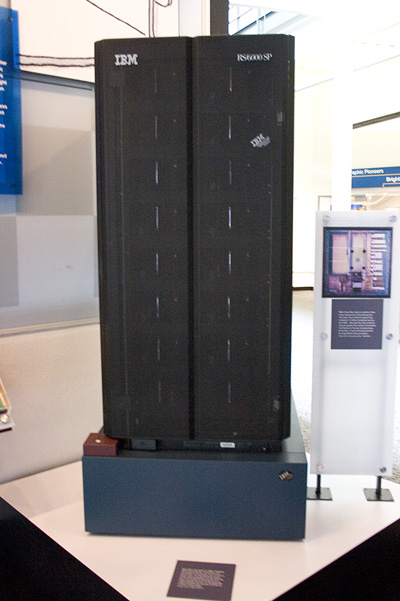
Sit with how backwards that is. We treat chess grandmasters and mathematicians as the peak of human intelligence. We treat walking across a room, recognizing your mother's face, or picking up a coffee cup as nothing at all — things a one-year-old can do. Yet for a computer, the ranking flips completely. Beating a grandmaster took a refrigerator-sized machine in 1997. Reliably picking up an unfamiliar crumpled object in a messy room is, even now, a frontier problem.
The short version, beloved by engineers: robots find the difficult things easy and the easy things difficult.
Blame a billion years of evolution
Why would nature build us this way? Moravec's answer was evolutionary, and it's beautiful.
The skills that feel effortless to us — seeing, balancing, grabbing, sensing the weight and slipperiness of a thing in your hand — are the oldest skills life has. They were refined across hundreds of millions of years, from the first creatures that had to move and hunt and not be eaten. By the time humans arrived, all of that was baked deep into our hardware, running silently below awareness.
"Encoded in the large, highly evolved sensory and motor portions of the human brain is a billion years of experience about the nature of the world and how to survive in it," Moravec wrote. Abstract reasoning — algebra, logic, chess — is by contrast a brand-new trick, maybe a few thousand years old, that we do slowly and with great effort. It feels hard precisely because it's new and unpolished. It's easy to program for the same reason: it's a thin, recent layer that we can actually describe with rules.
Minsky captured the flip side neatly: "In general, we're least aware of what our minds do best." The most sophisticated machinery in your head is the part that feels like nothing.
Why folding a towel is a nightmare
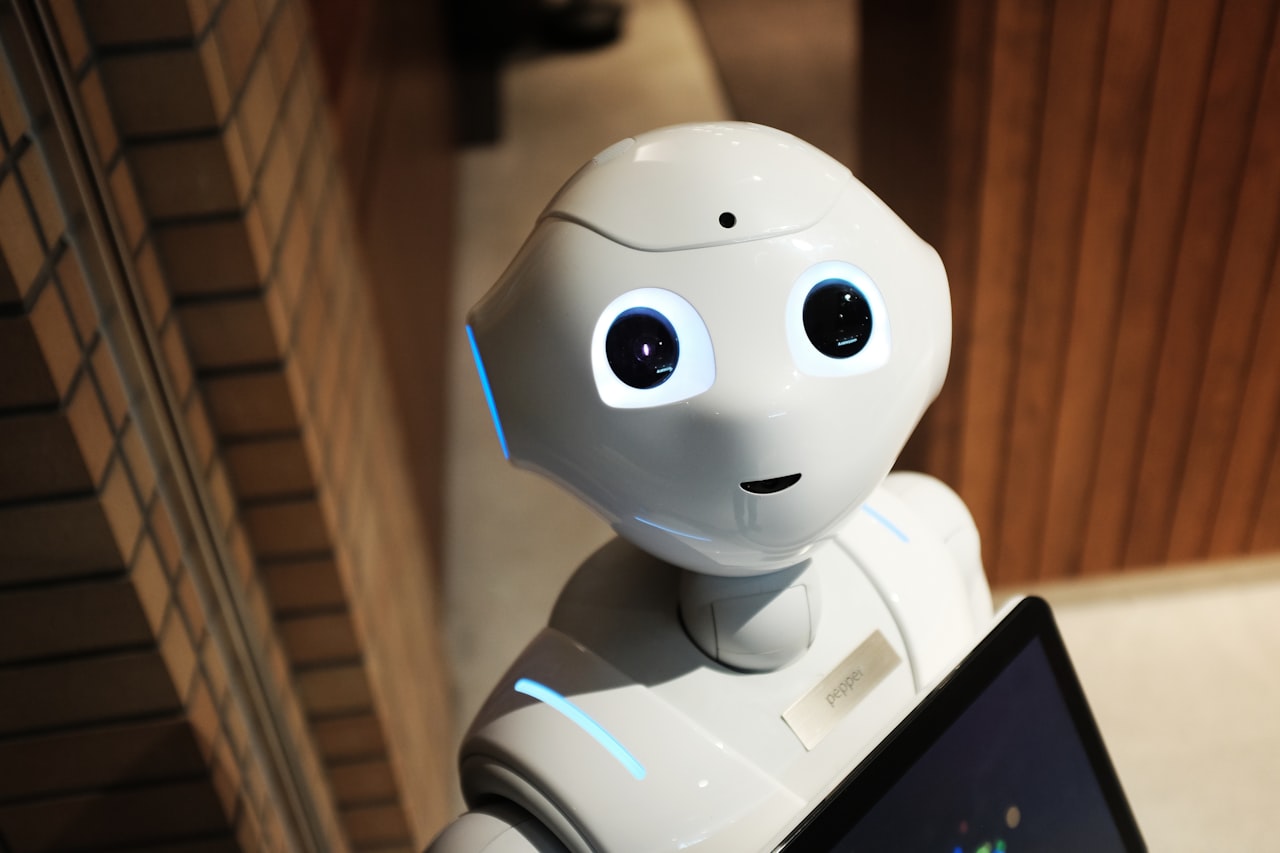
The cruelest test case for a robot is the one your grandmother does while chatting on the phone: laundry.
A chessboard is a closed, tidy world. Sixty-four squares, thirty-two pieces, rules that never change. A computer can race through millions of possible moves a second. A T-shirt is the opposite of a chessboard. It's a deformable object — floppy, infinitely variable, never the same shape twice. To fold it, a robot has to figure out where the edges and corners are when the whole thing is a wrinkled heap, predict how the fabric will drape and catch when lifted, and adjust its grip in real time using touch it doesn't really have. There are no clean rules, only an endless, slippery mess.
The numbers make it vivid. In 2010, a celebrated robot at UC Berkeley, the PR2, finally learned to fold towels reliably — it succeeded on all fifty unfamiliar towels it was given. The catch: it took roughly twenty to twenty-five minutes to fold a single towel. The machine that could have humiliated a chess champion in the next room needed nearly half an hour to do what a tired human does in ten seconds.
The paradox is still shaping AI today
You can feel Moravec's paradox in every headline about artificial intelligence right now. The systems that write essays, pass medical exams, and generate art — the things that look most like "thinking" — arrived faster than almost anyone expected. Meanwhile a robot that can tidy your kitchen, unload your dishwasher, and put a load of washing away without breaking the wine glasses is still, stubbornly, science fiction.
That's the paradox doing exactly what it predicted decades ago. The cognitive layer, being new and rule-shaped, was the low-hanging fruit. The sensorimotor layer — the part with a billion years of evolution behind it — is the hard, deep ocean we're only beginning to wade into.
So the next time an AI dazzles you with poetry or code, remember the quiet superpower you used this morning without a second thought: you reached out, in a cluttered room, and picked up exactly the right thing. A grandmaster of a skill so ancient and so total that no machine on Earth can yet match a sleepy toddler. The hardest problem in robotics is the one you solve before breakfast.