
The mantis shrimp has twelve colour receptors and discriminates worse than a bee
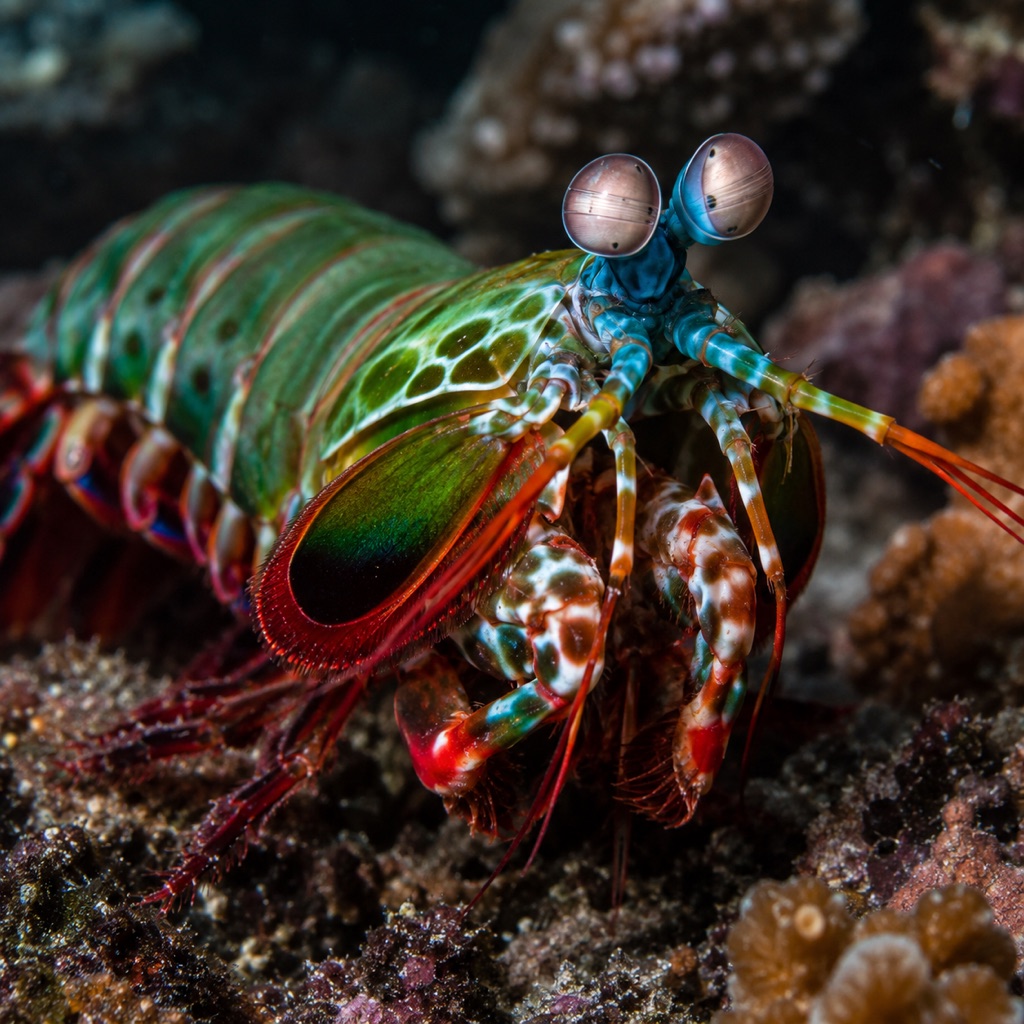
One sentence has been doing the rounds online since the early 2010s, and in the scientific literature since 1989: the mantis shrimp supposedly sees colours we are incapable of imagining. It has twelve types of colour photoreceptor, we have three, so its world must be four times richer than ours. The count is correct and the conclusion is wrong. Since 2014 we have known that this animal separates two neighbouring wavelengths less well than a bee, less well than a goldfish, and far less well than a butterfly. What makes the story interesting is not the correction: it is that the correction has itself been corrected twice, by the very laboratory that published it.
A discovery that outgrew its paper
In May 1989, Thomas Cronin and Justin Marshall published a cautiously titled paper in Nature: "A retina with at least ten spectral types of photoreceptors in a mantis shrimp" (vol. 339, no. 6220, pp. 137 to 140). At least ten. The count would later rise to twelve colour receptors in stomatopods, the marine crustaceans known as mantis shrimps or squillas. Those twelve channels sample the spectrum from 300 to 720 nanometres, from deep ultraviolet to far red, and they are not alone in the eye: add the receptors devoted to polarisation and to intensity and you reach some twenty input channels. The human eye has three types of cone.
The rest of the reasoning wrote itself, and it was wrong. Four times as many receptors, therefore a twelve-dimensional colour space, therefore hues we could not possibly conceive of. The researchers themselves described that runaway, in an i-Perception article posted on 17 September 2014 (vol. 5, no. 6, pp. 492 to 496) and signed by Qasim Zaidi, Justin Marshall, Hanne Thoen and Bevil Conway: "the scientific imagination ran wild: do they have a 12-dimensional (12-D) color space, so that they distinguish colors we confuse, and see colors we cannot even imagine?" In that same sentence, the authors split the twelve receptors into three ultraviolet ones and nine between 400 and 700 nanometres; that breakdown is not stable from one study to the next, with Michael Bok and his colleagues reporting up to six types of ultraviolet receptor in Neogonodactylus oerstedii (Current Biology, 2014, vol. 24, pp. 1636 to 1642).
One question, though, had never been measured. Behavioural tests had shown, as early as 1996, that the animal can learn to pick a colour out from among greys. None had established the threshold: how far apart do two wavelengths have to be before it can tell them apart? It took twenty-five years for anyone to go and find out.
The measurement that turned it all around
On 24 January 2014, Hanne H. Thoen, Martin J. How, Tsyr-Huei Chiou and Justin Marshall published "A Different Form of Color Vision in Mantis Shrimp" in Science (vol. 343, no. 6169, pp. 411 to 413, DOI 10.1126/science.1245824). The protocol measures a delta lambda function: the smallest wavelength gap an animal can reliably tell apart, sampled all along the spectrum. It is the standard unit of chromatic acuity, and it already existed for the bee, the goldfish, the butterfly and the human.
The key sentence of the abstract wastes no time on hedging: "Behavioral wavelength discrimination tests (Δλ functions) in stomatopods revealed a surprisingly poor performance, ruling out color vision that makes use of the conventional color-opponent coding system."
The figure, restated and set against the others by Ching-Wen Judy Wang and Justin Marshall in the introduction to a Journal of Experimental Biology paper posted on 8 January 2025, puts the mantis shrimp Haptosquilla trispinosa between 15 and 25 nanometres. In the same comparison: humans between 1 and 8 nanometres (De Valois and Jacobs, 1968), the goldfish between 3 and 20 (Neumeyer, 1986), the honeybee between 5 and 20 (von Helversen, 1972), and the butterfly Papilio xuthus between under 1 and 15 (Koshitaka and his colleagues, Proceedings of the Royal Society B, 2008, vol. 275, pp. 947 to 954). That last case is worth pausing on. The butterfly has eight varieties of spectral receptor, it drops to roughly 1 nanometre at three points in the spectrum (around 430, 480 and 560 nanometres), the smallest gap ever measured according to its authors, humans included. And the title of the paper reads: "Tetrachromacy in a butterfly that has eight varieties of spectral receptors". Eight receptors, four colour dimensions. Receptor count and discrimination acuity are not the same quantity, and the example had been sitting there since 2008.
Twelve channels, and last place in the ranking. In the same issue of Science, Michael Land and Daniel Osorio devoted a commentary to the result: "Extraordinary Color Vision" (pp. 381 to 382). The title is not sarcasm; the journal's standfirst spells it out: "The compound eyes of mantis shrimps see color in a fundamentally different way from other animals." The extraordinary part lies in the mechanism, not in the performance.
Twelve channels in order to compare nothing at all
The question the authors put in their abstract has remained the reference statement of the problem: "Why use 12 color channels when three or four are sufficient for fine color discrimination?"
Their answer turns the architecture on its head. A conventional system compares: it sets the responses of two or three broadband receptors against one another, and it is that ratio, not the number of receptors, that yields the acuity. This is opponent coding. The mantis shrimp, under the 2014 hypothesis, does not compare. Each narrowband receptor would act as an independent detector, and colour would be read as a pattern of activation, the position of the peak in a row of twelve bins. The authors liken the arrangement to a cochlea, which analyses the world of sound band by band rather than by comparing ratios.
This way of reading has a cost and a benefit. The cost: two neighbouring greens become indistinguishable. The benefit: recognition is immediate and demands almost no downstream computation. Zaidi and his co-authors tie that economy to the animal's constraints, offered as a hypothesis and not as a demonstration: fast hunting decisions taken with a small brain could have led to hard-wiring colour right at the entrance to the visual system.
Two things support the hypothesis. First, the mantis shrimp's eye scans. Michael Land, Justin Marshall, D. Brownless and Thomas Cronin described the slow eye movements of Odontodactylus scyllarus as early as 1990 (Journal of Comparative Physiology A, vol. 167, pp. 155 to 166), movements made necessary by the extremely compressed optics of that eye. An eye that scans reads a scene serially, like a barcode reader, which is where the hypothesis got its nickname. Second, the parallel noted in i-Perception: in the inferior temporal cortex of the macaque, cells tuned very narrowly to a single colour are enough, on a simple winner-take-all rule, to produce correct decoding. The authors simulated 279 such cells responding to 45 colours and recovered the same picture. Stomatopods split from the other crustaceans roughly 400 million years ago; Zaidi and his co-authors date the primate system to 40 million years. Two unrelated lineages would have converged on the same decoding strategy, one in the retina, the other several stages further along. The authors present it as a striking resemblance, not as an established fact.
The correction was corrected in its turn
The popular account usually stops in 2014, on the satisfying image of an overrated animal. It carried on, though, and in the same laboratory.
In March 2022, Amy Streets, Hayley England and Justin Marshall published "Colour vision in stomatopod crustaceans: more questions than answers" in the Journal of Experimental Biology (vol. 225, no. 6, jeb243699). They tested the barcode hypothesis on weakly saturated colours, the ones the model predicts should be confused with grey. Haptosquilla trispinosa told them apart without difficulty, saturated and desaturated alike. The secondary result is the more unsettling one. The animals were first tested for a week on the reef, at the Lizard Island station, then for twenty weeks in the laboratory under artificial lighting. Through the first ten laboratory weeks they all learned the task (P less than 0.001); through the ten that followed, under the same lighting, they no longer chose the right target any better than chance, and for no colour at all (P greater than 0.05). The same collapse happened again in a second species, Gonodactylus smithii. The authors read it as rapid plasticity in colour vision, most probably a change in opsin expression, and draw an awkward consequence for the whole literature: the historic failure of Odontodactylus scyllarus on a weakly saturated blue, reported by Marshall, Jones and Cronin in 1996 (Journal of Comparative Physiology A, vol. 179, pp. 473 to 481) and long cited as evidence for the barcode, may come down to a colour sense temporarily altered by the aquarium.
Then, on 8 January 2025, Ching-Wen Judy Wang and Justin Marshall published, in the same journal, "Behavioural evidence of spectral opponent processing in the visual system of stomatopod crustaceans" (vol. 228, no. 1, jeb247952). The test is simple: under coloured light, a system with no opponency can no longer separate a colour from a grey. In the first experiment, 69 animals were trained and only 20 proved reliable. The green group scored 71.08% under natural light and 75.7% under green lighting; the red group went from 74.73% to 73.74%. Only the blue group collapsed, from 76% to 40%, statistically indistinguishable from a coin toss in a three-choice test (chi-squared, P equal to 0.3291). That last group rests on just four individuals and a few dozen trials, which the authors do not hide. Their conclusion: the first direct behavioural evidence of spectral opponency in stomatopods, and therefore a hybrid system. Each of the eye's four midband rows would work as a near-dichromatic channel, largely self-contained, with the bin-by-bin reading supplying the general sense of colour.
Why the twelve-colour version survives
The belief does not rest on a scientific misunderstanding but on an arithmetical extrapolation: three receptors produce the human spectrum, so twelve produce an outsized version of it. It fails on one single, decisive point. The number of receptors does not set chromatic acuity; the processing of their outputs does. And the 2025 result adds a further layer to the lesson: this animal does possess a form of opponency, and its discrimination remains coarse. Comparing is no more sufficient than counting.
Above all, it travelled before its refutation, through channels the refutation has never caught up with. Matthew Inman's comic "Why the mantis shrimp is my new favorite animal", published on The Oatmeal, declares at the foot of the page that it was inspired by a RadioLab episode about colour (21 May 2012) and points to three press pieces: ABC News, the Los Angeles Times (8 June 2012) and Wired (October 2009). None of those sources was cheating, and none of them is later than June 2012: the 2014 paper did not exist yet.
Then there is the asymmetry of format. "Twelve receptors, a rainbow you cannot imagine" fits on one line. The accurate version calls for defining a delta lambda function, explaining why comparing beats counting, conceding that a 2014 result was qualified in 2022 and then partly overturned in 2025, and closing on a hybrid hypothesis nobody has settled yet. Justin Marshall co-signed the 1989 paper and the 2025 one alike. The 2022 abstract says it flatly: we still do not know why these animals discriminate colours so poorly while holding the most complete set of spectral sensitivities in the animal kingdom, nor what mode of processing they use. Thirty-six years after the receptors were first counted, the mechanics have moved a great deal. The opening question has not.