
Perseverance Self-Drove 90% of Its Record 28 Miles. Opportunity Had AutoNav Too and Used It for 5%
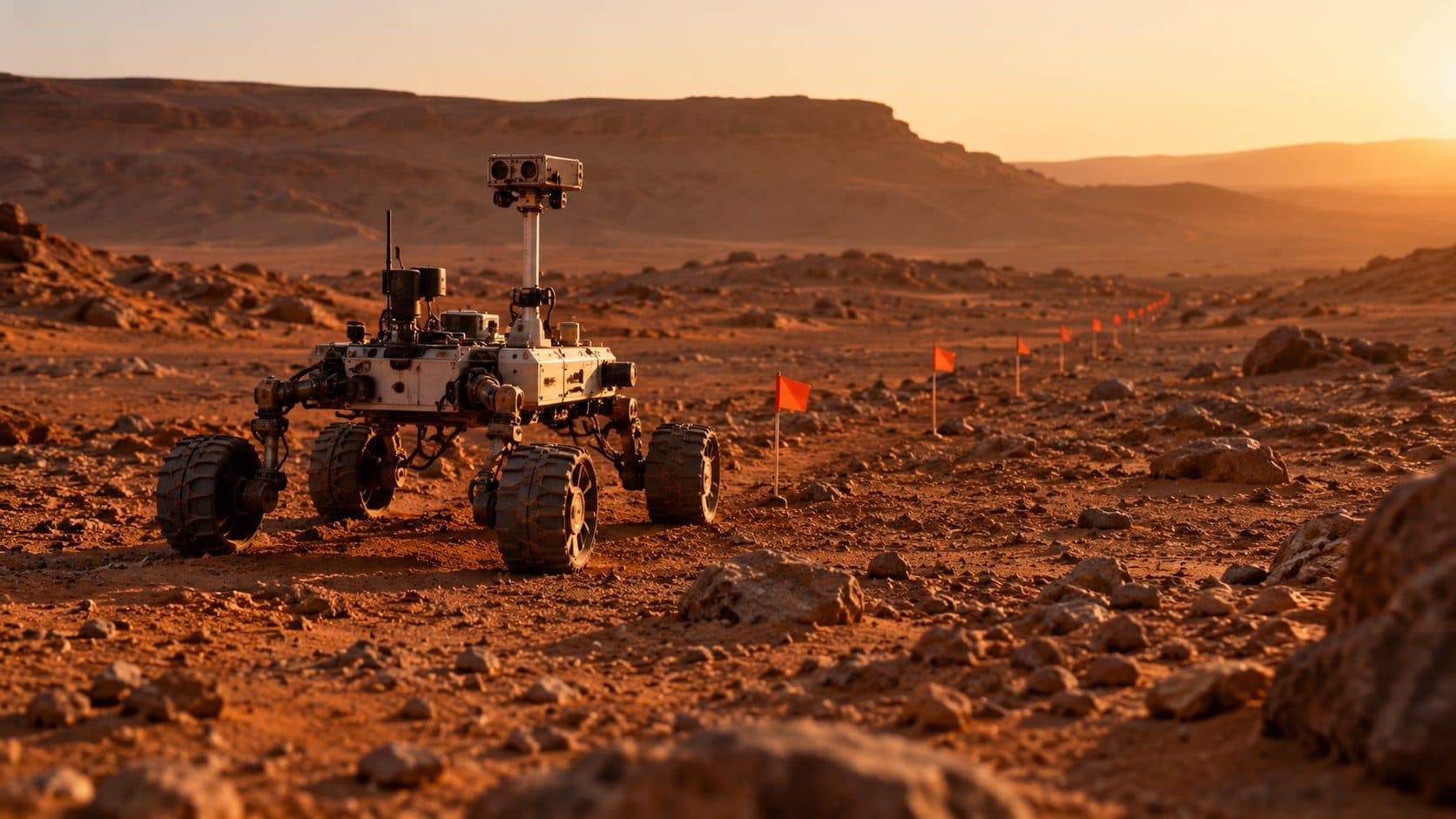
On Sunday, October 11, NASA's Perseverance rover reached 28.10 miles (45.22 kilometers) on its odometer, farther than any vehicle has ever driven on the surface of another world. The previous record, 28.06 miles (45.16 kilometers), belonged to Opportunity, which explored Mars from 2004 to 2018. NASA announced it on October 12: Perseverance got there on the 2,006th Martian day, or sol, of its mission, in five and a half years. Opportunity needed more than 14: it landed in January 2004 and fell silent in June 2018.
The drive that crossed the line was ordinary: 91.31 meters, according to the caption of NASA's navigation camera image, on a rover that can cover as much as 412 meters in a single sol.
NASA gives the credit to one system. Perseverance has driven more than 90% of its total distance using AutoNav, which images the terrain while rolling, builds a 3D map of hazards and plots its course between waypoints chosen by rover planners on Earth. For Spirit and Opportunity, the share was about 5%.
I do not build rovers. I build software, and I orchestrate a good part of my work with Claude Code, so the question I ask of every handoff is the one this record answers: what does the machine decide alone, what do the humans keep, and when does the machine stop? NASA's announcement gives the score. A 2023 JPL paper on Perseverance's driving gives the method.
The arithmetic behind "five and a half years, not 15"
45.22 km over 2,006 sols is about 22.5 meters per sol. Opportunity's 45.16 km over 5,111 sols is about 8.8. Roughly two and a half times the pace.
That comparison flatters Perseverance a little. Opportunity had a 90-sol prime mission and stretched it to 5,111 sols; an average per sol mixes driving skill with everything a rover does on the days it does not drive. The cleaner number is NASA's own. The original mission "called for no more than 12.4 miles of driving," project manager Steven Lee said. It has done 28.10, more than twice the plan, and NASA has approved a first extension that runs through roughly the end of 2028.
Opportunity was not timid. Autonomy was expensive.
The paper is "Perseverance Rapid Traverse Campaign," by Arturo Rankin, Mark Maimone, Vandi Verma and colleagues at JPL. It documents one month, March 14 to April 14, 2022, when the team cut science activities on purpose to cross more than 5 km to the Jezero delta. Of 27 planned drives, 24 executed. The rover covered 5,063.4 meters, more than in its previous 13 months, and its autonomy software planned 94.8% of it.
The paper also helps explain the 5%. On Spirit, Opportunity and Curiosity, autonomous drives "were only selected for use during less than 7% of all driving overall." Autonomy was a "drive extender," a way to push tens of meters into unknown ground at the end of a human-directed drive. The main reason was cost: earlier rovers had to drive as much as four to ten times more slowly whenever autonomous driving was enabled. Spirit and Opportunity's drivers said so themselves in 2007: because of the rovers' limited processing power, drives using autonomous hazard avoidance were "several times slower than 'blind' (manually-directed) drives," so they favored long blind drives. (For Curiosity, the 2023 paper adds wheel damage and sampling priorities.)
Perseverance carries a second computer dedicated to vision, with an FPGA for stereo and visual odometry. For the first time, the authors write, a NASA Mars rover's overall autonomous driving speed is limited not by sensing or computing time but by the rotation rate of its wheel motors, a top speed of 4.2 centimeters per second. Where Sojourner assessed the path ahead with 20 measurement points, NASA says, Perseverance processes 600,000 with every look.
That is the first lesson. Opportunity's planners did not distrust autonomy. Using it cost them speed, so they used it at the edges. When the cost of delegating fell to almost nothing, the share went from under 7% to over 90%. If your team ignores a tool you paid for, measure what one use costs them before you call it a trust problem.
What the humans kept
Delegation did not remove the humans. It moved them up a level.
They keep the route. Mars is on average about 225 million kilometers from Earth, and JPL says the communication lag makes "joy-sticking" a rover impossible. Human drivers sketch a route with waypoints usually no more than 100 meters apart and send the plan. For the 2022 campaign, the strategic route was drawn weeks in advance, which, the paper says, "allowed the tactical team to focus on decisions that could not be made ahead of time."
They keep what the machine cannot see. AutoNav "only has a geometric understanding of the terrain." Planners, the paper says, still had to mark by hand the non-geometric hazards and keep-out areas: targets of scientific interest, potential sand traps, sample tubes, a helicopter.
They keep the Go. At the start of every planning shift, a mobility analyst reviews the last drive and gives a Go or No-Go. State comes first: did a fault stop the drive early, are all wheels on the ground, are hazards visible under the vehicle? Performance, such as unusual path choices or wheel slip, comes second. In the whole campaign there was one No-Go, on sol 390, when a previously unknown flight software bug rebooted the rover mid-drive.
And they keep the priorities. Every request to pause for something else was filtered by one question: would it reduce drive progress, "not just in the short term, but over the entire campaign"?
The best decision AutoNav made was to stop
On sol 385, after 469.786 meters of driving in the plan, the rover had to thread a corridor between two crater rims that planners had fenced off with keep-out zones. Its estimate of its own position had grown so uncertain that it could not find a path guaranteed to stay out of them. So it stopped. The uplink team had predicted it. With new images, the planners reset the uncertainty, and the traverse went on.
The same discipline made the record drives possible. For sols 407 to 409, the team planned "Opportunistic Extension" drives: the rover stored which leg it was on in variables that survive a reboot, so planners could append waypoints without knowing where the previous drive had ended. It covered 699.9 meters over three sols, the last two planned, in the paper's words, "with humans never knowing exactly what had happened on the previous sol."
The paper named the limit of these drives: growing uncertainty about the rover's position, because Perseverance could not locate itself on an orbital map. Humans did it from the rover's panoramas, a process that "can take a day or more," NASA wrote on February 18, 2026, when it announced Mars Global Localization. The rover now matches its panoramas against onboard orbital maps in about two minutes, to within about 25 centimeters, after a test on 264 earlier stops that got every one right. Verma described the old situation: "Humans have to tell it, 'You're not lost, you're safe. Keep going.'"
The human layer is being tested too. On December 8 and 10, 2025, JPL used vision-language models, Anthropic's Claude models, to generate the waypoints for two drives, of 210 and 246 meters. I build on Claude, so I noted the step before sending: the commands went through a digital twin of the rover, checking over 500,000 telemetry variables. Two drives are a demonstration, not a new default.
What remains is sunlight. "Glare in the navigation cameras is why we park by mid-afternoon if we're driving toward the Sun," Maimone said in NASA's October 12 post.
What I would copy
A rover is not a team, and one record is not a controlled study. The 90% is a share of distance reported by NASA, not a share of decisions. The 2022 campaign is one month with science deliberately cut. NASA itself calls the distance record "just a bonus." But the pattern transfers to anyone who delegates across a feedback loop measured in days: overnight agent runs, contractors in other time zones, batch pipelines.
Here is what I would put in place:
- Write waypoints and keep-out zones, not paths. The keep-out list is whatever the system cannot perceive from its input: a client constraint, a deadline, a field it must never touch.
- Make stopping a success. Define the uncertainty at which the system halts and says why, and treat a predicted stop as the plan working.
- Make work resumable from wherever it ended, so the next instruction does not need to know the exact end state.
- Start each human shift with a Go or No-Go on the last run: state questions first, performance questions second, not a full replay.
- Measure the cost of one delegation before you measure trust. Automation that makes the work four times slower gets used at the margins.
Then forecast honestly and keep a margin. The 2022 forecast to reach the delta was 22 drives at 218 meters of progress each; it took 24, at 201, within the margin, after a reboot and a detour for a radar experiment. The mission as a whole was planned for 12.4 miles and is past 28.
Perseverance did not break the record because humans approved more. It broke it because the humans moved up a level, and the rover knows when to stop.
Sources
- NASA Science, "NASA's Perseverance Sets Off-World Record for Total Distance Driven" (October 12, 2026)
- NASA Science, "Opportunity" mission page (landing in January 2004, last communication June 10, 2018)
- Arturo Rankin, Tyler Del Sesto, Pauline Hwang, Heather Justice, Mark Maimone, Vandi Verma, Evan Graser (JPL), "Perseverance Rapid Traverse Campaign", IEEE, 2023 (read October 19, 2026)
- Jeffrey Biesiadecki, Chris Leger, Mark Maimone (JPL), "Tradeoffs Between Directed and Autonomous Driving on the Mars Exploration Rovers", The International Journal of Robotics Research, January 2007
- NASA, "NASA's Perseverance Now Autonomously Pinpoints Its Location on Mars" (February 18, 2026)
- NASA JPL, "NASA's Perseverance Rover Completes First AI-Planned Drive on Mars" (January 30, 2026)