
9.8 Million Blood Test Results: Fasting Mattered for 10 of 121 Tests. Past 12 Hours, It Helped None.
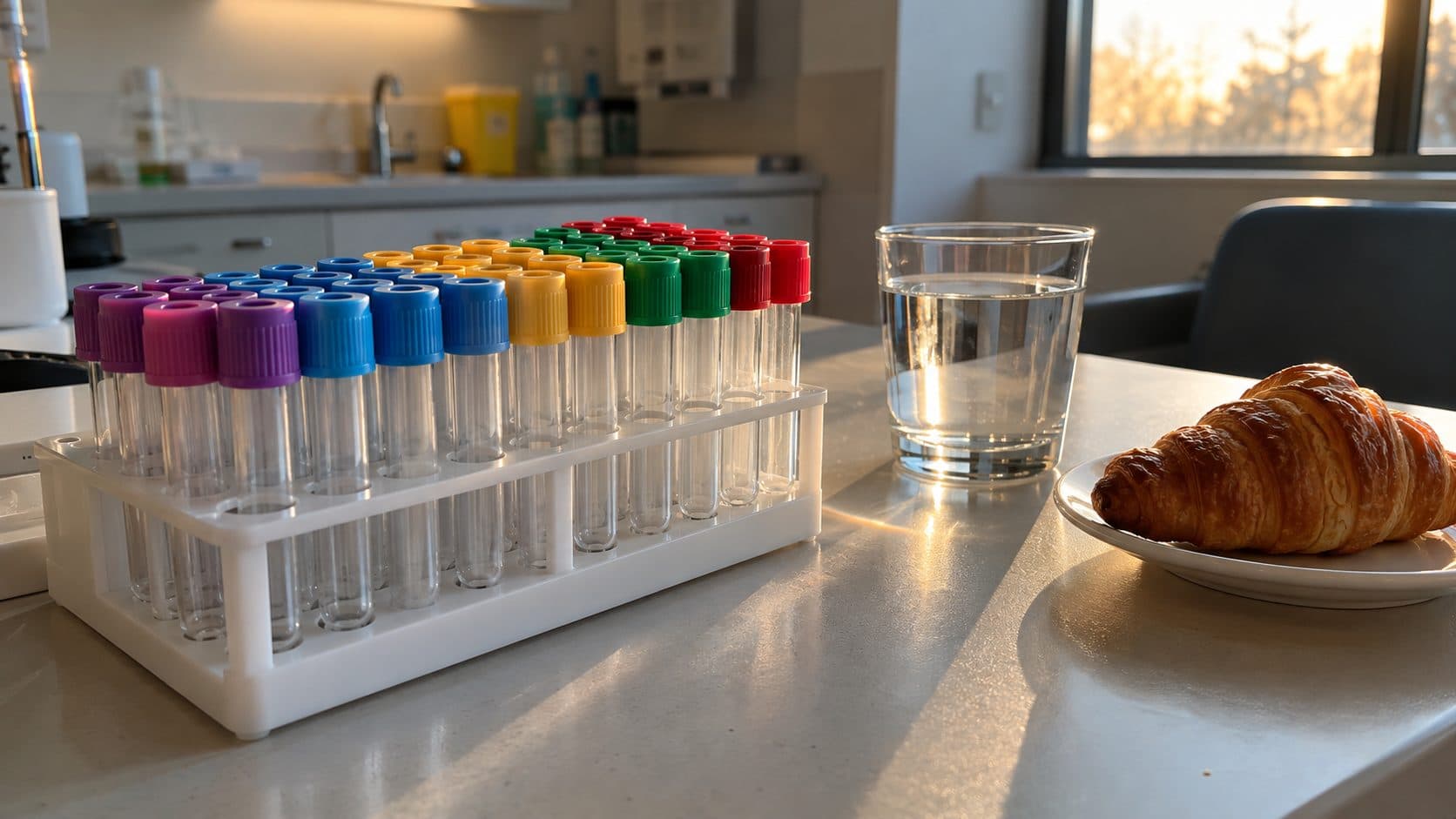
On September 28, 2026, JAMA Internal Medicine published a study of 9,755,547 blood test results from 101,148 adult outpatients at a 670-bed university hospital in the Seoul metropolitan area. The question, familiar to anyone who has skipped breakfast for a lab: does fasting actually change the numbers?
For most routine tests, the answer was no, or not by enough to matter. Of 121 analytes with enough data, 27 looked sensitive to fasting when patients were compared with each other. When the same patients were compared with themselves across visits, 10 held. And no test showed a difference beyond the study's threshold between fasting 8 to 12 hours and fasting more than 12.
I am not a clinician. I build software, and much of that job is writing rules into products. This paper is a clean case study of a rule that started with glucose and lipid tests and became the default for much broader panels, and of how close a huge dataset came to telling the wrong story. The full paper is open access. Here is what it shows, what it does not, and which tests still need fasting.
How the study worked
The data are routine records from February 2021 to December 2023. At the hospital's outpatient phlebotomy unit, the time since the patient's last meal, as reported by the patient, was recorded at the moment of the draw, in 30-minute steps, whenever at least one test that explicitly required fasting was on the order. The authors sorted results into three groups: under 8 hours, 8 to 12 hours, and more than 12 hours.
Of 372 test items, 121 had the 1,000 observations the authors required. And about 90% of the results came from patients who had fasted more than 12 hours. Only 1.6% fell in the 8 to 12 hour window, and 8.3% under 8 hours.
They ran three analyses: a between-group comparison adjusted for age, sex and ordering department; a within-person comparison among patients who had the same test under two fasting durations on separate visits; and a half-hour time trend inside the under-8-hour group.
The yardstick is the best part. A difference did not count because it was statistically significant; with millions of results, tiny differences are. It counted only if it exceeded the total allowable error derived from biological variation in the database of the European Federation of Clinical Chemistry and Laboratory Medicine (EFLM): roughly, the largest difference that should not change how a result is read, set per test, outside the study.
What still moved after a meal
In the within-person comparison of under 8 hours against more than 12 hours, the authors single out four analytes that were higher after a recent meal, beyond their threshold:
- Glucose: 10.8% higher, against an allowable 3.1%.
- Triglycerides: 20.1% higher, against 13.2%.
- GGT (gamma-glutamyl transferase, a liver enzyme): 14.8% higher, against 9.2%, with a wide confidence interval of 3.9% to 25.7%.
- Lipase (a pancreatic enzyme): 36.4% higher, against 6.3%. The authors warn that few patients contributed pairs for it.
Two went the other way. Total bilirubin was 17.0% lower and 25-hydroxyvitamin D 9.9% lower after a short fast, so both were higher after a long one. Whole-blood glucose, CA 125 and total carbon dioxide were also confirmed within individuals.
In the under-8-hour group, adjusted glucose fell from 134.0 mg/dL half an hour after a meal to 113.3 mg/dL at 4 hours, a 15.4% drop, and stayed similar after that. Lipids showed no significant trend within those first hours.
For most routine tests, including the complete blood count, electrolytes, kidney function, AST, ALT, total cholesterol and HDL cholesterol, differences stayed within the threshold or were not confirmed. Between 8 to 12 hours and more than 12 hours, nothing crossed it at all. Glucose was 0.7% lower, triglycerides 2.4% higher.
27 became 10
Between groups, some lipid and liver-enzyme results looked higher after prolonged fasting, a paradox. Within the same patients, none of it was reproduced. The patients who arrive fasted early in the morning are not necessarily the ones whose blood is drawn after lunch. As the authors put it, an apparent fasting effect may instead reflect who is tested at which time of day and for what clinical reason. Of the 27 analytes flagged between groups, the other 17 either lost significance within individuals or had fewer than 30 patients with paired measurements, too few to estimate.
Then the authors did something I wish more dashboards did: they distrusted their better method too. Within individuals, HbA1c and glycated albumin came out slightly higher with short fasting. Both reflect blood sugar over weeks to months; one meal cannot move them. The authors' explanation: short-fasting samples more often come with unscheduled or follow-up visits during periods of poorer control. Comparing a person with themselves removes stable differences between people. It does not remove the reason they came in that day.
Product analytics has both traps. Users who adopted a feature against users who did not is the between-group comparison. The same user before and after is better, but it still carries whatever brought them back that week.
What the study cannot tell you
Most of these limits come from the authors themselves:
- One secondary-care hospital in Korea, outpatients only. Diets, practices and lab methods differ elsewhere.
- Fasting times were reported by patients and not verified, and meal composition was not controlled.
- Fasting time was recorded only when a fasting test was on the order, so tests such as ferritin or thyroid function entered only alongside one: a possible selection bias.
- The median age was 61. Applicability to younger adults, including premenopausal women, is uncertain.
- They did not measure how often a difference would push a result across a decision threshold, such as a diagnostic cut-off for fasting glucose. That may matter most for values near the line.
- It is retrospective and observational, and it measured lab values, not patient outcomes. The authors call for prospective multicenter studies to confirm it.
Which tests still need fasting
The paper's own conclusion: at least 8 hours of fasting should be maintained when glucose or precise lipid measurement is the goal, and more flexibility may be reasonable for many other routine tests. Fasting beyond 12 hours brought no measurable advantage for any analyte, triglycerides included.
Current guidance points the same way. The US National Institute of Diabetes and Digestive and Kidney Diseases says the fasting plasma glucose test and the oral glucose tolerance test come after at least 8 hours of fasting, meaning nothing to eat or drink except sips of water. For the A1C test, it says: "You can eat and drink before this test."
For lipids, a 2016 joint consensus of the European Atherosclerosis Society and the EFLM already recommended non-fasting lipid profiles as routine. It lists cases where fasting can sometimes be required: non-fasting triglycerides above 5 mmol/L (440 mg/dL), known hypertriglyceridaemia followed in a lipid clinic, recovery from hypertriglyceridaemic pancreatitis, starting medications that cause severe hypertriglyceridaemia, or other tests on the same order that need fasting or a morning sample, such as fasting glucose. In Denmark, the consensus notes, non-fasting lipid testing has been the clinical standard since 2009.
JAMA Internal Medicine ran an invited commentary next to the study, titled "Time to Stop Fasting Before Blood Sampling." One of its authors, Børge Grønne Nordestgaard, was first author of that 2016 consensus. Its opening, the part outside the paywall, says that "most people spend the majority of the day in a nonfasting state" and that fasting has been shown to be clinically relevant "for only a few tests."
None of this is a reason to change your own preparation on your own. The instruction you receive is tied to the tests on your order. The useful question for your doctor or lab is which of them needs the fast, and for how long.
What I would check before adding a rule to a product
Fasting, the authors write, "originated with lipid and glucose testing but is now applied by default to much broader test panels." Software is full of rules like that: a field made mandatory for one customer, a validation added after one incident, a check that now runs before every job.
What I would check before adding one, or keeping one:
- Write down which case it protects. Glucose, not "the panel".
- Decide in advance how big an effect has to be to matter, with a threshold you did not pick after seeing the data.
- Compare like with like: the same user, account or document, before and after. Then ask what else changed between the two.
- Look for the overshoot. When the rule says 8 to 12 hours and about 90% of results come after more than 12, people are paying a cost that, in this study, bought nothing measurable.
Nearly ten million results did not show that fasting is useless. They showed which few tests it protects, and how far a rule nobody scoped can travel past them by default.
Sources
- JAMA Internal Medicine, "Fasting Duration and Differences Across Routine Laboratory Tests" (Shin S, Kim S, et al.), full text on PubMed Central (published online September 28, 2026)
- JAMA Internal Medicine, "Time to Stop Fasting Before Blood Sampling" (Nordestgaard LT, Balling M, Nordestgaard BG) (September 28, 2026, opening paragraph read)
- European Heart Journal, "Fasting is not routinely required for determination of a lipid profile: clinical and laboratory implications including flagging at desirable concentration cut-points, a joint consensus statement from the European Atherosclerosis Society and European Federation of Clinical Chemistry and Laboratory Medicine" (published online April 26, 2016)
- National Institute of Diabetes and Digestive and Kidney Diseases, "Diabetes Tests & Diagnosis" (read October 19, 2026)