
The Oldest Song in the World Is 3,400 Years Old
Somewhere around 1400 BC, in a bustling port city on the Syrian coast, a scribe pressed a reed stylus into wet clay and wrote down a song. Not the words of a song — those we have from many ancient places — but the actual music: which notes to play, on which strings, in which order. Then the tablet was baked, buried, forgotten, and dug up again thirty-three centuries later. When scholars finally learned to read it, they realized they were holding the oldest known piece of written music on Earth: a hymn to a goddess, complete with its melody, waiting all that time to be heard again.
A tablet from a lost city
The city was Ugarit, a wealthy trading hub on the Mediterranean coast of what is now northern Syria. In the early 1950s, French archaeologists excavating its ruins uncovered a hoard of clay tablets covered in cuneiform — the wedge-shaped script pressed into clay across the ancient Near East. Among them were the fragments of around three dozen musical texts, written in the Hurrian language. Most are too damaged to do anything with: chipped, cracked, missing the crucial lines. But one tablet, catalogued as "h.6," survived almost whole. It is the only one of the bunch substantially complete, and that single accident of preservation is why we can talk about a 3,400-year-old song at all.
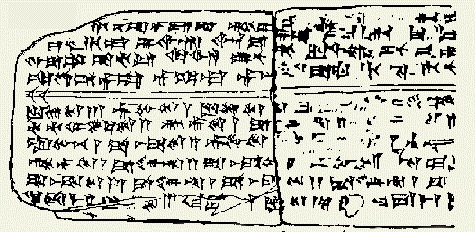
The tablet is a hymn to Nikkal, an ancient Near Eastern goddess of orchards and the wife of the moon god. The top portion holds the words in Hurrian. The bottom holds something far rarer: musical instructions, written in Akkadian, the diplomatic language of the age. To the untrained eye it is just more cuneiform. To a musicologist, it is a score.
How do you write music with no notes?
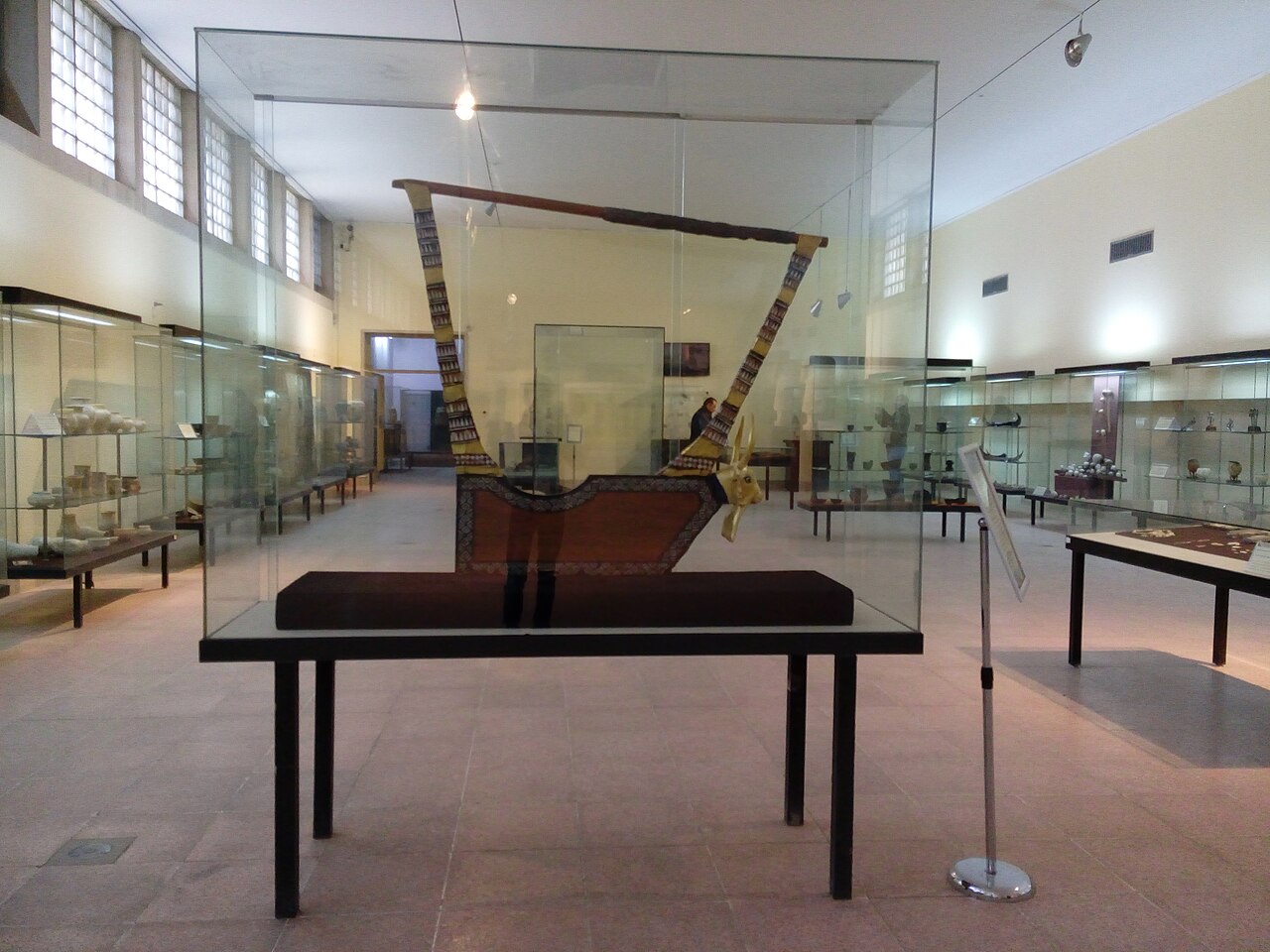
Here is the clever part. The Hurrian scribe had no staff, no clefs, no little black dots — none of the notation we inherited from medieval Europe. Instead, the system was built entirely around a lyre, a nine-stringed instrument plucked across the ancient world. We know this because three other surviving tablets spell out, in Akkadian, exactly how to tune that lyre: which pairs of strings should sound which intervals, and what each tuning was called.
So the "score" on tablet h.6 does not name pitches at all. It names intervals — pairs of strings — followed by a number telling the player how many times to sound them. In effect, it is the world's oldest tablature: not "play a C," but "play the pair of strings that gives this interval, twice." It is a way of writing music that assumes you already have the instrument in your hands and know how it is tuned. Once you grasp that, the marks stop looking like a dead language and start looking like a set of fingering instructions across the strings of a lyre.
The fifteen-year decipherment
Reading those marks was a lifetime's work. The American Assyriologist Anne Draffkorn Kilmer spent roughly fifteen years wrestling with the tablet before publishing an influential reconstruction in 1972 — turning the cuneiform intervals into a melody you could actually play and hear. For a public that had only ever imagined ancient music in the vaguest way, suddenly there was a tune. It moved in gentle, harmonized steps, and it sounded, against all expectation, almost familiar.
But here is the honest catch, and it is part of what makes the hymn so fascinating: nobody is sure she got it right. The notation is sparse and ambiguous, and at least five rival scholars have published completely different decipherments of the very same tablet — different melodies, different rhythms, different ideas of how the words and notes line up. Listen to two reconstructions side by side and you might struggle to believe they came from the same source. We have the world's oldest song, and we are still arguing about how it goes.
Why it still gives people chills
What survives, then, is not a definitive recording but a genuine signal across an almost unimaginable gulf of time. Someone in a Bronze Age city cared enough about a melody to encode it so a stranger could one day play it back. That intent is the real artifact. Tablet h.6 was inscribed before the Trojan War, before Tutankhamun's tomb was sealed, before the first line of the Hebrew Bible was written. The temples of Ugarit are dust, the Hurrian language is dead, and the goddess Nikkal has no worshippers left. And yet, every time a musician picks up a lyre and works through those intervals, a song someone hummed thirty-four centuries ago briefly comes back to life — slightly wrong, perhaps, but unmistakably there.