
He drank the bacteria, and what he proved was not the ulcer
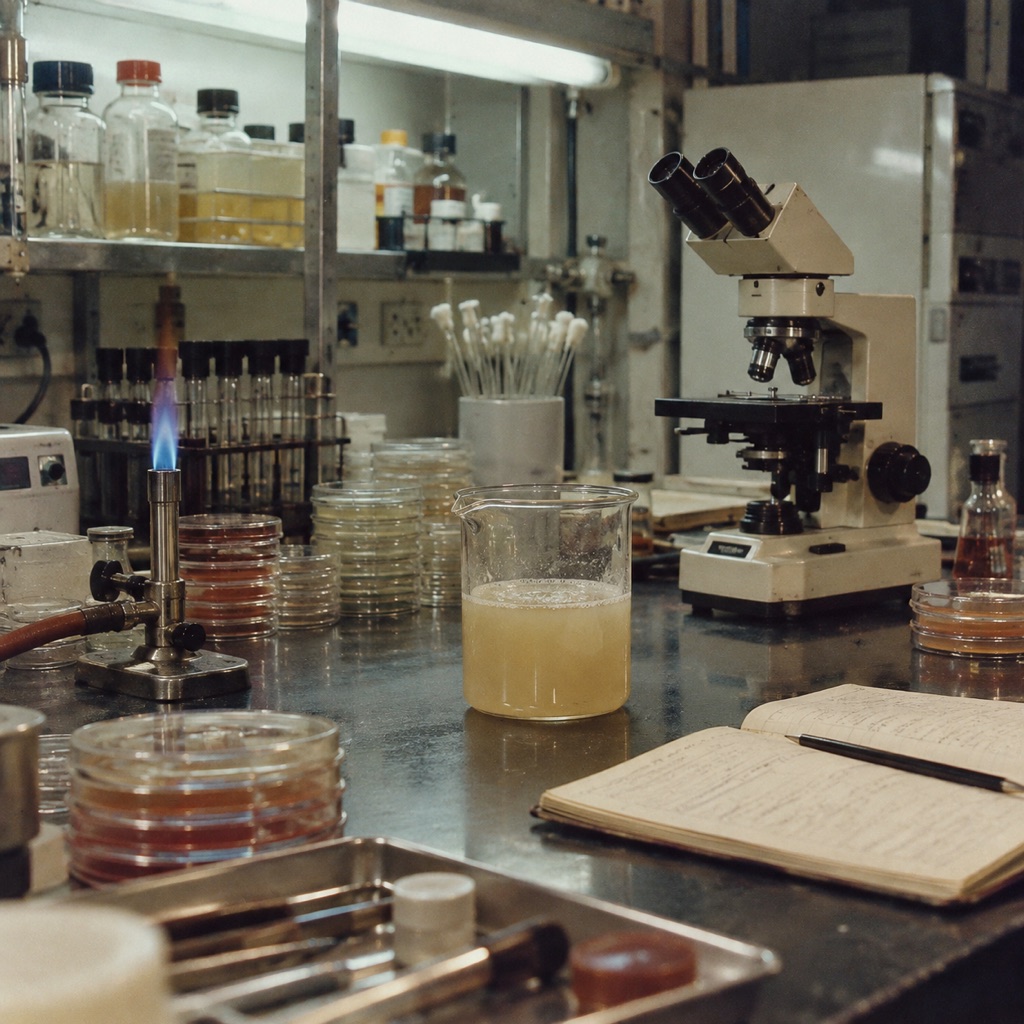
In 1982, the cause of peptic ulcer disease was not an open question. It was settled. Too much acid, secreted by a stomach that temperament, stress, smoking or unlucky heredity pushed into overdrive. The 2005 press release from the Nobel Assembly at the Karolinska Institutet says as much: at that point, "stress and lifestyle were considered the major causes of peptic ulcer disease". Barry Marshall, in his Nobel lecture of 8 December 2005, quotes the historian Daniel Boorstin: "The greatest obstacle to knowledge is not ignorance, it is the illusion of knowledge."
The ulcer was already solved, and already rewarded
The case was closed because a drug worked. According to the 1988 Nobel press release, James Black characterised a new family of histamine receptors in 1972, the H2 receptors, then developed the first clinically usable H2 antagonist, cimetidine. The same text describes that step as the introduction of "a new principle in the treatment of peptic ulcer", and the 1988 prize in physiology or medicine went to Black, Gertrude Elion and George Hitchings, "for their discoveries of important principles for drug treatment".
Marshall notes it himself: the arrival of the H2 blockers, five years before his own work, seemed to confirm the acid theory, since almost every ulcer healed as soon as acid secretion was brought down. But they came back the moment treatment stopped. Marshall draws a blunt conclusion from that: cimetidine was a treatment, not a cure, and by 1983 it was clear that most ulcer patients would have to be treated for life. There was an effective drug, so everyone believed the cause was in hand.
A pathologist, a silver stain, and an Easter weekend
J. Robin Warren, born in 1937, is a pathologist at Royal Perth Hospital. His Nobel lecture opens on a precise date: "My adventure with Helicobacter began in June 1979." A routine biopsy shows severe active chronic gastritis and, on the surface of the epithelium, a thin blue line. His colleagues can see nothing at that spot, which is exactly why he applies a Warthin-Starry, a silver stain that brings out small curved and spiral bacilli, glued to the epithelium and lined up like a palisade.
Barry Marshall, born in 1951, is at that point a young doctor in training, a "clinical fellow" in the words of the Nobel press release. From August 1981 he takes over the clinical follow-up of the patients on Warren's list. In late 1981 it is he who writes the protocol for a prospective study of 100 consecutive patients referred for gastroscopy, and submits it to the ethics committee of Royal Perth Hospital. The study starts before March 1982 and ends in late May.
The cultures fail for months, because the laboratory was throwing out negative plates at 48 hours, the way it would for a throat swab. The breakthrough comes from an accident of the calendar, the week of 8 to 13 April 1982. Microbiology at Royal Perth is swamped: by Marshall's recollection, which he is careful to label as a recollection, a methicillin-resistant Staphylococcus aureus had just been detected in the hospital and was tying up the laboratory. Nobody comes in to read the plates on Easter Saturday. The plates, from patient number 37, a 70 year old man with both a duodenal ulcer and a gastric ulcer, sit in the incubator from Thursday morning to Tuesday morning, five full days. On the Tuesday, the colonies are there.
Two letters appear in the Lancet of 4 June 1983 (volume 1, issue 8336, pages 1273 to 1275). The full paper follows on 16 June 1984 (volume 1, issue 8390, pages 1311 to 1315): out of the 100 patients, spiral or curved bacilli are demonstrated in 58, and cultured from 11 of those biopsies. One number stays with Marshall above all others: the 13 patients in the series who had a duodenal ulcer were all infected, a clean 100 percent.
That round number deserves the footnote Marshall himself supplies in his Nobel lecture. One duodenal ulcer patient was negative on the endoscopic biopsy. He reclassified her as positive after the bacterium turned up on the much larger surgical specimen taken shortly afterwards. The 13 out of 13 is therefore accurate as published, but it rests on a rereading, not on thirteen biopsies that were positive from the start.
The third postulate
Association was not enough, and the criticism was fair: these bacteria could be opportunistic commensals, settled into a stomach already made sick by something else. Settling the matter meant Koch's postulates, which Marshall lists as follows: the bacterium must be present in every case, be isolated from the diseased host and grown in pure culture, reproduce the disease in a healthy susceptible host, and be recovered from that experimentally infected host.
The first two were in hand. The third called for an animal model. In January 1984, Marshall tries the experiment on four piglets, with Stewart Goodwin. The bacterium does not take, the gastric biopsies stay normal, the animals grow too big, and the experiment is dropped without ever being published.
Two things reassure him in mid 1984. A homemade serological test, crude by his own admission, tells him that 43 percent of healthy blood donors in the port of Fremantle are carrying the bacterium, so carrying it is not necessarily fatal. And bismuth plus metronidazole has just cured the first four patients he treated, so there is a therapeutic way out.
That left consent, which he settles in a single sentence: the only person in the world capable, at that moment, of giving informed consent was himself. He does not go to the ethics committee, and he explains why without sparing himself: he would have run the experiment anyway, and a written refusal would then have barred him from publishing it. His head of microbiology, David McGechie, laughingly declines the offer to "take the bug". Marshall asks his head of gastroenterology, Ian Hislop, for an endoscopy to obtain healthy control tissue, without mentioning that it is the baseline of a protocol; he adds that he suspects Hislop worked it out.
A quarter of a beaker, in one gulp
On the morning of the experiment he skips breakfast and takes 400 mg of cimetidine, on the theory that lower acidity will make colonisation easier. Two hours later, Neil Noakes scrapes a heavily seeded four day old culture plate and disperses the bacteria in alkaline peptone water. At 10 o'clock, Marshall is handed a 200 ml beaker a quarter full of a cloudy brown liquid. He swallows it in one go, then fasts for the rest of the day.
Three days of nothing. On the third evening, a feeling of fullness after a modest meal. Between the fifth and the eighth day, he wakes at dawn to vomit a clear, viscous liquid, with no acid in it. He sleeps badly, wakes up clammy, feels lethargic. His wife tells him his breath is putrid; his colleagues at Fremantle hospital had noticed it too, more politely.
On the tenth day, Hislop scopes him again. The Gram stain of the first biopsy shows the spiral bacteria, and the next day Ross Glancy shows him a slide loaded with Helicobacter and pus cells. On the fourteenth day, a third endoscopy: the stomach looks normal and, across eight samples, culture, histology and electron microscopy find nothing left, beyond the look of a gastritis on its way to healing.
Two details matter here, and both cut against the legend. Marshall says he cleared the bacterium on his own, with no antibiotic; the disappearance remains, he writes, a mystery to this day, and the serologies drawn then and again a few months later stayed negative. And the tinidazole he does take is swallowed after the fourteenth day endoscopy, not before, which contradicts the popular version of a wife forcing him into emergency treatment. He adds that tinidazole alone would not have been enough anyway: in a later trial, 23 patients out of 24 treated with that drug alone did nothing but develop resistant bacteria.
What the broth proves, and what it does not
The paper appears on 15 April 1985 in the Medical Journal of Australia, volume 142 issue 8, pages 436 to 439, signed by Barry J. Marshall, John A. Armstrong, David B. McGechie and Ross J. Glancy, under a title with no emphasis in it: "Attempt to fulfil Koch's postulates for pyloric Campylobacter". The abstract is written in the third person and never names the volunteer: "A volunteer with histologically normal gastric mucosa was given pyloric Campylobacter by mouth. A mild illness developed, which lasted 14 days. Histologically proven gastritis was present on the tenth day after the ingestion of the bacteria, but it had largely resolved by the fourteenth day."
The last sentence of the abstract is a hypothesis, not a conclusion: it is "proposed" that this disorder may progress to a chronic infection that predisposes to peptic ulceration. The experiment demonstrates an acute gastritis caused by the bacterium, in one subject. It does not demonstrate the ulcer, and the paper makes no such claim: the third postulate is fulfilled for gastritis only, while the disease everyone was trying to explain stays out of reach. That is precisely why the title speaks of an attempt.
A replication arrives from New Zealand. In the American Journal of Gastroenterology of March 1987 (volume 82 issue 3, pages 192 to 199), Arthur Morris and Gordon Nicholson report the ingestion of the bacterium by a volunteer the article declines to name either: epigastric pain on the third day, positive culture on antral biopsies and acute gastritis on histology on the fifth, fasting gastric pH risen to 7.6 on the eighth, bacterium cultured in both antrum and fundus on the eleventh. Twenty-eight days of doxycycline eradicate nothing. Twenty-eight days of bismuth subsalicylate leave the final biopsies culture negative, but with minimal residual chronic gastritis. The same authors returned to the case four years later, in a letter to the Annals of Internal Medicine of 15 April 1991 (volume 114 issue 8, pages 662 to 663) titled "Long-term follow-up of voluntary ingestion of Helicobacter pylori", so the 1987 conclusion was not the last word on that volunteer.
Why the "stress" version held on for another ten years
The conversion did not follow the experiment, it followed the treatment trials. From 1985, Marshall sets up a double blind placebo controlled trial with four arms, cimetidine or bismuth, with antibiotic or placebo, in 100 patients carrying both a duodenal ulcer and the bacterium. Lasting healing tracks with eradication there, not with lower acidity, and smoking stops carrying any weight once the bacterium has been cleared.
It took the consensus conference of the National Institutes of Health, held from 7 to 9 February 1994 and published in JAMA on 6 July 1994 (volume 272 issue 1, pages 65 to 69), for an institution of that standing to write in black and white that ulcer patients infected with H. pylori should receive antimicrobials on top of antisecretory drugs, at first presentation as well as at recurrence. That same year, the International Agency for Research on Cancer, meeting in Lyon from 7 to 14 June, concludes that the infection is carcinogenic to humans, in volume 61 of its monographs. Marshall dates general acceptance to after 1994, ten years after the broth.
The Nobel Prize in physiology or medicine is announced on 3 October 2005, jointly to Marshall and Warren, "for their discovery of the bacterium Helicobacter pylori and its role in gastritis and peptic ulcer disease". The press release gives the number that measures the size of the earlier error: H. pylori causes more than 90 percent of duodenal ulcers and up to 80 percent of gastric ulcers.
As for the popular form of the story, it was born of a leak. Marshall recounts having dinner with Warren a few weeks after the experiment and describing to him, with some enthusiasm, how severe his episode had been. At 5 the next morning, Perth time, an American journalist who had miscalculated the time difference calls Warren and asks him the ritual question about the harmless commensal. Warren lets slip that Marshall has just infected himself and "nearly died". It is Marshall who later calls the phrase a slight exaggeration, but one that "made good copy". The journalist worked for The Star, a tabloid. The headline ran the next day: "Guinea-pig doctor discovers new cure for ulcers ... and the cause".
Two of Marshall's own accounts do not entirely agree on the sequence: his autobiographical note gives the version with the dinner and the 5 a.m. call, while his Nobel lecture has the tabloid interview follow instead from an article by Lawrence Altman published in the New York Times after an interview in July 1984. In both versions, the popular story comes before the scientific publication of April 1985.
So the public got the dramatic version, in which a doctor poisons himself and cures the ulcer, rather than the accurate one, in which a doctor gives himself a fourteen day gastritis and ticks off, partially, Koch's third postulate.