
75% of Silent Films Are Gone: The Slow-Motion Disaster of Nitrate
Imagine an entire art form — its first decades, its founding masterpieces, the faces that taught the world how movies could feel — and then imagine three-quarters of it simply gone. Not censored, not hidden in some forgotten vault waiting to be found, but chemically dissolved, burned, or melted down for the few cents of silver in each reel. That is the real history of silent cinema. In 2013 the Library of Congress published a sober, careful count, and the number it landed on still feels impossible: about 75% of America's silent feature films no longer exist in any form. The villain of the story isn't a fire or a careless executive. It's the film itself.
A material that eats its own pictures
The early film industry shot almost everything on cellulose nitrate, a stock prized for its gorgeous, luminous image — and cursed with a fatal flaw. Nitrate is chemically unstable. Left alone in a can, it slowly digests itself in a process archivists have mapped into grim, recognizable stages. First the silver image begins to fade and a sweet, acrid odor seeps from the reel. Then the emulsion turns soft and sticky, blistering with gas bubbles. By the third stage the picture is gone for good — even a perfect copying machine has nothing left to copy. The film then congeals into a solid amber puck, and finally crumbles into a fine brown powder, as if the movie had decided to return to dust.
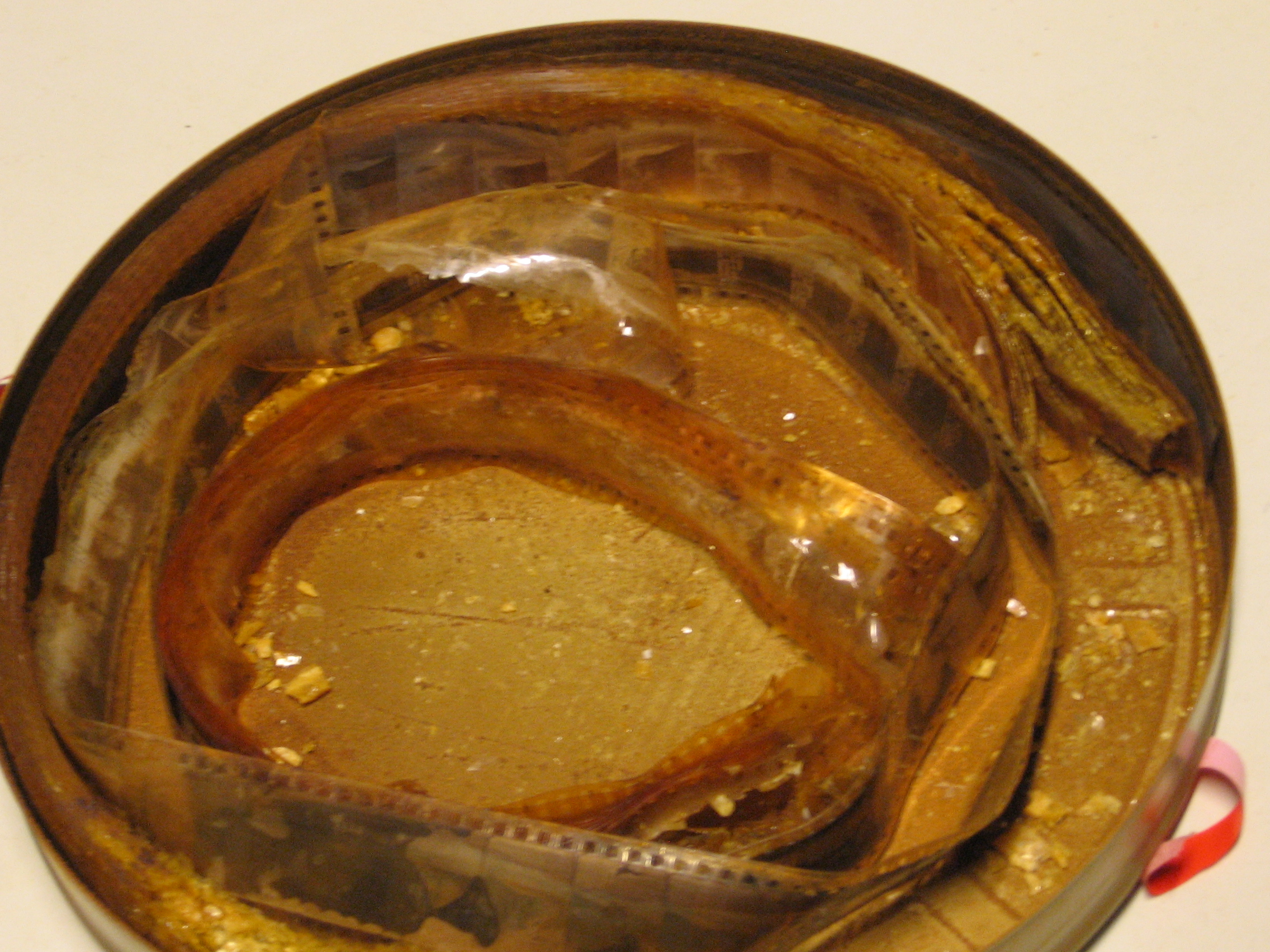
The cruelest part is that decay is autocatalytic: the gases nitrate gives off as it breaks down accelerate the breakdown of the film around it. One rotting reel poisons its neighbors. And the whole reaction speeds up with heat — which is exactly how a slow chemical death can turn, without warning, into a fire.
When the vaults caught fire
Nitrate doesn't just decompose. It burns ferociously, producing its own oxygen as it goes, which means it can keep flaming even underwater and can't be smothered the way an ordinary fire can. Stored badly, a decaying reel in a sealed can becomes a slow pressure cooker of flammable gas.
The most infamous example is the Fox vault fire of July 9, 1937, in Little Ferry, New Jersey. During a brutal heat wave, the spontaneous combustion of decomposing nitrate touched off an explosion that shot flames over 100 feet into the air and destroyed roughly 40,000 reels — wiping out the great majority of Fox's feature films made before 1932, including most of cowboy star Tom Mix's work. It wasn't the only such blaze, just the one that swallowed the most history in a single night.

Worth more as silver than as art
Here is the detail that turns tragedy into something closer to farce. After the Fox fire, salvage crews hauled away 57 truckloads of burnt nitrate — not to mourn it, but to extract the silver from the emulsion. Each charred can was worth about five cents.
That arithmetic ran the whole industry. Studios saw silent films not as heritage but as inventory, and once the talkies arrived in the late 1920s the silents felt instantly obsolete — like keeping a warehouse of buggy whips after the car. So thousands of prints and negatives were deliberately destroyed, dumped, or sent off precisely so the silver could be reclaimed. A film that took hundreds of people months to make was, in the accountant's column, a nickel's worth of metal. We didn't only lose silent cinema to chemistry and bad luck. We threw a great deal of it away on purpose.

The slow rescue
The reckoning came late. As fires and shuttered studios kept eating the record through the mid-twentieth century, the Library of Congress and, after its founding in 1967, the American Film Institute began the painstaking work of finding nitrate prints and copying them onto stable "safety" film before they vanished. It is a race against a clock that never stops ticking, because every surviving nitrate reel is still, quietly, decomposing. Modern archives keep them in freezing, climate-controlled vaults to slow the chemistry to a crawl — but slowing is the best anyone can do. There is no cure.
There are small miracles. Lost films keep turning up: in foreign archives that bought prints and forgot them, in private collections, even in a swimming pool in the Yukon, where a 1929 cache of nitrate reels was found buried under permafrost in 1978, frozen just enough to survive. Each rediscovery is a reminder of the scale of what's missing.
The kicker
The Library of Congress study found that only about 14% of those American silent features still exist in their original 35mm format — the way they were meant to be seen. The rest of the survivors limp on as foreign edits or murkier, lower-quality copies. So when you watch a restored silent film today, all crisp and shimmering, remember you're seeing one ticket holder from a sold-out theater that burned down. The medium that taught the world to dream in moving pictures forgot most of its own dreams — because the very thing that made the images so beautiful was also quietly, patiently, turning them into smoke and silver and dust.