
IMAX 70mm: why only 30 theaters on Earth could screen Oppenheimer
When Oppenheimer hit theaters in July 2023, Christopher Nolan kept repeating a strange piece of advice: see it in IMAX 70mm if you possibly can. The catch was that almost nobody could. Out of the tens of thousands of screens on Earth, exactly thirty could show the film the way it was actually shot. To watch Oppenheimer as Nolan intended, you didn't just buy a ticket — you joined a global scavenger hunt for one of the rarest projection setups still running.
A film frame the size of a paperback
Most movies you've ever seen were shot on 35mm film, where each frame is a small rectangle a bit larger than a postage stamp. IMAX 70mm throws that out the window. It runs the film sideways through the camera and uses a colossal frame that spans fifteen perforations — those little sprocket holes along the edge — instead of the usual four or five. That's why insiders call it "15/70."
The result is a negative so large that a single IMAX frame holds roughly the same detail as an 18K digital image. For comparison, the crisp 4K TV in your living room is about a tenth of that. It's the highest-resolution capture format ever used to make a commercial movie, and standing in front of one of those screens you can feel it: pores, dust motes, the grain of a wooden table all rendered with eerie clarity.
Nolan filmed something nobody had ever shot
Nolan built Oppenheimer from two interlocking formats: 65mm large-format film with 5 perforations for many scenes, and full IMAX 15/70 for the showcase moments. But he also pulled off a genuine world first. He wanted parts of the story — the cold, bureaucratic perspective of Lewis Strauss — shot in black-and-white IMAX, something that had literally never existed.
So Kodak engineers were asked to manufacture large-format black-and-white film stock from scratch. Their Double-X emulsion had only ever been cut for smaller 35mm and 16mm formats. After months of trial and error, cans started arriving at the production with handwritten labels — the first 65mm black-and-white film ever made. Panavision and IMAX even had to re-engineer the camera pressure plates to handle it. Nolan got his monochrome, and cinema got a brand-new tool that hadn't been on the menu a year earlier.
A movie that weighs as much as a grand piano
Digital cinema is weightless — a film travels as a hard drive or a satellite download. An IMAX 70mm print of Oppenheimer is the opposite of that in every way. Because the film runs horizontally and the frames are enormous, a three-hour runtime eats an absurd amount of physical stock.
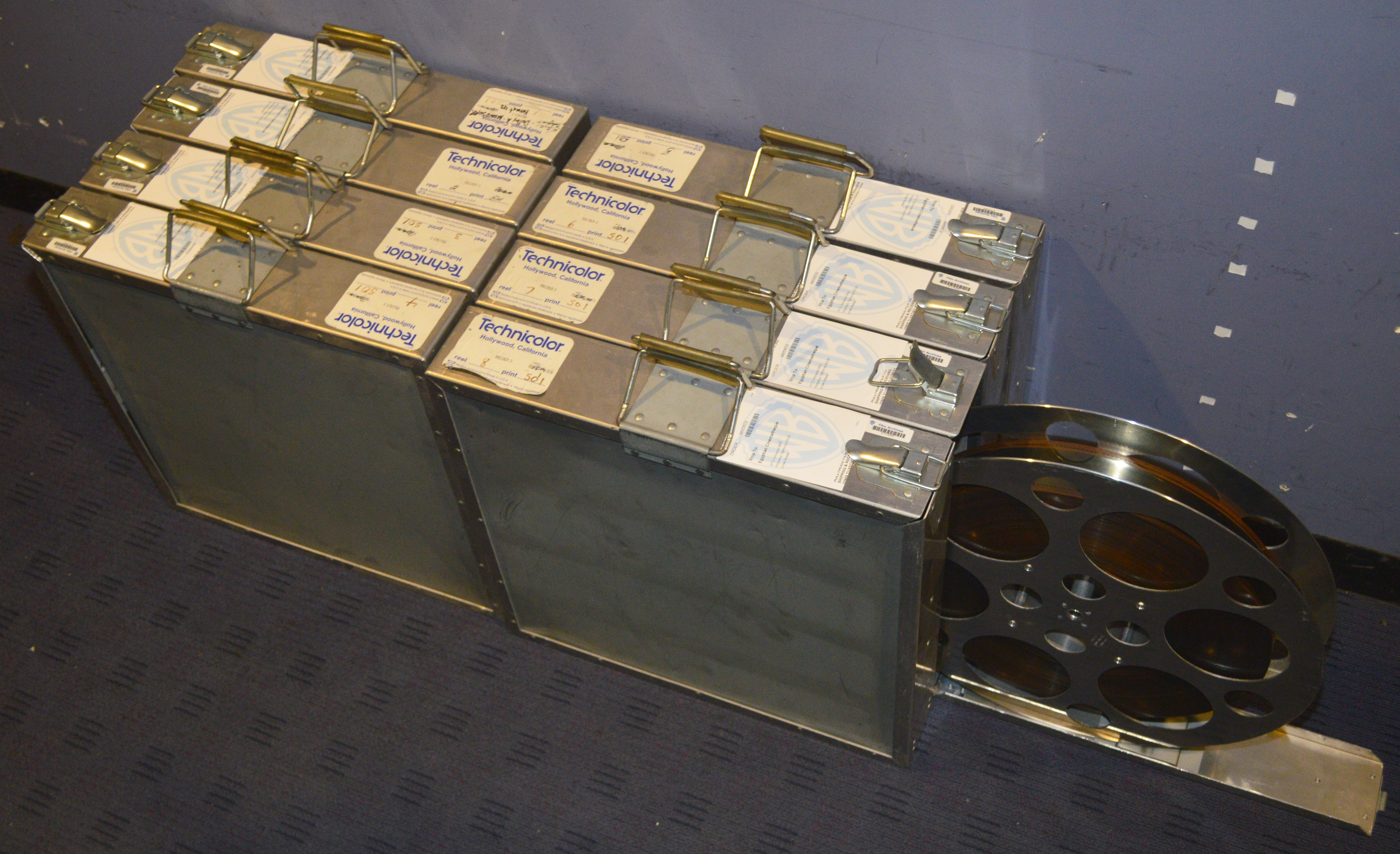
A complete print of Oppenheimer was built from 53 reels. Stretched end to end, it ran about 11 miles — roughly 18 kilometers of celluloid. And it tipped the scales at around 600 pounds, about 270 kilograms, the weight of a grand piano or a couple of refrigerators. IMAX engineers admitted the three-hour runtime pushed the format to its "outer limit"; the reels barely fit on the largest available platters.
Why only thirty rooms on the planet qualified
Showing this format is brutally demanding. You need a true IMAX 15/70 projector — a beast of a machine that runs film flat instead of vertical, with a vacuum system to hold each giant frame dead still. You need a projectionist who actually knows how to thread 600 pounds of film without scratching it. And you need a screen tall enough to do that 1.43:1 frame justice.
Worldwide, only about thirty cinemas ticked all those boxes for the 70mm version, with 19 of them in the United States. So screenings sold out weeks ahead, fans drove across state lines, and some theaters extended their 70mm runs by weeks just to meet demand. Tickets to a format that was supposedly obsolete became one of the hottest seats of the year.
The kicker
Here's the lovely irony. In an age when films are beamed to projectors as encrypted files and "shipping a movie" means clicking download, Nolan made the most anticipated picture of the year travel the world the old way: as 53 metal cans of physical film, 270 kilograms of it, hand-threaded by a vanishing breed of projectionist into one of thirty surviving machines. The story of the atomic age — humanity's most abstract, world-altering leap — could only be seen at its absolute best by reaching back to the most stubbornly physical technology cinema ever built.