
Ford did not double wages so his workers could buy his cars
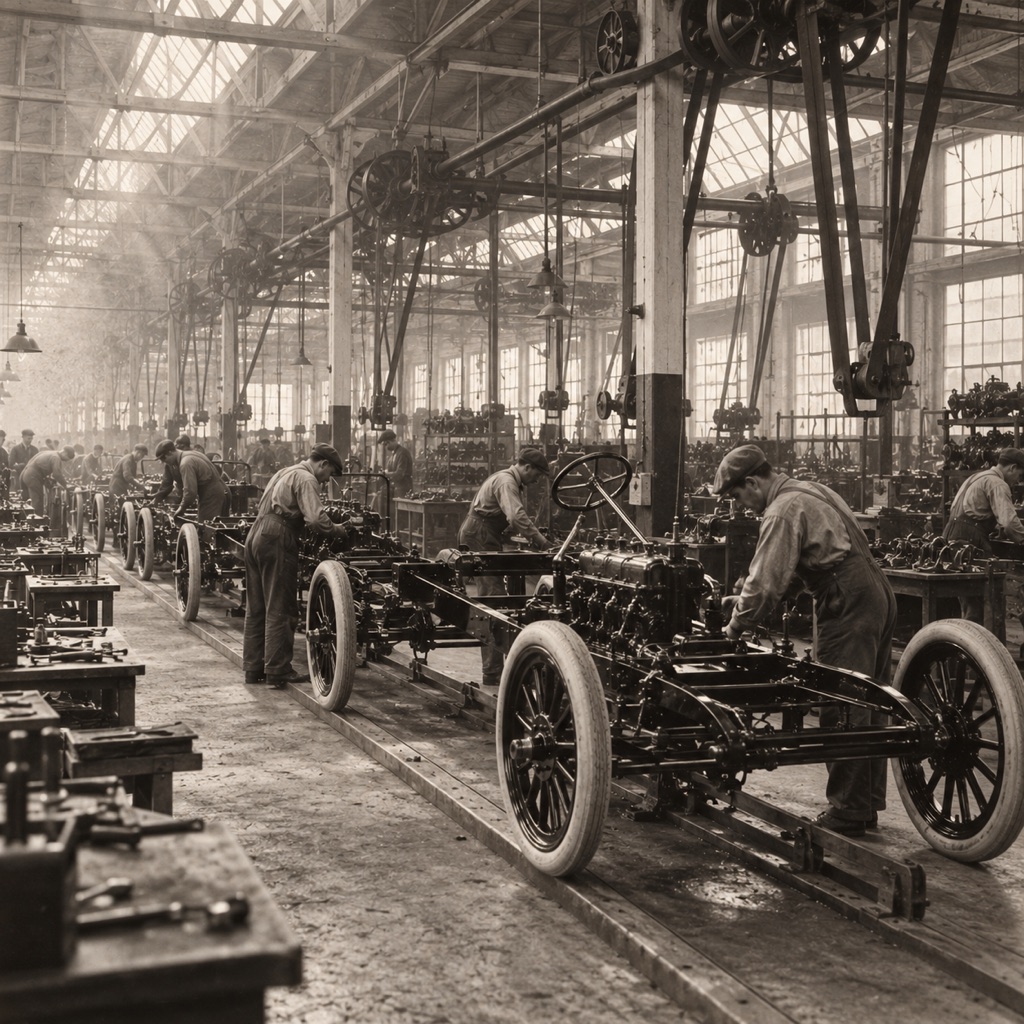
In 1913, the Ford Motor Company hired 50,448 men. Its average payroll across the year came to 13,623 positions. To keep thirteen thousand slots filled, in other words, it had to fill fifty thousand. Annual turnover ran at 370 percent, in a Detroit labor market where 200 percent already passed for ordinary. That number, and not some intuition about the buying power of working men, is where you have to start if you want to understand what happened on January 5, 1914, at Highland Park.
The version that survived
The legend fits in a single management textbook sentence: Henry Ford doubled wages so his workers could afford a Model T, inventing his own market in the process. It is elegant, it is memorable, and the arithmetic contradicts it on the spot.
Ford published the numbers himself. In My Life and Work (1922) he prints the table setting the price of his touring car against his output: for the 1913-1914 business year the car sold for 550 dollars and the plant turned out 248,307 of them. Against that, the average payroll for 1914 was 12,115 people. If every Ford employee without exception had bought a car that year, the maneuver would have absorbed less than 5 percent of a single year of production. The comparison mixes Ford's fiscal year with a calendar year headcount, which does not change the order of magnitude. You do not spend half your projected profits to manufacture a customer base that small.
More awkward for the legend: in the passage where Ford explains his decision, he never once mentions his workers buying cars. He writes that it was "an act of social justice," that he did it "for our own satisfaction of mind" (satisfaction of mind in the text, not peace of mind, as it is usually quoted), and then, further on: "We wanted to pay these wages so that the business would be on a lasting foundation." Elsewhere in the same book he does argue the general case that cutting wages cuts purchasing power, but never as the motive for January 1914. The one sentence where he puts a figure on his own reasoning is this: "The payment of five dollars a day for an eight-hour day was one of the finest cost cutting moves we ever made."
One nuance all the same, and it is a delicious one: John R. Lee, who ran the personnel side, noted in 1916 that company policy was to sell its men nothing and push them to buy nothing, "with the exception of Ford cars." So the idea did exist. It simply never served to justify the expense.
7,302 departures in a single month
What Ford delicately calls a cost, an internal company survey documents in detail. It counts the departures for March 1913: 5,156 "five day men," 1,276 discharges, 870 formal resignations. Total: 7,302 people out the door in thirty-one days, from a payroll of roughly thirteen thousand.
The "five day men" are the decisive category, and they account for 71 percent of the exits. They are not men who quit: they are workers absent five days running without an excuse, whom the company writes off as gone. Nobody gives notice, nobody hands in his apron. People simply stop showing up.
On top of that hemorrhage sits a daily fever. On October 6, 1913, out of 12,548 men on the rolls, 1,250 were absent: 10 percent. On a line where every station is one precise operation, that means running 1,300 to 1,400 inexperienced replacements through the plant every morning. And Ford was not short of applicants. The hiring line outside the factory was already, in the words of one observer of the day, one of the sights that sharpened the curiosity of gawking tourists. The American economy had also been in recession for a year: the cycle peak is dated to January 1913, the trough to December 1914, twenty-three months of contraction. Ford's problem was not finding hands. It was keeping them in place for more than a few weeks.
The company had already tried an answer. On October 1, 1913, following a study by John R. Lee, it granted a general 15 percent raise, rationalized a wage scale that had until then been left to the discretion of the foremen (sixty-nine different rates brought down to eight), and stripped those same foremen of the power to fire. Lee, in his own account, presents the raise as the counterpart to a day cut from ten hours to nine. Turnover fell in October, then climbed sharply again in November and December. January 1914 was not a flash of insight: it was the second stage of a rocket whose first stage had not been enough. The biographer Allan Nevins stands close to alone in defending the opposite reading, that of a "practical idealism" the October reforms had already satisfied; he does not engage with the November and December figures.
What was announced on January 5 was not a wage
Henry Ford and his right-hand man James Couzens laid the scheme out to a handful of reporters on January 5, 1914, with considerable fanfare and suspicious discretion: only the Detroit Free Press, the Journal and the News were summoned, at a moment when Reuters, the national wire services and the trade press all had correspondents in town. The statement opens like this: "The Ford Motor Company, the greatest and most successful in the world, will on January 12 inaugurate the greatest revolution in the matter of rewards for its workers ever known to the industrial world."
The substance comes down to two measures: the day drops from nine hours to eight, and minimum daily pay rises from about 2.34 dollars to 5 dollars, for those judged eligible. The "five dollar wage" does not exist. In March 1914 the base hourly rate for a factory worker was 29 cents, which is 2.32 dollars for eight hours: near enough the old pay. Everything above that is legally classified as profit sharing. The distinction is not cosmetic: it lets the company condition payment on the private conduct of the recipient, and owe nothing at all should business turn down. The plan is in fact presented as an experiment the company commits to for one year only. When Lee published his assessment in the Annals of the American Academy of Political and Social Science in May 1916, he titled the article, with no apparent irony, "The So-Called Profit Sharing System in the Ford Plant."
The eligibility rules filter hard. Lee lists three categories: married men living with their families and providing for them, single men over 22 with proven habits of thrift, and men under 22 as well as women who were the sole support of a relative. Asked about it by the New York Times on January 7, executives explained that women were excluded because they are "not as a rule heads of families." Two further conditions would be added later: six months of residence in Detroit to be hired, six months of service to draw the profit share.
Above all, you had to pass inspection. A Sociological Department visited the home of every worker and had to certify him before any money changed hands: thirty investigators at launch according to Lee, some fifty two years later, while the literature cheerfully cites one hundred and fifty, a figure Lee gives nowhere. Excessive drink, gambling, overcrowded housing, a disorderly home, food judged unwholesome, no regular savings: all grounds for exclusion. The scale for returning to grace was graduated. A worker who lost his share got all of it back if he came into compliance within thirty days, 75 percent within sixty, 60 percent within ninety, then 40 and 25 percent in the fourth and fifth months; after six he was fired. The withheld fraction went to charity, to prove, Lee writes, that the company was not looking to profit from its men's failings. Since 50 to 60 percent of the workforce spoke no English and interpreters had proved unworkable, Ford opened its own school: 1,500 enrolled in 1916. Lee wrote that same year that 69 percent of the workforce had been admitted within the first six months, 87 percent after a year, 90 percent by mid-1916.
The return on the operation
The effects show up in the same ledgers as the disease. Annual turnover falls from 370 percent in 1913 to 54 percent in 1914, then to 16 percent in 1915: 50,448 departures, then 6,508, then 2,931. Those figures come from Sumner Slichter's count (1921); other sources give slightly different ones without changing the conclusion. March, compared against itself, goes from 7,302 exits to 447. Absenteeism recorded on October 6, 1914, is 311 men out of 12,645, or 2.5 percent against 10 percent a year earlier to the day.
On the production side, O. J. Abell, writing in the trade journal Iron Age in January 1915, concludes that between 1913 and 1914 the company turned out roughly 15 percent more cars per day, with 2,000 fewer workers, meaning 14 percent of the payroll, and fewer hours per worker. His calculation rests on Ford's testimony before the United States Commission on Industrial Relations, which is to say on the statements of the interested party, and that invites caution. Lee, as reported by Nevins, is said to have calculated for his part that the plan had raised wages by 105 percent and labor costs by only 35 percent.
One objection remains worth putting, and the economists Daniel Raff and Lawrence Summers are the ones who put it: the drop in turnover, on its own, does not pay for the plan. Valuing the training of a replacement at one week's pay, they estimate that turnover savings cover about 6 percent of the cost of the scheme, 19 percent under the most favorable assumption. If the books balance, then, it is not only because fewer men were being replaced, it is because the men who stayed worked differently.
The scheme was expected to cost 10 million dollars over 1914, against expected profits of around 20 million. Net profit actually booked that year was 31,757,769 dollars, against 27,087,204 in 1913. No serious protest from a minority shareholder is on record, and this was a group that included men perfectly willing to take what they saw as Ford's whims to court.
As for the labor market, it answered without ambiguity. The New York Times of January 13, 1914, describes twelve thousand men massed outside the plant since ten o'clock the previous evening despite the blizzard, a riot, and police finally turning the fire hose on the crowd in weather "hardly different from zero," meaning zero degrees Fahrenheit, roughly minus eighteen Celsius. "As soon as they had dried off or found new clothes, the job seekers came back."
Why it is the other version we remember
Three things worked in the legend's favor. First the sheer scale of the coverage: the New York press gave Ford more than fifty columns in seven days, most of it on page one, and the New York Times, sober as its reputation runs, published thirty-five articles in ninety days. A story told that loudly settles fast around the simplest formula. Then Ford himself, who spent the following years talking about social justice and purchasing power in terms broad enough that readers could find in them, after the fact, a commercial strategy he had not invoked in January 1914.
Finally, the popular version is more comfortable. It turns an engineer's answer to a problem of workforce reliability, complete with systematic home inspection, into a parable about the employer who enriches his own customers. The first explains why turnover went from 370 percent to 16. The second runs up against no number at all, because it contains none.