
The founding sentence of reverse engineering comes from a case Atari lost
On September 10, 1992, the Court of Appeals for the Federal Circuit wrote a sentence the software world has been quoting ever since: "reverse engineering object code to discern the unprotectable ideas in a computer program is a fair use." Pulling machine code apart to reach the ideas copyright does not protect counts as fair use. The sentence is genuine, and it sits in Atari Games Corp. and Tengen, Inc. v. Nintendo of America Inc. and Nintendo Co., Ltd., 975 F.2d 832.
The last word of the opinion gets quoted far less: AFFIRMED. The preliminary injunction barring Atari from exploiting Nintendo's program stands. The party arguing for the freedom to reverse engineer wins the principle and loses the round. Nothing is settled on the merits: at this stage of the case the court rules only on how likely Nintendo is to prevail, and it finds that likelihood sufficient. Two independent grounds carry the result, the copy obtained from the Copyright Office and the substantial similarity between the two programs. To which is added, on the defense Atari raised, a sentence the court takes from the district court's order of April 11, 1991: "Atari lied to the Copyright Office in order to obtain the copyrighted 10NES program."
A lock spread across two chips
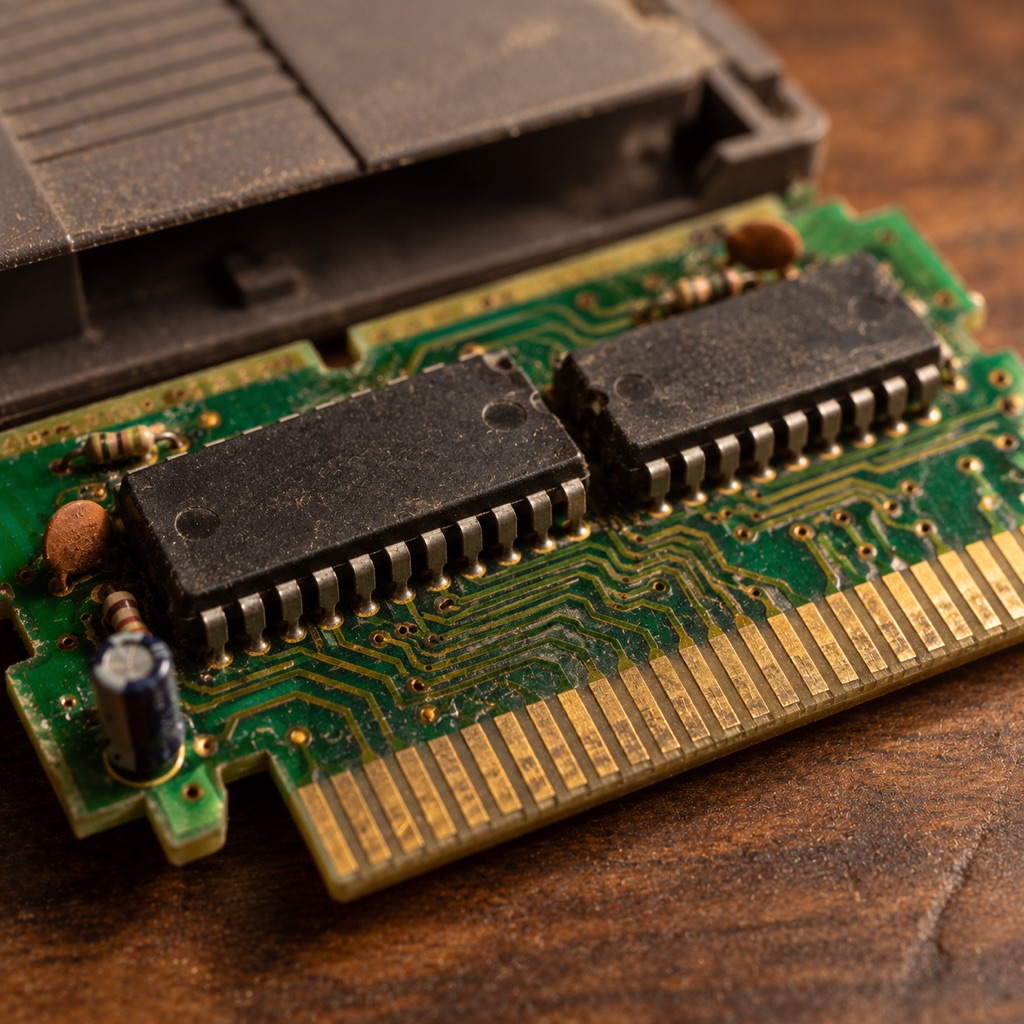
The 10NES is a program spread across two chips, built to stop the console from accepting unauthorized cartridges: a master chip in the console, the lock, and a slave chip in the cartridge, the key. When a cartridge goes in, the console waits for a coded message. If it arrives, the machine boots. If not, it refuses the cartridge. The patent on the device, US 4,799,635, filed on December 23, 1985 in the name of Nintendo Co. Ltd., inventor Katsuya Nakagawa, and granted on January 24, 1989, describes two twin components, microprocessors for instance, one mounted in the external memory and the other in the main unit: running in sync, they perform the same operation under the same program, exchange their results and compare them.
What is at stake is not technical, it is contractual. In a decision of March 7, 1990 between the same parties, the Federal Circuit presents Nintendo as the undisputed leader of the sector, with 80 percent of the home video game market. The figure sits in the statement of facts, and goes undisputed there. The 10NES turns that share into a tollgate: no key without a license. The one Atari accepts in December 1987 caps it at five new NES games a year, bars it from adapting a game to another home system for two years from first sale, and requires Nintendo to manufacture the cartridges before selling them back. Its subsidiary Tengen released three games under that regime, listed by the court in 1990: Pac-Man, Gauntlet and RBI Baseball.
Atari goes after the lock as early as 1986. Listening in on the dialogue between the two chips yields nothing. The analysts move to the chips themselves: chemical stripping layer by layer, microscope examination of the object code, fragments of which Atari copies out by hand. It is not enough to reproduce the security system.
The 1988 form
The Copyright Office keeps part of the deposit copies filed for registration under its own control, the 10NES copy among them. It does not keep them all, and 17 U.S.C. § 706(b) makes the release of copies subject to the conditions its regulations set. Section 201.2(d)(2) of title 37 of the Code of Federal Regulations, as amended on July 1, 1986, opens three doors: authorization from the rights holder, a court order, or the written request of an attorney acting for a party to litigation that is "actual or prospective." The third requires the names of all parties and the nature of the controversy, the court where the case is pending or, for merely contemplated proceedings, a full statement of the facts, and an assurance that the reproduction will serve that litigation only.
In early 1988, Atari's attorney takes that third door. According to the court, the request falsely stated that Atari was then a defendant in an action pending in the Northern District of California, and gave the Library of Congress the assurance that the copy "[would] be used only in connection with the specified litigation." No such proceeding existed. Atari would not sue Nintendo until December 1988, on antitrust and unfair competition grounds, and Nintendo would not bring its infringement action until November 1989.
Atari argues that the regulation covers prospective litigation too. The court answers that the word demands more than a subjective expectation of a lawsuit at some undetermined date: it takes an objective and reasonable apprehension, absent which alleging a future and speculative disagreement would be enough to obtain a copy of any deposited work. Then it closes the reasoning on itself. In 1988 Atari was a licensee and, above all, had no product at all, infringing or not, able to do what the 10NES did. "Without any allegedly infringing program at all in 1988, Atari had no reason to fear a copyright infringement suit from Nintendo." The reasoning is circular by construction, and the court owns it: Atari risked nothing precisely because it had not yet cloned the chip, so it had no claim to the copy that let it get there. None of which declares the fraud established; the court says only that Nintendo is likely to prove it.
With the source code in front of them, Atari's analysts return to the stripped chips. Under the microscope they transcribe the object code into a handwritten list of zeros and ones, then use the Copyright Office document to correct their errors. The court is explicit: the Copyright Office copy facilitated the replication of the object code.
What the Rabbit had no reason to do
The clone that comes out of it is called Rabbit. It runs on a different microprocessor, a faster one, which forces Atari to insert pauses so the master chip can still follow it, and it is written in a different language. Line by line, the two programs differ. The signals they produce are, on the district judge's finding, functionally indistinguishable.
What gives it away is the surplus. Nintendo's slave chip does more than open the console: it shuts itself down if the message received from the master chip is wrong. The Rabbit reproduces that behavior, useless to its stated purpose. Second clue: Nintendo modified its slave program in 1987 by deleting instructions, and the Rabbit contains the equivalent of those deleted instructions. Those useless elements, the court writes, strongly suggest substantial similarity, and it leans on case law holding that shared errors are the strongest evidence of copying. It quotes Learned Hand: "No plagiarist can excuse the wrong by showing how much of his work he did not pirate" (Sheldon v. Metro Goldwyn Pictures Corp., 81 F.2d 49, 56, 2d Cir. 1936). Atari answers that those instructions were groundwork for future compatibility; refusing to rest a justification on speculative future events, the appeals court holds, was no abuse of the trial judge's discretion.
The principle stands, the party invoking it does not
On the principle, the court sides with Atari. An author cannot buy himself patent-style protection by putting an idea, a process or a method into an unreadable format and then suing whoever tries to understand it. The disassembly needed for that understanding is fair use, and the trial court was wrong to presume otherwise: Atari was free to strip chips it lawfully owned.
Then comes the restriction that decides everything. To invoke fair use, you must hold an authorized copy of the work. The court points to Harper & Row v. Nation Enterprises, 471 U.S. 539 (1985), where the Supreme Court held that knowingly exploiting a purloined manuscript could not square with the good faith the exception rests on. Hence the formula that sinks Atari: "Reverse engineering, untainted by the purloined copy of the 10NES program and necessary to understand 10NES, is a fair use." The principle exists, it covers only the share of the work left untouched by the improperly obtained copy, and Atari mixed the two.
That left the copyright misuse defense, drawn in part from the two year exclusivity clause imposed on licensees. Only one circuit had accepted it by then, in Lasercomb America v. Reynolds, 911 F.2d 970 (4th Cir. 1990), and no statute enshrines it: it is, the court says, a purely equitable construct. And whoever asks for equity must come with clean hands, a rule it traces to Keystone Driller Co. v. General Excavator Co., 290 U.S. 240, 245 (1933). The lie to the Copyright Office shuts the door, and the court takes care to decide no more than it must: even if the Ninth Circuit were one day to recognize the defense, Atari appears in no position to raise it. The petition for rehearing was denied, and the suggestion for rehearing en banc declined, on November 17, 1992.
What history remembered instead
The other decision of the same season runs the other way. On April 3, 1992, the federal court for the Northern District of California barred Accolade from disassembling Sega's code and selling the games that came out of it. On August 28, 1992, the Ninth Circuit ordered the injunction dissolved and announced that its opinion would follow. It came down on October 20, 1992, Sega Enterprises Ltd. v. Accolade, Inc., 977 F.2d 1510, then amended on January 6, 1993: disassembly is fair use as a matter of law where it is the only way to reach the unprotected elements of the code and the party undertaking it has a legitimate reason to want that access. Accolade had bought a Genesis console and three Sega cartridges at retail, then wired a decompiler into the console's circuitry.
The chronology is worth keeping in order, because it usually gets told backwards. When the Federal Circuit rules on September 10, 1992, the Ninth Circuit has already knocked the injunction down thirteen days earlier, but has not yet published its reasons. So the Federal Circuit cites the trial court judgment in the Sega case, 785 F. Supp. 1392, as cutting against its own. That is the very judgment the Ninth Circuit will reverse, with reasons, six weeks later.
Which is why the popular version took hold. Two nearly simultaneous decisions say roughly the same thing about disassembly, but one ends with a win for the party doing the disassembling and the other with an injunction against it. The most quotable sentence comes from the losing file, cut loose from the lie that came with it. There is also a substantive difference rarely brought up: the Federal Circuit conditions fair use on holding an authorized copy, a condition the Ninth Circuit does not impose, since it instead rejects the argument built on § 117 and on lawful ownership of the copy. And an irony of jurisdiction: this classic of software copyright comes out of the patent court, which had the case because the consolidated litigation included patent infringement claims, and which applied copyright law borrowed from the Ninth Circuit.
One trace is quieter than the sentence on fair use: a form. In 1991, before the appellate ruling even landed, the Copyright Office issued a notice published at 56 Fed. Reg. 12,957, which the Federal Circuit reproduces in a footnote. The Office observes there that an attorney filling out the old Litigation Statement could allege in general terms that a controversy existed where none did, and thereby obtain reproductions the regulation did not allow. The form was amended to require particulars about contemplated proceedings and supporting documents. The notice names no one, and the Office never said what had put it on alert: the overlap of dates with the case is striking, it does not amount to a demonstration. The fix, for its part, held. Circular 6, revised in 2019, asks anyone invoking merely contemplated proceedings to give a full statement of the facts of the controversy, to attach any letter or document supporting the prospect of a suit, and requires the official form, of which no substitute is accepted.