
Atari's Buried Cartridges: The Myth That Turned Out to Be True
For thirty years it was the gaming world's favorite ghost story: somewhere out in the New Mexico desert, the legend went, a defeated video game company had secretly buried a mountain of its worst product under cover of darkness, then poured concrete over the shame. Most people filed it next to alligators in the sewers — too neat, too symbolic, too good to be true. And then, on a windy spring morning in 2014, a backhoe sank its teeth into a landfill in Alamogordo, and the dirt gave up its secret. The myth was real. It had been real the whole time.
The game that broke a company
To understand the grave, you have to understand the funeral. In 1982, Atari was the fastest-growing company in American history, and it bet enormous money on a tie-in to that summer's biggest movie: E.T. the Extra-Terrestrial. The catch was the schedule. A cartridge normally took six to eight months to build. The programmer was given about five weeks, so the game could sit under Christmas trees. He did something almost heroic under the circumstances, but the result was a confusing, buggy thing where E.T. spent most of his time falling into pits he couldn't climb out of.
Atari manufactured millions of copies — some accounts say more than were warranted by the entire installed base of consoles. Stores couldn't move them. Worse, E.T. arrived just as the whole industry was buckling under a flood of cheap, terrible games. The great video game crash of 1983 wiped out most of the American market almost overnight, and Atari, with warehouses full of cartridges nobody wanted, became its biggest casualty.
A funeral in the desert
So in September 1983, the company did what you do with inventory that has become a liability: it threw it away. Between ten and twenty semi-trailer truckloads of crushed cartridges, consoles, and computers rolled out of an Atari storehouse in El Paso and into the municipal landfill at Alamogordo, a quiet town better known for its proximity to the first atomic bomb test. The dumping started around September 26. Within days, workers poured a layer of concrete over the top.

That concrete is where the legend was born. Atari gave vague, shifting explanations to reporters, and one anonymous workman offered a wonderfully grim reason for sealing it: there were dead animals down there, he said, and they didn't want children getting hurt digging in the dump. The truth was almost certainly more boring — keeping scavengers out — but to a generation of gamers it sounded like a cover-up. The numbers swelled in the retelling, too: people swore millions of cartridges were down there. (A former Atari manager later put the real figure at around 728,000.)
Digging up a myth
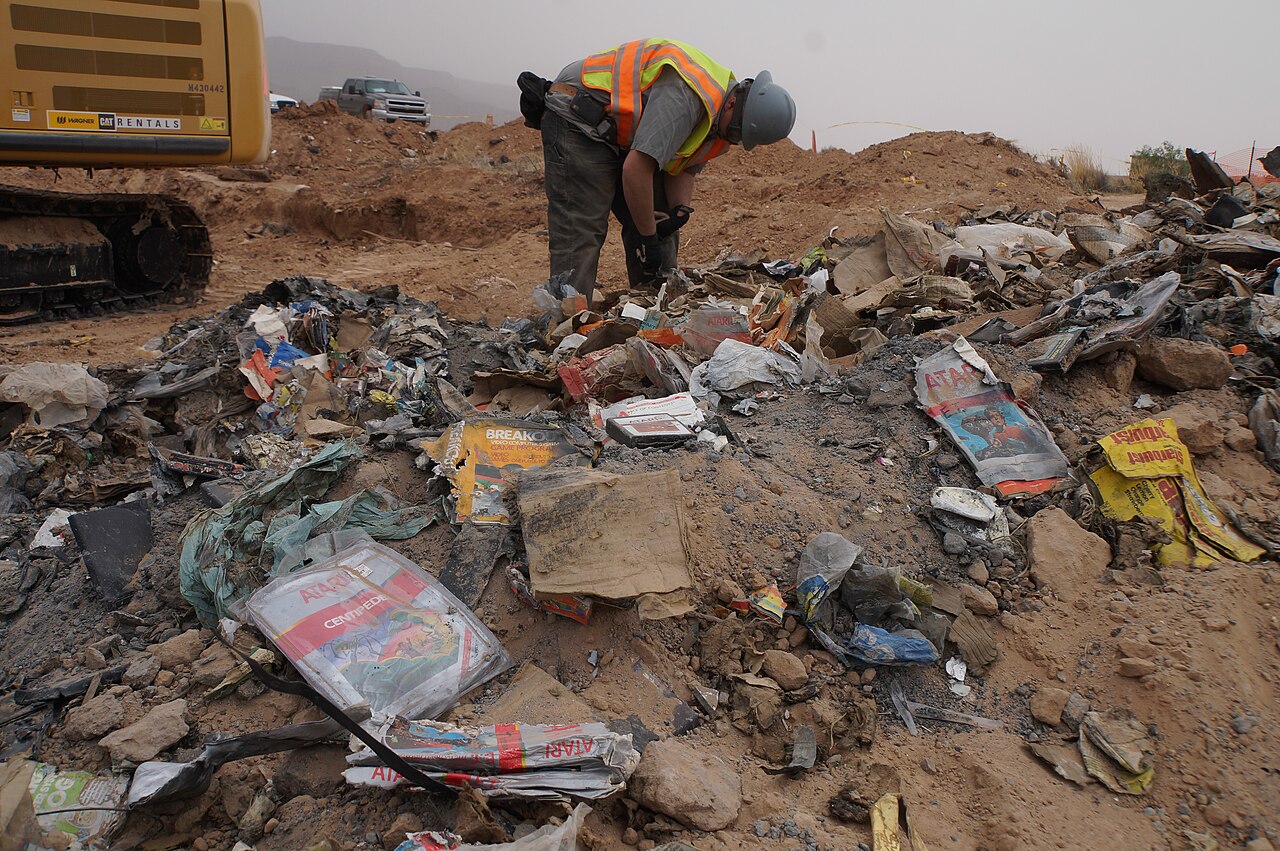
For decades the site sat there, paved and forgotten, until a documentary crew decided to find out if the story was true. On April 26, 2014, the excavation became a public spectacle. Hundreds of people drove out to a working landfill — to a dump — and stood in the wind to watch. There were food trucks. There was an actual costumed E.T. There was a man who had driven from out of state on the off chance he might own a piece of buried history.
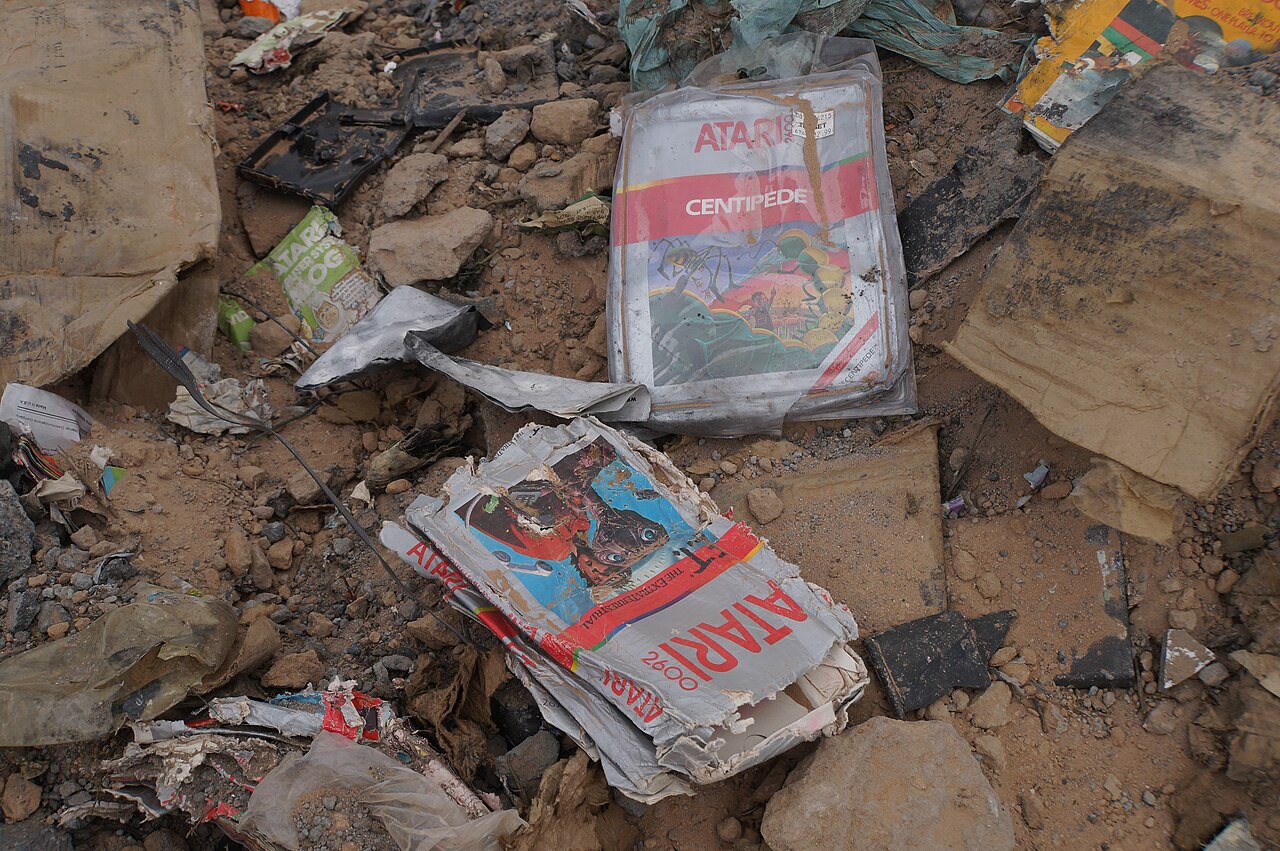
And the desert delivered. The team pulled up battered, dirt-caked cartridges by the handful, and they were not all E.T. — far from it. The haul included Centipede, Pac-Man, Warlords, Star Raiders, the whole graveyard of an era. In the end the dig recovered just over 1,300 cartridges. The crowd cheered each one out of the ground like an archaeologist lifting a pharaoh's mask.
What the trash became
Here's the part that turns the story around. The crushed garbage Atari paid to hide became treasure. Cleaned-up cartridges went to auction on eBay and through the city, and the haul raised more than $107,000 — money that flowed to Alamogordo's public works and its little Tularosa Basin Museum of History. A single mud-stained copy of E.T. sold for over $1,500. The cheap game that helped sink a billion-dollar company was now worth, gram for gram, vastly more buried and ruined than it ever was new and shrink-wrapped on a shelf.
The relics scattered into institutions that take such things seriously: the New Mexico Museum of Space History, the Centre for Computing History in England, and — the final twist — the Smithsonian, which now keeps a landfill-recovered E.T. cartridge in the same national collection as the Wright Flyer and the lunar module.
And that's the quiet kicker. Atari buried E.T. to make it disappear, to bulldoze an embarrassment out of memory. Instead the burial is the only reason most of us remember the game at all. The company's most spectacular failure didn't vanish under the concrete — it was preserved by it, turned from a punchline into a legend, and finally dug back up to sit, dirt and all, in a museum. Some mistakes are too good to stay buried.