
France's Newest Reactor Began a Planned 350-Day Outage. Its First Cycle Ran With Temporary Fixes.
In the night of Friday, September 25, to Saturday, September 26, 2026, EDF shut down unit 3 of the Flamanville nuclear plant for its first "visite complète", or VC1: the first full inspection of a new reactor after its first operating cycle. Flamanville 3 is an EPR, France's 57th reactor, connected to the grid on December 21, 2024, and at 1,600 MW the most powerful in the French fleet. EDF's page gives the scale: about 20,000 activities, 2,500 workers on site at the same time, 200 partner companies, and a planned duration of "about 350 days".
AFP's headline said "almost a year". The more useful documents are the regulator's. ASNR, France's nuclear safety authority, issued two expert opinions on the modifications EDF planned for this outage, dated January 15 and July 16, 2026, and authorized them on September 2, 24 days before the outage began. Read with EDF's pages and earlier decisions, they describe a first cycle that ran on time-limited arrangements, and an outage designed to retire them.
I am not a nuclear engineer. I ship software, and what interests me is a question every release raises: what are we knowingly leaving temporary? Here the answer is public, in detail.
350 days, and the rules behind it
The inspection is mandatory. EDF says every French reactor gets one after its first cycle, at the latest 30 months after fuel loading. Fuel went into Flamanville 3 in May 2024, so the deadline was November 2026. EDF compares the work to a ten-year inspection: a pressure test of the primary circuit, leak tests of the containment, inspection of the reactor vessel, the turbine and pressure equipment.
It is long: AFP reported EDF's estimate of 190 to 200 days for full inspections at Chooz and Civaux, and said this one takes longer because of the number of checks. On EDF's transparency platform for planned unavailability, the outage has been listed since November 12, 2025: 0 MW available out of 1,600, from September 26, 2026 to September 11, 2027. That is exactly 350 days, with the note "This outage may be rescheduled". As of October 20, 2026, the entry had not changed.
At 1,600 MW, each day offline is up to 38.4 GWh not generated; 350 days at full power would be about 13.4 TWh. AFP put the reactor's total production since grid connection at 9.9 TWh.
Renaud Crassous, of EDF's nuclear generation division, put the cost at "several hundred million euros", AFP reported. In January 2025 the Cour des comptes, France's public audit court, estimated the plant's total cost at about 23.7 billion euros in 2023 money, financing included, and noted that EDF's own figures left out the preparation and execution of this first inspection and the replacement of the vessel head. The build budget stopped before the first maintenance.
The part you cannot inspect gets an expiry date
The headline job is the vessel head: the lid of the reactor vessel, about 99 tonnes and 5.75 meters across according to EDF, which seals the primary circuit and carries the 89 mechanisms that move the control rods.
In late 2014, Areva NP found an anomaly in the chemical composition of the steel in the vessel's bottom and head, one that could reduce its resistance to crack propagation. ASN, as the regulator was then called, made it public on April 7, 2015. In October 2017 it concluded that the anomaly did not rule out commissioning the vessel, provided specific inspections were carried out during operation. For the head, the feasibility of those inspections was not established. So the head got a date: the 2018 decision allowed it until December 31, 2024. Startup was then planned for autumn 2019.
Construction slipped. In May 2023 the regulator accepted Framatome's request to keep the head until the first refuelling outage, then expected 15 to 18 months after commissioning, to avoid a dedicated shutdown in 2024. It attached a condition: if the project slipped significantly again, EDF would have to re-examine replacing the head before startup. The old head was in use until this shutdown, about 28 months after fuel loading. Its replacement, made by Framatome, reached the site on June 16, 2026; the old head will be stored on site for two years. On October 13, ICI Cotentin reported that the swap was due between November and early 2027.
A workaround for one cycle, a fix for the next
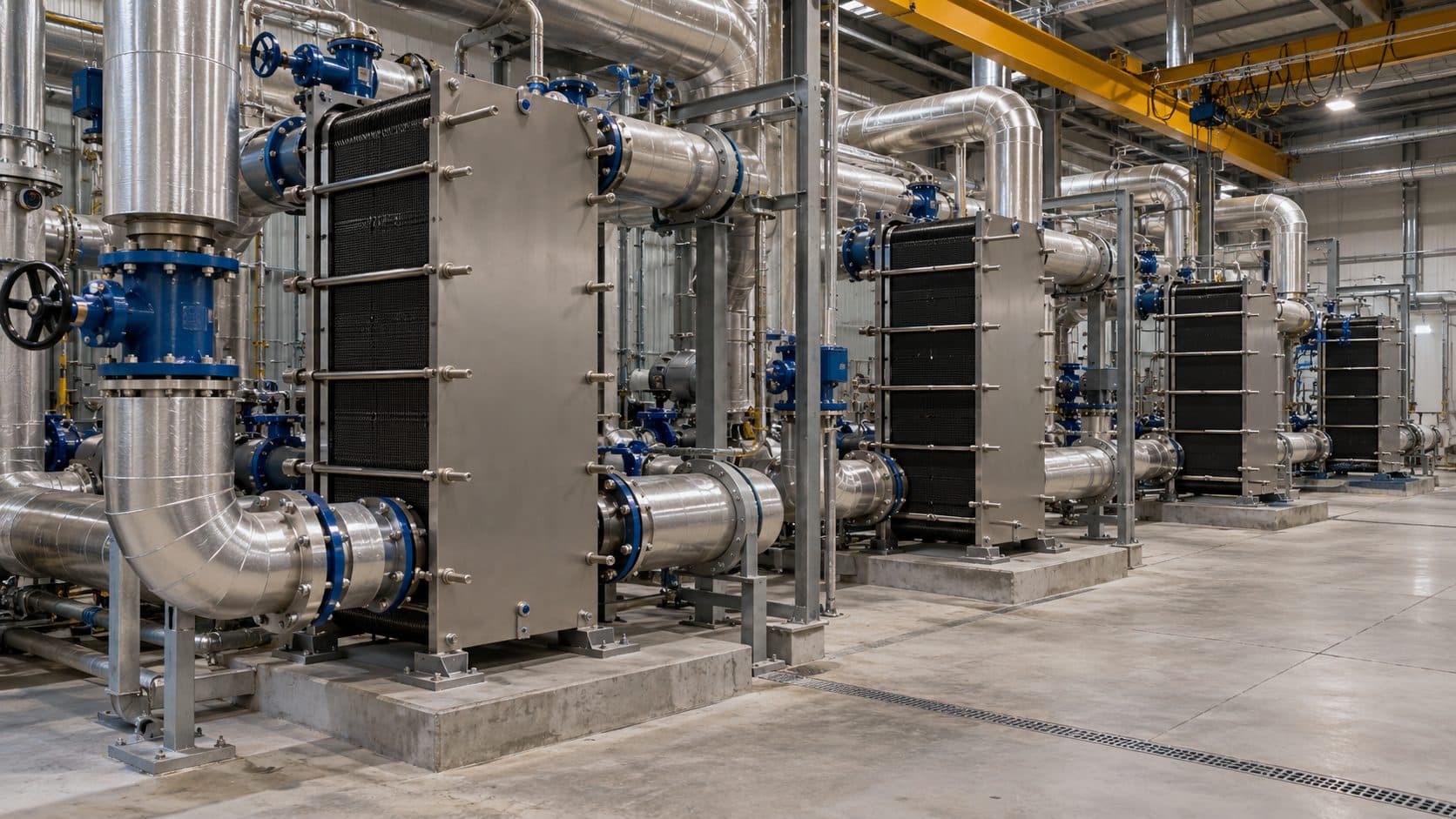
The less visible job is cooling. Heat from the reactor's auxiliary systems goes into an intermediate water loop, itself cooled by filtered seawater through heat exchangers, in four redundant, independent trains. In 2019, ASNR writes, EDF's tests showed those exchangers lacked the heat-exchange capacity required by the safety case. For the first cycle, EDF modified the impellers of the seawater pumps to raise their flow.
That workaround had a written limit, and it was not this outage. ASN's commissioning decision of May 7, 2024, notes that EDF modified the seawater system so the exchangers would suffice until the first ten-year inspection, despite the expected slow loss of performance from fouling and a possibly warmer sea, and requires their replacement at that inspection at the latest. EDF first planned to wait that long; in January 2023 it decided to do it at VC1 instead, swapping the tube exchangers for plate exchangers to treat the under-performance "definitively".
The replacement does not stop at four exchangers. ASNR lists a finer mesh on the shellfish filter upstream, a filter-washing function that must now work during an accident, a cap on the seawater flow that washing may use, new fouling monitoring, and new anchors drilled into an existing concrete slab, where some rebar may be cut. Since design conditions cannot be recreated on site, EDF relies in part on tests run on a test loop fitted with an equivalent filter.
Not every temporary arrangement ends in new hardware. On December 27, 2025, the first full-power measurement of primary-loop flow exceeded the per-loop maximum of 30,595 m³/h by 93 m³/h on one loop and 8 on another, while flow through the vessel stayed within its criteria. ASNR's experts found a 500 m³/h relaxation acceptable for the first cycle; EDF intends to make it permanent. Sometimes the fix is the specification.
A test that stops one step early
The reactor protection system also gets a new version of its application software. ASNR judged EDF's updated development process satisfactory and noted improved test coverage for the modules modified for VC1. EDF plans to extend that coverage to the other modules carrying the most important safety functions only at the next ten-year inspection; ASNR considers an earlier deadline should be set, notably for the modules EDF itself identified as the most complex.
One finding is pure test design. A periodic test checks that the "diesel ready for coupling" signal appears within 15 seconds of an emergency diesel starting. The safety report assumes 15 seconds for the full sequence, up to actual connection to the backup switchboards. The test stops at an intermediate signal. EDF committed to an analysis of that criterion by the end of July 2026; I found no public trace of its conclusion.
Space out the changes to redundant copies
Relays reaching the end of their 13-year qualified life are replaced by another brand rated for 40 years. They sit in all four redundant trains, so a shared defect could hit all four at once: a common-cause failure. EDF leaves four weeks between interventions on redundant channels, a delay that, ASNR notes, helps reveal latent defects. Power cuts hit one of the four electrical divisions at a time. Control cabinets are updated in batches, each fully available again before the next. And the electrical work waits after shutdown until the decay heat of the fuel in the pool has fallen enough for a single cooling train to remove it.
Not everything is staggered. The standard control software is updated on all four divisions together, with the core fully unloaded. The new version already carries protection thresholds meant for hardware not yet installed (the new exchangers, and new boron meters on the safety injection system), so those thresholds are set temporarily until that hardware is in.
What the documents do not show
These are pre-outage documents. They judge planned changes acceptable; they report no results. The shutdown itself had a first hiccup: in the night of September 30 to October 1, EDF reported, the indications of a boron meter were lost during cooldown; safety injection and the emergency diesels started automatically and were quickly stopped, and manual analyses confirmed the boron concentration was compliant. The EPR's director, Sébastien Miossec, said this did not compromise the outage's duration, ICI Cotentin reported on October 13, after EDF briefed the local information commission. As of October 20, 2026, EDF still gave about 350 days. The cost is one executive's range, quoted by AFP. And this is not a story of corners cut: the head ran within an extended authorization, and the first-cycle arrangements described here sit in the regulator's own files.
What I take from it
A reactor is not a web service; the software parallels are analogies only.
- Give every temporary arrangement a written limit and a condition for review. The head's authorization had a date, then an event with a condition attached.
- If you cannot monitor a component in service, plan its replacement, not its inspection.
- A workaround can be allowed for years and still be worth retiring at the first window. EDF had until the first ten-year inspection and chose the first outage.
- Test the requirement end to end. If the promise is "connected in 15 seconds", a test that stops at "ready" proves something else.
- When one defect could hit every redundant copy, change them one at a time, with time between them: in software terms, a staggered rollout with a soak period.
- Budget the first maintenance window as part of the build.
The paperwork is part of the system too. EDF filed its request for these modifications on August 12, 2024, three weeks before the reactor's first chain reaction. The file was incomplete, so the review was split in two; the complement cited in the authorization is dated August 25, 2026, eight days before it.
The first concrete was poured in December 2007. Starting up was half the job. The other half is the list of what you knowingly left temporary, and the dates written next to it.
Sources
- EDF, "Début de la visite complète n°1 (VC1)" (updated September 29, 2026)
- EDF, "Le nouveau couvercle de cuve est arrivé sur site" (June 16, 2026)
- EDF DOAAT transparency platform, "05470_EDF_T_00261880, Flamanville 3" (published November 12, 2025, read October 20, 2026)
- ASNR, "Avis d'expertise n° 2026-00080" (July 16, 2026)
- ASNR, "Avis d'expertise n° 2026-00003" (January 15, 2026)
- ASNR, "Avis d'expertise n° 2026-00007" (January 23, 2026)
- ASNR, "Décision n° CODEP-DCN-2026-045697" (September 2, 2026)
- ASN, "Réacteur EPR de Flamanville : l'ASN rend son avis" (October 11, 2017)
- ASN, "L'ASN autorise l'utilisation du couvercle de la cuve du réacteur EPR de Flamanville jusqu'au premier arrêt pour rechargement du réacteur" (May 19, 2023)
- Cour des comptes, "La filière EPR : une dynamique nouvelle, des risques persistants" (January 14, 2025)
- AFP via Connaissance des Énergies, "L'EPR de Flamanville va être mis à l'arrêt pour près d'un an à partir de samedi" (September 23, 2026)
- ASN, "Décision n° 2024-DC-0780 du 7 mai 2024" (May 7, 2024; commissioning decision, prescription INB167-82 on the RRI/SEC exchangers)
- ASN, letter CODEP-DCN-2023-015520 on the RRI/SEC exchangers (July 13, 2023)
- EDF, "Actualité de l'unité de production n°3" (October 1, 2026)
- ICI Cotentin, "EDF fait le point sur le lancement du marathon de la première visite complète de l'EPR de Flamanville" (October 13, 2026)
- AFP via Connaissance des Énergies, "L'EPR de Flamanville raccordé au réseau électrique, une première en France depuis 25 ans" (December 21, 2024)