
Wood Mackenzie Says Batteries Now Beat Gas Peakers in All 43 Markets. In Europe, They Got Dearer.
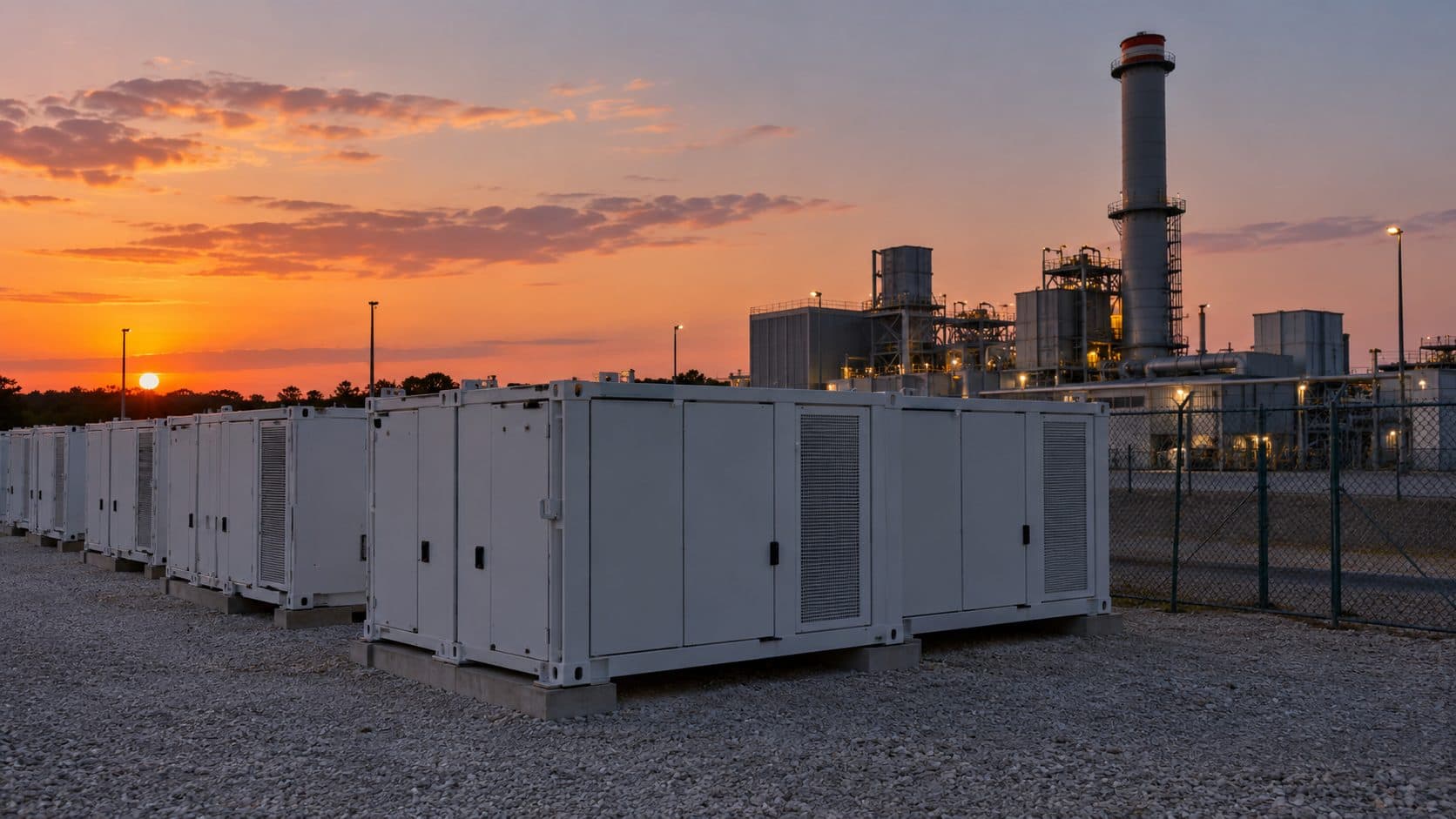
On October 8, Wood Mackenzie published the summary of its latest global reports on the levelized cost of electricity. The headline: four-hour battery storage is now less expensive than open-cycle gas turbines in all 43 markets where both technologies were modeled. In the same release, single-axis tracker solar is the lowest-cost new-build technology in 43 of 48 modeled markets, with onshore wind leading in the other five.
"This economic shift is decisive and widening," said Ahmed Jameel Abdullah, principal analyst at Wood Mackenzie. "Gas turbine shortages and rising fuel volatility are driving up peaking costs, while expanding battery manufacturing continues to push storage costs down."
I do not build power plants. I am the CTO of a LegalTech product built on Claude, and I ship iOS apps on the side. Everything I sell runs on compute that someone else powers. In July, Wood Mackenzie wrote that the biggest constraint facing AI infrastructure "is no longer demand for computing power", it is "access to reliable electricity." On October 4, I wrote about who pays for the wires when a data centre arrives. This is the other half of that bill: what it costs to cover the peak, and how fast that capacity can be built.
So I read past the headline. Here is what the release says, what it does not, and what I would check.
What a peaker is, and why a battery can replace one
A gas peaker is an open-cycle turbine built to run only when demand spikes. It sits idle most of the year. Lazard's 2026 cost study, published in July, models a new US peaker at a capacity factor of 10 to 15 percent: at best, it produces 15 percent of what it could if it ran all year. That is why its cost per megawatt-hour is high. Its fixed costs are spread over very few hours of output.
A four-hour battery does the same job differently. It charges when power is cheap and discharges at full power for four hours. Lazard models one cycle a day, 350 days a year. For an evening peak, that is enough. For a cold, windless week, it is not, and nothing in the Wood Mackenzie headline claims otherwise. Four hours is four hours.
The numbers in the release
The release gives a few regional figures, all of them modeled:
- Middle East and Africa: utility-scale solar at $37 per MWh. Four-hour storage at $120 per MWh in 2026, forecast to fall 33 percent to $80 by 2035. In this region, storage now displaces open-cycle gas turbines on cost "in every gas market."
- Asia Pacific: China's grid-scale storage benchmark is more than 55 percent below the rest-of-region average of $134 per MWh. My arithmetic: that puts China below about $60. Competitive Chinese supply is expected to pull the rest of the region down to $92 by 2036, with Japan, Australia and the Philippines staying at a premium because of import duties, installation costs and domestic manufacturing policies.
- Solar in Saudi Arabia and the UAE is on track to fall below $20 per MWh by 2033.
What the headline leaves out
Two passages in the body of the same release, and one absence, changed how I read the headline.
First, in Europe, batteries got more expensive. Battery storage turnkey capex rose about 2 percent, "the first increase in three years," as cell prices rebounded around 10 percent from their 2025 low on stronger demand and higher lithium prices. Wood Mackenzie forecasts a 12 percent fall by 2031, then a slower pace as lithium prices roughly double in 2029. Fixed-tilt solar capex in Europe rose 14 percent in 2026 on higher module costs. Batteries are the headline winner, and in Europe their capex went up in this update. So the comparison is not only about batteries. The other side moved too, which is what the analyst's quote says about turbine shortages and fuel.
Second, in North America, solar is getting dearer, and fastest for small buyers. Utility-scale module prices are expected to rise around 5 percent a year through 2030 under tariffs, duties and new Section 232 import restrictions. Residential and commercial projects face module price increases of 6 percent in 2027 and a further 14 percent in 2028. Tax credits still give storage an advantage. And investment in gas generation capacity is "entering a supply deficit cycle through the late 2030s, driven by data centre load growth," which keeps thermal capital costs elevated.
Third, the release gives no method. No gas price, no capacity factor for the peaker, no cost of capital. On subsidies, beyond that North America line on tax credits (and a cost spike expected once the investment tax credit phases out from 2038), it does not say whether the 43-market comparison counts them. The assumptions sit in the five regional reports it links to.
A second model that shows its working
Lazard's LCOE+ publishes its assumptions, so I put it next to the headline. It covers the US only, and it dates from July.
A new US gas peaker: $144 to $276 per MWh, with gas at $3.45 per MMBtu, a capital cost of $1,100 to $1,650 per kW and 24 months of construction. A 100 MW, four-hour standalone battery: $210 to $292 per MWh without subsidies, $148 to $209 with the investment tax credit. Lazard says storage costs rose in its 2026 study, "reversing last year's declines," after tariffs curtailed access to low-cost Chinese cells. It also notes "a sharp increase in announced new-build gas generation despite a 15-year high LCOE and historically long development lead times," with turbine supply constrained.
On those numbers, an unsubsidized US battery and a new peaker overlap. With the credit, the battery's whole range sits below the peaker's $210 average. Lazard finances storage and generation on different capital structures (20 percent debt for storage, 60 percent for generation) and warns that its analysis "is not a forecasting tool." So this is not a rebuttal of Wood Mackenzie. It is a reminder that "cheaper in all 43 markets" is the output of assumptions the press release does not show.
Why speed matters more than the last dollar
For data centres, the cost gap is half the story. The calendar is the other half.
On October 1, Wood Mackenzie wrote that projects bypassing the grid can be delivered in 24 to 48 months when equipment is already secured and voltage ride-through compliance confirmed, but that in-flight and early-stage projects "could face three-to-six-year equipment wait times." Virtual power plants can be delivered in 6 to 18 months, and data centre buyers are pursuing a 19 GW pipeline of them, led by the US. Its US Energy Storage Monitor, released September 23, counted a record 18.9 GWh of US storage installed in the second quarter of 2026, and on October 16 its storage team wrote that utility-scale storage offers speed to power to hyperscalers facing grid-connection delays.
A turbine delivered in 2030 does not power a cluster in 2027. Capacity that can be connected sooner shapes where compute shows up first.
What I would check
I buy compute by the token, not power by the megawatt-hour. The same reading still applies.
- Treat cost-of-electricity headlines as models, not quotes. Before repeating one, look for four inputs: storage duration, fuel price, cost of capital and subsidies. If the page does not give them, say so.
- Ask how a new cloud region is powered. Wood Mackenzie lists three ways data centre developers cope with slow grids: delay start-up, accept an unreliable grid connection "with operation affected", or build on-site generation as a bridge. If a provider's new region sits on the second option, that is a reliability term my own uptime inherits.
- Remember the duration. A four-hour battery covers the evening peak. For anything that must ride through a multi-day event, ask what runs after hour four.
- If you run a small business in France and an installer is quoting solar and a battery for your roof, these are not your prices: they are grid-scale models. The direction still helps. In Europe, solar capex rose 14 percent in 2026 and battery capex about 2 percent in this update, and Wood Mackenzie expects battery capex to fall 12 percent by 2031.
The battery did not win by getting cheaper everywhere: in Europe, its capex went up. It also won because the turbine on the other side got scarcer and its fuel harder to price. For anyone whose product runs on someone else's electricity, that second half is the one to watch.
Sources
- Wood Mackenzie, "Four-hour battery storage now beats gas peaking on cost globally" (October 8, 2026)
- Lazard, "Lazard's Levelized Cost of Energy+ (LCOE+)" (report dated July 2026, read October 19, 2026) and its report PDF
- Wood Mackenzie, "Speed to power: the infrastructure solutions shaping the global data centre race" (October 1, 2026)
- Wood Mackenzie, "6 key questions about US energy storage in 2026 answered" (October 16, 2026)
- Energy-Storage.news, "Data centre buildout uplifting US BESS market outlook, Wood Mackenzie says" (September 24, 2026, US Energy Storage Monitor released September 23)
- Wood Mackenzie, "Powering the data boom: answering nine key questions about powering AI data centres" (July 17, 2026)