
Ariane 64 Has Flown Three Times, All for Amazon. The Fourth Is Due No Earlier Than November 23.
On October 14, 2026, Arianespace announced the tenth flight of Ariane 6. Mission VA271, which Amazon calls LE-04, is scheduled for no earlier than November 23 from Europe's Spaceport in Kourou, French Guiana, with a final launch window to be set closer to the date. The plan is to carry 36 Amazon Leo internet satellites to low Earth orbit, about two hours and four minutes from liftoff to the last deployment. If it succeeds, Arianespace will have launched 136 Amazon Leo satellites.
The release ends with a box of statistics, and two of its lines, read together, are the story. VA271 will be the fourth flight of Ariane 64, the four-booster version of Ariane 6. It will also be Arianespace's fourth mission for Amazon Leo in 2026. The first three Ariane 64 flights all carried Amazon satellites. Europe's most powerful rocket, developed under ESA to guarantee the continent's autonomous access to space, is maturing on an American constellation.
I do not build rockets. I am the CTO of a LegalTech company built on Claude, which puts me on the buyer's side of capacity I do not control. So I read Arianespace's releases, the ESA and CNES pages on the new boosters, Amazon's own mission log, and the order from the US Federal Communications Commission that explains why Amazon needs launches so badly.
Four Ariane 64s, four Amazon missions
Ariane 6 first flew in July 2024. By February 2026, ESA counted five flights, all with two boosters (Ariane 62). Then:
- February 12, 2026: first Ariane 64, 32 Amazon Leo satellites. ESA says the four-booster version can take around 21.6 tonnes to low Earth orbit, more than double the 10.3 tonnes of Ariane 62.
- April 30: second Ariane 64, 32 more.
- June 17: third Ariane 64 and first flight of the P160C boosters, with 36 satellites, which Arianespace calls the heaviest payload ever launched by an Ariane.
- August 27: an Ariane 62 put EUMETSAT's MTG-I2 weather satellite into geostationary transfer orbit, Ariane 6's first mission to that orbit, per CNES.
- No earlier than November 23: fourth Ariane 64, 36 satellites, the second time with P160C boosters.
Three of Ariane 6's four flights in 2026 were for Amazon. If VA271 flies on schedule, that becomes four of five. On September 9, Amazon added six Ariane 64 launches to the order it signed in 2022, taking it from 18 to 24, with the new flights beginning in 2029 and missions through 2031.
What the P160C changes, and what it keeps
A solid booster is a casing packed with propellant in which fuel and oxidizer are already mixed; CNES compares its consistency to a pencil eraser. On Ariane 6, these boosters do most of the early work: CNES says they deliver 90% of the launcher's thrust off the pad.
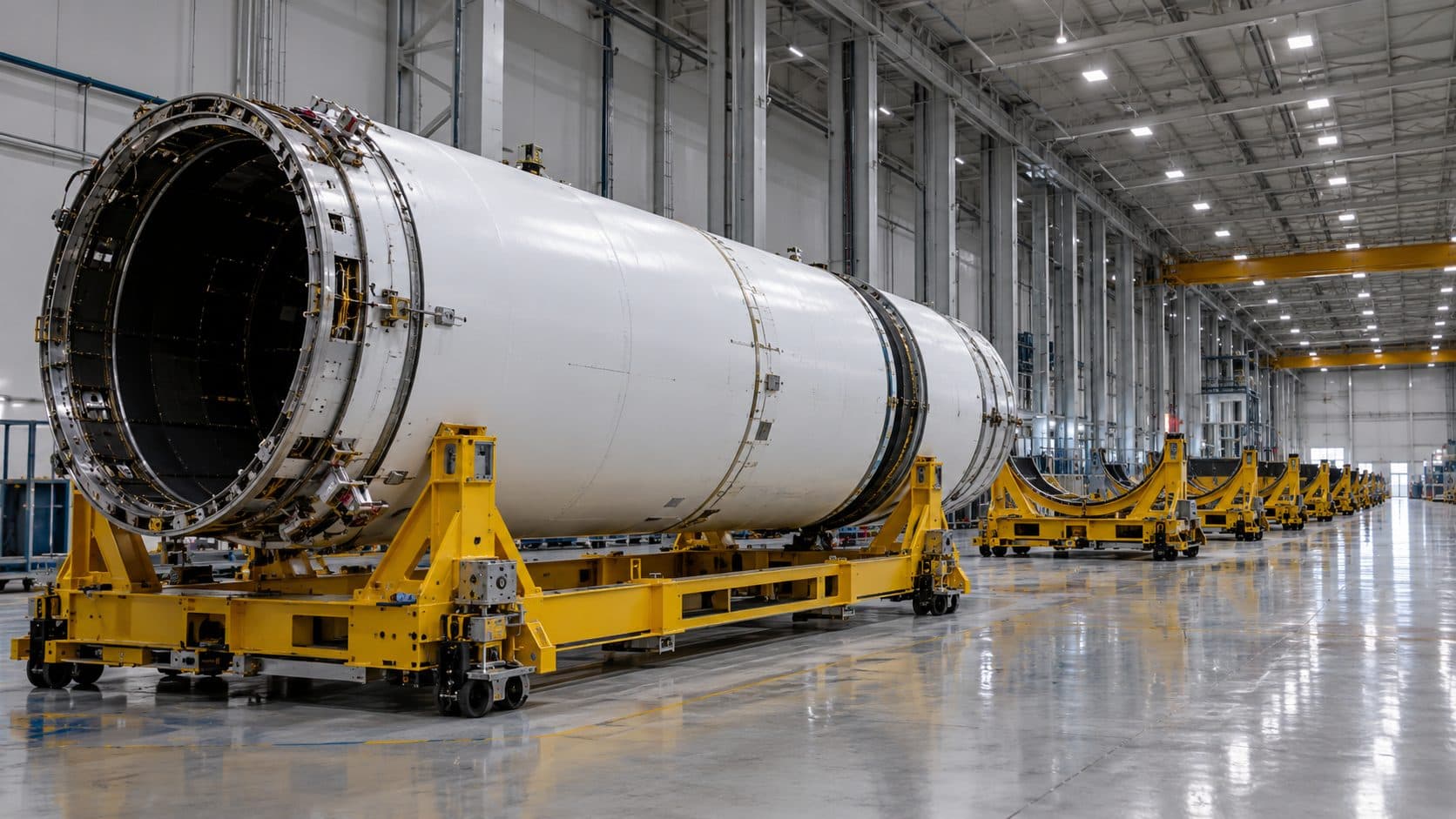
The P160C replaces the P120C that flew on Ariane 6's first missions. Arianespace says the change is inside: the booster's length and width are unchanged, while the motor within is one meter longer and holds up to 156 tonnes of propellant. CNES puts the gain at 14 extra tonnes and about 10% more performance "for the same cost". The "C" stands for Common: CNES says the same motor is planned as the first stage of the Vega C light launcher.
Before it flew, CNES fired a qualification model on its vertical booster test stand in Kourou on April 24, 2025: 2 minutes and 20 seconds, with some 600 pressure, temperature and deformation readings to compare against predictions. Its first flight was a paying mission.
The number engineers quote is about 10% more performance in low Earth orbit, or up to two metric tons more payload for Ariane 64, per Arianespace. The number Amazon quotes is "four additional satellites per launch". Going from 32 to 36 is 12.5% more satellites per flight. If the 21 flights left on the contract each carried 36 rather than 32, that would be 84 extra satellites: more than two extra launches' worth.
The customer needs the launcher just as much
Amazon's side of the story is in an FCC order dated June 5, 2026. Amazon Leo's first-generation license covers 3,232 satellites. The rules required half of them, 1,616, in orbit by July 30, 2026, and all of them by July 30, 2029. When Amazon asked for relief in January, it had launched 180 and expected about 700 by the July deadline. It argued, in the FCC's summary, that "launch provider delays and shortages of launch availability" had caused significant backlogs. The FCC did not move the date. It granted a waiver with conditions: satellites deployed after July 30, 2026 lose their processing-round priority, a rank that matters when sharing spectrum with other systems, for up to 20 months or until half the constellation is up, and it kept the rule that a missed 50% milestone costs Amazon its surety bond. The 2029 deadline stands.
Amazon's mission log, updated on October 14, lists 14 completed launches. Adding them up gives 396 satellites: 224 on ULA's Atlas V, 72 on SpaceX's Falcon 9 and 100 on Ariane 64, about a quarter. None flew on the two US rockets Amazon booked in bulk in 2022, ULA's Vulcan Centaur and Blue Origin's New Glenn. On September 9, Satellite Today noted that both were out of service. The log shows no launch since July 2, and one upcoming mission: LE-04.
The arithmetic shows why Amazon keeps buying launches. 3,232 minus 396 leaves 2,836 first-generation satellites to launch before July 30, 2029. At 36 per Ariane 64, that is about 79 launches. Even if all 21 remaining Ariane flights carried 36, Arianespace's total would reach 856, about a quarter of the first generation. "Europe's launch infrastructure is part of the operational architecture of the Amazon Leo constellation," said Chris Weber, Amazon Leo's vice president of business and product.
Cadence is the product
This mission's date has already moved once. According to European Spaceflight, a provisional CNES schedule had this mission no earlier than October 7. In September, ArianeGroup and Arianespace said the 2026 schedule had to be adjusted while "additional checks" were carried out within the Ariane 6 production line, without saying what they were. ESA said it was "aware of the delays" and declined to comment on the root cause. On October 13, the French newspaper La Tribune reported that ArianeGroup had resolved an anomaly on a liquid hydrogen turbopump, the high-speed pump that feeds propellant from the tanks to an engine. Asked by European Spaceflight, an ArianeGroup spokesperson declined to address the report directly and pointed to the new date. October 7 to November 23 is 47 days.
European Spaceflight reports that Arianespace had been expected to fly seven or eight Ariane 6 missions in 2026, and now likely six. The companies say the supply chain is on track for nine to ten launches a year "as early as 2027".
Amazon did not buy a rocket. It bought places on a production line, and checks on that line pushed the next place back by almost seven weeks.
What I take from it as someone who ships software
A launcher is not a software product, and a 24-launch order is not a subscription. But the shape of this deal is common.
- Name your anchor customer's share. Every Ariane 64 so far has been an Amazon mission, and so was the P160C's first flight. Amazon says Amazon Leo is Arianespace's largest single customer. That is fine when it is a known number on the roadmap, not a surprise.
- Measure upgrades in the customer's unit. "10% more performance" is the engineer's number. "Four more satellites per launch" is the one a buyer prices.
- Change the inside, keep the interfaces. The P160C kept the booster's outer length and width, and Arianespace says the launcher kept its overall architecture. As an analogy only, that is the hardware version of a backward-compatible release.
- Concentration runs both ways. Amazon booked several providers and still told its regulator that launch shortages slowed it down. Arianespace's CEO says Ariane 6's two ambitions, Europe's autonomous access to space and the international commercial market, "go hand in hand", and the October 14 release says these flights show it can serve constellations, "including future European constellations". Both claims hold only while the cadence holds.
- Publish dates as "no earlier than". Arianespace and Amazon both do.
What the documents do not show
None of these documents gives the contract's value. The cause of the delay is reported, not officially confirmed. Nothing says every remaining Amazon flight will carry 36 satellites. Payload figures depend on the target orbit, and the published numbers do not line up neatly: Arianespace says the P160C adds up to two metric tons to Ariane 64, Amazon says more than two. And November 23 is a target, not a launch.
Europe built Ariane 6 to guarantee its own access to space. In 2026, the customer that filled its most powerful version was American, and the next proof is a date that starts with "no earlier than".
Sources
- Arianespace, "Arianespace to launch 36 Amazon Leo satellites on November 23 at the earliest, for 10th Ariane 6 flight" (October 14, 2026)
- Arianespace, "Amazon Leo and Arianespace strengthen partnership with six additional Ariane 64 launches" (September 9, 2026)
- Arianespace, "Ariane 6 builds on commercial success at the International Space Summit with its largest order intake since entering service" (September 10, 2026)
- ArianeGroup, "Arianespace successfully launches 36 additional Amazon Leo satellites with an Ariane 64 equipped with advanced boosters" (June 17, 2026)
- ArianeGroup, "Arianespace successfully launches another 32 Amazon Leo satellites with Ariane 6" (April 30, 2026)
- ESA, "More power: first Ariane 6 with four boosters lifts off" (February 12, 2026)
- CNES, "8e mission commerciale d'Ariane 6 réussie" (August 27, 2026)
- CNES, "Everything you ever wanted to know about the P160C, Ariane 6 and Vega's future engine" (May 5, 2025)
- Amazon, "Amazon Leo mission updates: Nearly 400 satellites in orbit; next Ariane 6 launch date announced" (updated October 14, 2026)
- Amazon, "Amazon Leo's largest Arianespace launch yet will feature upgraded boosters to deploy more satellites" (June 5, 2026)
- FCC Space Bureau, "Kuiper Systems LLC, Application for Extension or Waiver of the Milestone Deadline, Order DA 26-553" (June 5, 2026)
- Satellite Today, "Amazon Leo Orders 6 More Ariane 64 Launches from Arianespace" (September 9, 2026)
- European Spaceflight, "Arianespace Targets 23 Nov Ariane 6 Return Following Reported Turbopump Fix" (October 15, 2026)
- European Spaceflight, "ESA Acknowledges Ariane 6 Delays Following Reports of Turbopump Issue" (updated September 21, 2026)