
The Tetris Effect: When a Game Rewires Your Brain
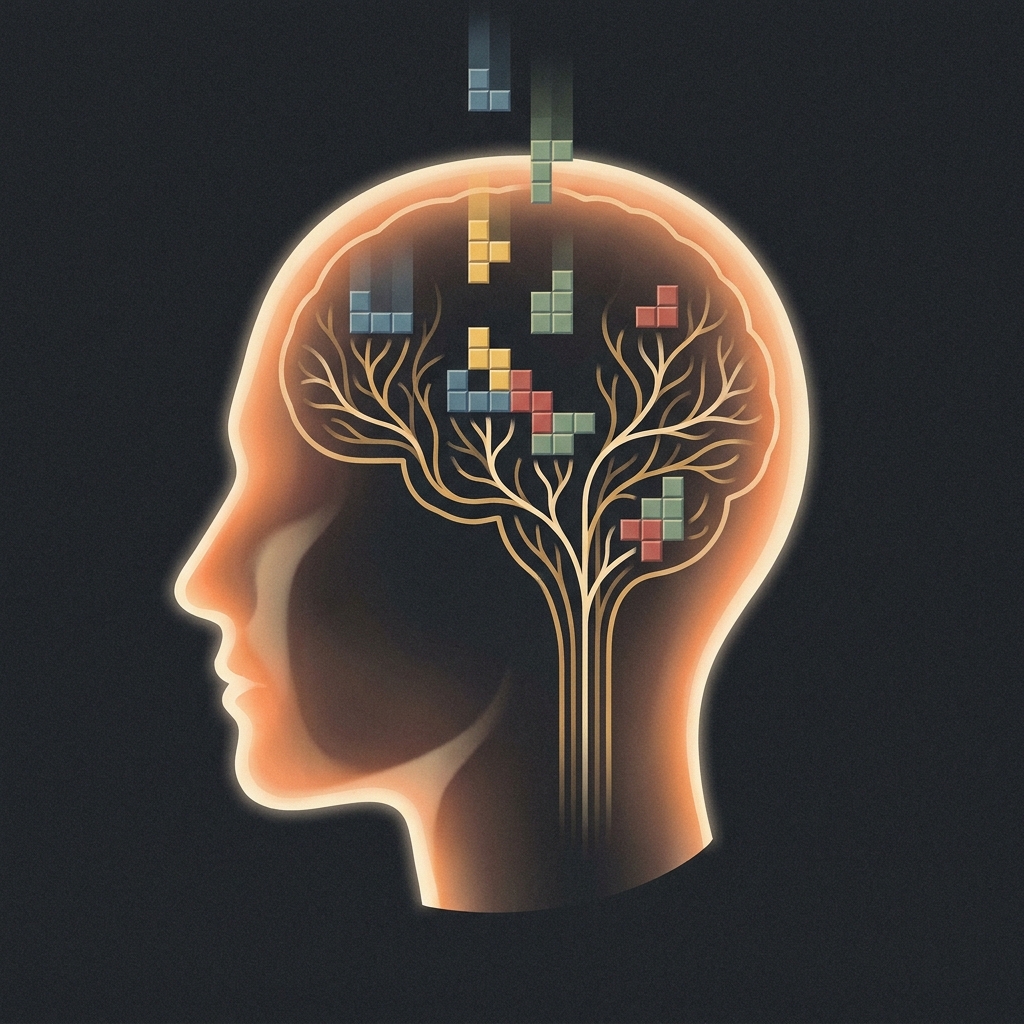
Play Tetris long enough and something strange starts to happen off-screen. You close your eyes to sleep and watercolor-bright blocks drift down behind your eyelids. You glance at a supermarket shelf and your brain quietly tries to slot the cereal boxes into a tidy row. You see a gap between two parked cars and think, almost involuntarily, an L-piece would clear that. The game has leaked out of the screen and into your perception. There's a name for this — the Tetris effect — and it turns out to be a doorway into how the brain learns, dreams, and even how it might be coaxed into protecting us from our worst memories.
When a game won't stay on the screen
The phrase was coined by journalist Jeffrey Goldsmith in a 1994 Wired article, "This Is Your Brain on Tetris," after he found himself mentally rotating buildings on his walk home. But it was British psychologist Mark Griffiths who gave the phenomenon a formal footing, folding it into a broader idea he called Game Transfer Phenomena — the way prolonged, immersive gameplay spills over into our thoughts, sensations, and dreams once the console is off.
It shows up in three recognizable flavors. There are the intrusive thoughts (catching yourself fitting real-world objects together). There are visual images, especially hypnagogic hallucinations — the half-dreaming flickers you get in the drift toward sleep, when tetrominoes tumble across the inside of your eyelids. And there are the dreams themselves, where the falling blocks happily set up shop. What makes Tetris such a reliable trigger is that it's relentless, visual, spatial, and just hard enough to demand your full attention — exactly the recipe the brain uses to decide something is worth rehearsing offline.
Three months that physically reshape the cortex
Here's where it stops being a curiosity and starts being neuroscience. In a study led by Richard Haier, 26 adolescent girls played Tetris for 30 minutes a day over three months, with brain scans before and after. Two things changed.
First, the cortex physically thickened in specific regions — most notably Brodmann area 6, a strip of frontal cortex involved in planning complex, coordinated movement, along with parts of the left temporal lobe. The act of repeatedly judging shapes and choosing where to drop them had, in a measurable sense, built more brain in the places doing the work.
Second — and this is the beautiful paradox — the brain got lazier in the best way. When you first play, Tetris lights up large swaths of cortex and burns a lot of glucose; the brain is throwing energy at an unfamiliar problem. But after several weeks of practice, even as players got dramatically better at the game, their brains spent less energy doing it. Glucose consumption dropped. The players who improved the most showed the biggest drops. That's the signature of neural efficiency: skill isn't just more activity, it's the brain learning to get more done with less fuel — laying down cleaner, cheaper circuitry for a task it now knows well.
Tetris versus the flashback
The most surprising chapter is medical. A traumatic memory tends to replay as an involuntary image — the flash of headlights, the moment of impact — and those visual flashbacks rely on the same visuospatial machinery the brain uses to, well, play Tetris. Researchers at Oxford and Sweden's Karolinska Institutet had a daring idea: what if you could give that machinery something else to chew on, soon after the trauma, before the memory hardens?
In an early proof-of-concept trial, car-crash survivors in an emergency department briefly recalled their accident and then played Tetris. Over the following week they had significantly fewer intrusive memories than those who didn't. The effect held up and scaled. In a later trial of 99 healthcare workers carrying traumatic memories from the COVID-19 pandemic, a Tetris-based intervention cut intrusive memories roughly tenfold after one month, and at six months around 70% were free of those flashbacks. The leading explanation is elegant: a flashback and a falling tetromino are competing for the same limited visual-spatial workspace. Fill that space with rotating blocks at the right moment and there's simply less room for the memory to burn itself in.
The kicker
So the same quirk that makes you see falling blocks behind your eyelids is, underneath, the brain doing one of its favorite tricks — taking a vivid, demanding pattern and replaying it offline to make sense of it. Usually that just means you dream in tetrominoes. But aimed deliberately, that very mechanism can be turned around and used against trauma, crowding out a flashback with a falling block. It's a rare thing: a 1984 puzzle game, dreamed up by a Soviet computer scientist named Alexey Pajitnov, that turned out to be a quiet little key to how memory is made — and, sometimes, how it can be gently unmade.