
Tardigrades: surviving the vacuum of space by turning into glass
There is an animal you could boil, freeze to a hair above absolute zero, blast with a lethal dose of radiation, and fling naked into the vacuum of space — and it would shrug, wait, and walk away. It is roughly half a millimetre long, has eight stubby legs and claws like a tiny bear, and it lives in the moss on your roof, in Antarctic lakes, on Himalayan peaks. We call it the tardigrade, or the water bear. And its survival trick is not armour or super-healing. It is, of all things, turning itself into glass.
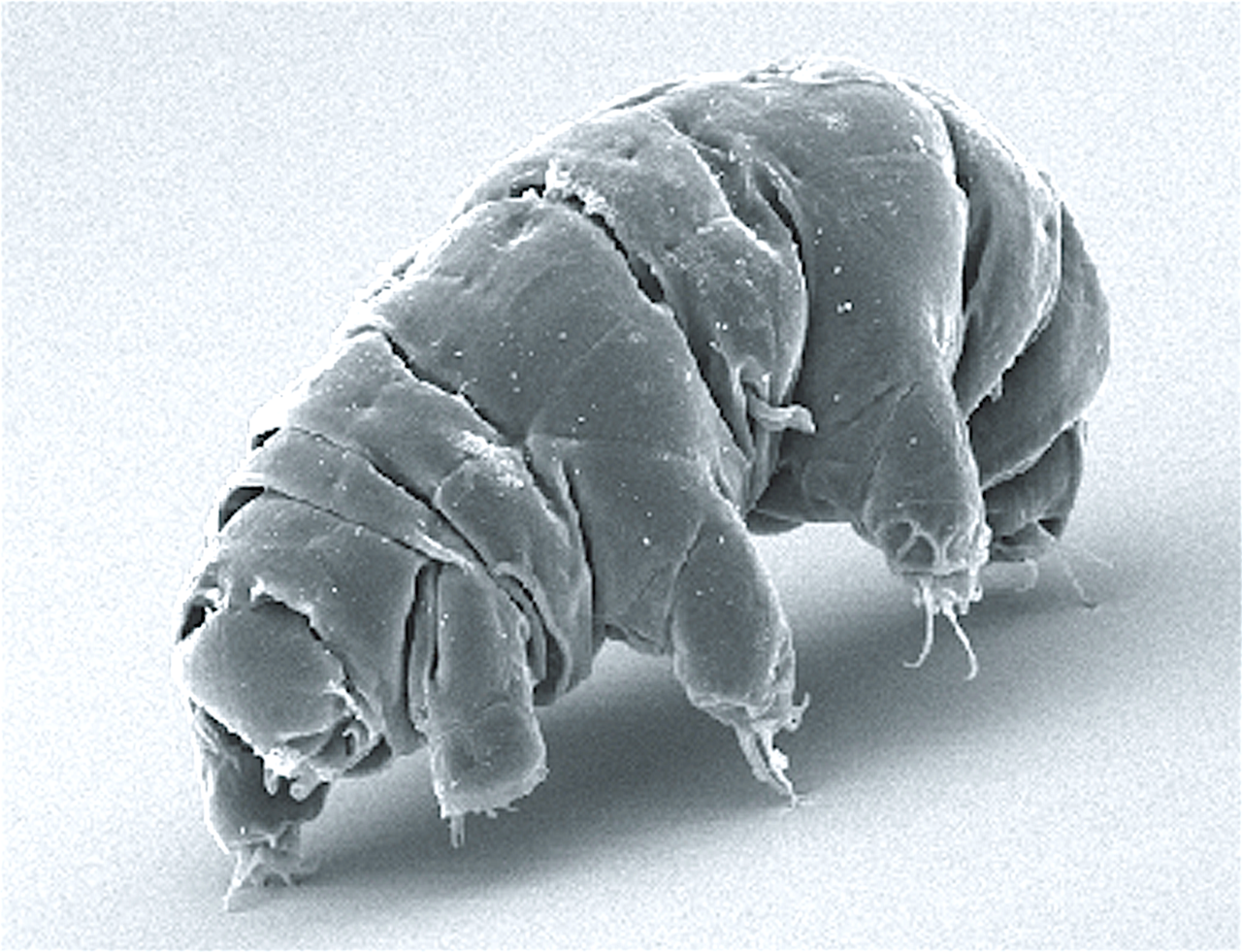
Becoming a tun
When a tardigrade's world dries out, it doesn't fight it. It surrenders, beautifully. It pulls in its legs, curls into a tight barrel-shaped ball, and expels almost all of its body water — somewhere around 97% of it. This shrivelled little husk is called a "tun," after the old word for a large wine cask, which is exactly what it looks like under a microscope: a plump, sealed barrel where a plump, walking animal used to be.
In this state, metabolism doesn't just slow down. It effectively stops. The chemistry of being alive — burning fuel, repairing damage, dividing cells — flatlines. The tardigrade is not dead, but it is not measurably alive either. It is paused. This dormancy is called cryptobiosis, "hidden life," and a tun can hold the pause for years, even decades, waiting for a single thing to happen: the return of water.
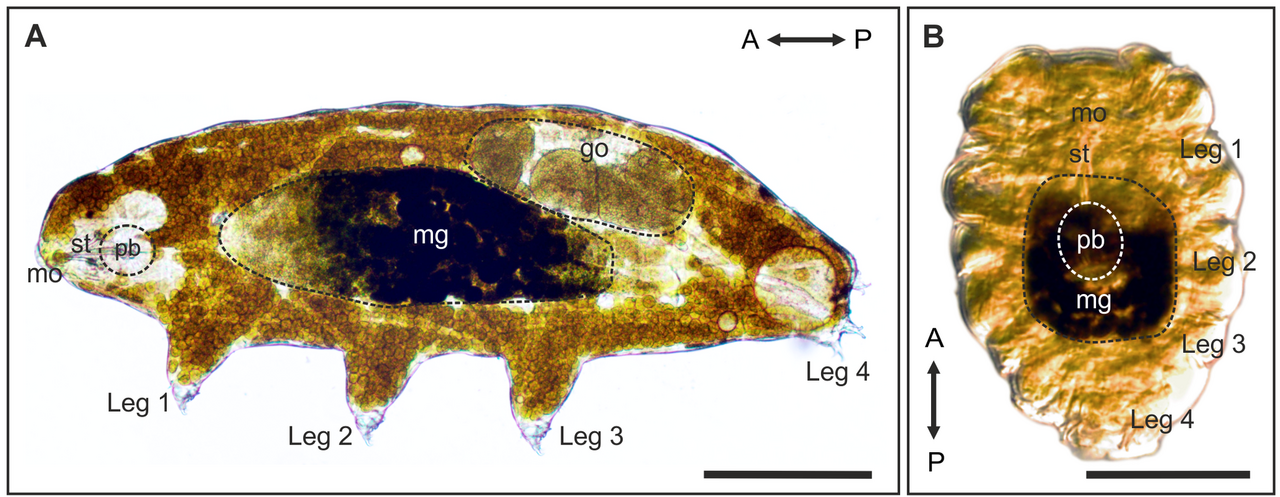
The glass that keeps you alive
Here is the part that turns a curiosity into a marvel. Losing your water should be a death sentence. Cells are crowded with delicate molecular machinery, and water is the scaffolding that holds it in working order. Take the water away and proteins unfold, clump together, and shatter; the whole architecture collapses.
Tardigrades cheat by replacing the water with glass. As they dry, they flood their cells with special proteins — intrinsically disordered proteins, floppy molecules with no fixed shape — and as the last moisture leaves, these proteins set into an amorphous, glassy solid. Not crystals, which would slice cells apart with sharp edges, but a smooth, structureless solid, the same kind of state as a windowpane. Scientists call this vitrification. The biological glass fills every gap, freezes each molecule in place, and holds the entire cell in suspended animation like an insect trapped in amber. Nothing can drift, denature, or break, because nothing can move at all. When water comes back, the glass dissolves, the machinery clicks back into motion, and the bear walks on.
Built for places that don't exist on Earth
Locked in glass, a tardigrade becomes almost absurdly durable. In the tun state it has been brought down to about −272°C — a fraction of a degree above absolute zero, colder than deep space — and heated past 150°C, and lived. It has survived pressures six times greater than the bottom of the Mariana Trench. And it shrugs off radiation doses that would kill a human hundreds of times over.
That radiation resistance has its own dedicated bodyguard. In 2016, Japanese researchers discovered a protein found in no other animal, which they named Dsup — short for "Damage suppressor." Dsup wraps around the tardigrade's DNA like a physical shield, blunting the molecular shrapnel that radiation throws off. The discovery was striking enough that when scientists spliced the Dsup gene into human cells in a lab dish, those cells took roughly half as much DNA damage from X-rays as normal ones.
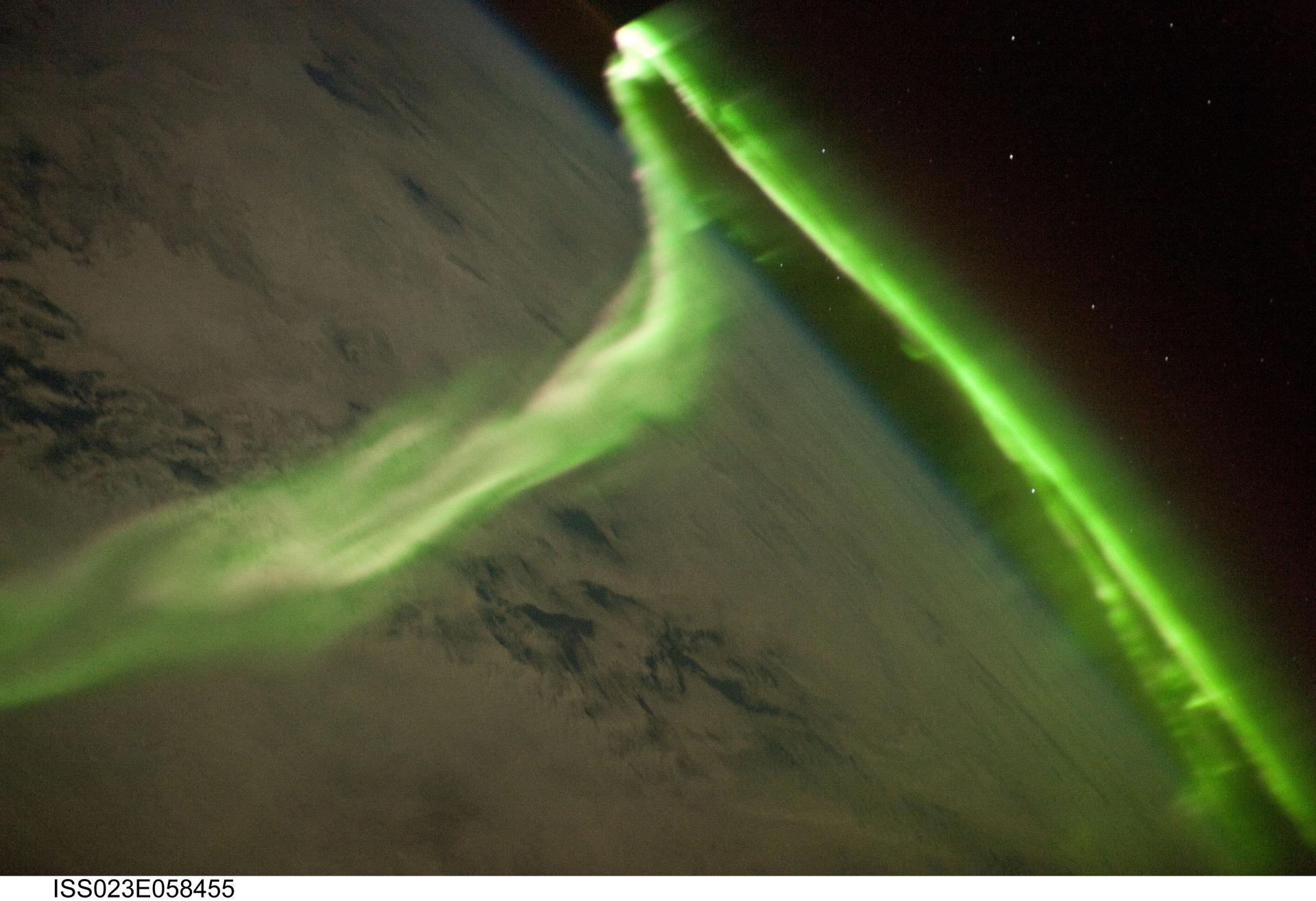
Ten days in the void
All of this raised an irresistible question, so in September 2007 the European Space Agency simply opened the door. On the FOTON-M3 mission, around 3,000 dried tardigrades were bolted to the outside of the spacecraft and exposed directly to open space — full vacuum, the cold, cosmic radiation, and for some, the raw ultraviolet glare of the unfiltered Sun — for ten days in low Earth orbit.
When the capsule came home and the survivors were given a drop of water, they rehydrated, uncurled, started walking, ate, and laid eggs that hatched into healthy young. It was the first time any animal had been shown to survive direct exposure to the vacuum of space and live to reproduce. The tardigrades that had only faced vacuum and cosmic rays came through in large numbers; even the ones hit by full solar UV had survivors.
So the next time you scrape a bit of damp moss off a wall, remember what might be hiding in it: a creature engineered, by nothing but evolution, to outlast the death of almost everything. We have spent billions designing machines to endure space. The water bear got there first, by learning how to disappear into glass and wait.