Polybius: The Arcade Machine That Drove Players Mad — and Never Existed
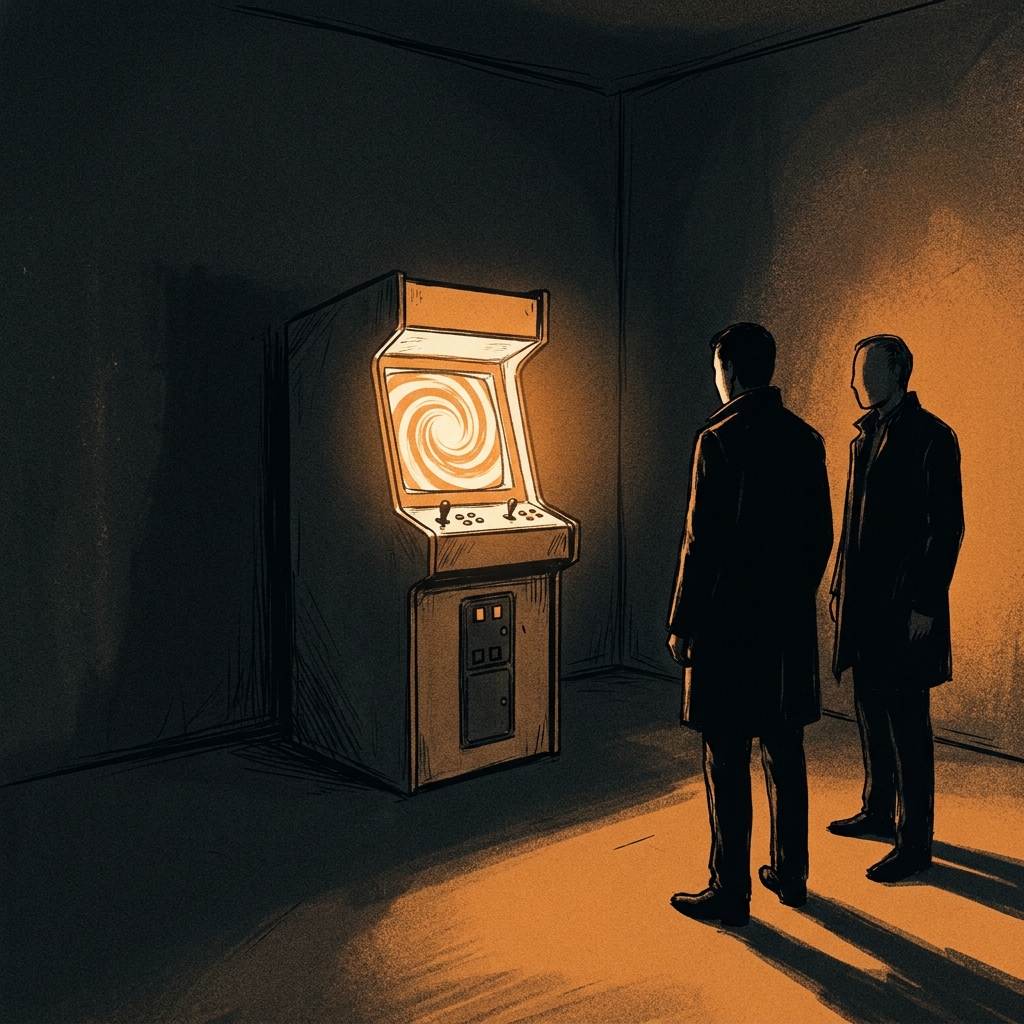
Picture a strip-mall arcade in Portland, Oregon, sometime in 1981. Among the rows of Pac-Man and Asteroids sits a black cabinet you've never seen before, marked only with one strange word: Polybius. Kids line up for it. They play, and then something goes wrong — nightmares, blackouts, amnesia, even seizures. Men in black suits show up at odd hours, fiddle with the machine, copy down readings, and leave the coins inside. Then, one day, every cabinet vanishes without a trace. It's one of gaming's most enduring ghost stories. There's just one problem: as far as anyone can prove, Polybius never existed at all.
A legend with no paper trail
Here's the strange thing about a story set firmly in 1981: nobody wrote it down at the time. Not one newspaper, not one gaming magazine, not one arcade flyer from the actual era mentions a game called Polybius. For an event supposedly involving collapsing children and government agents, that silence is deafening.
The earliest known printed reference doesn't appear until the September 2003 issue of GamePro magazine, in a feature on gaming myths called "Secrets and Lies," which rated the game's existence as "inconclusive." Online, the trail goes back a little further: a listing on the vintage-arcade site CoinOp.org, dated February 6, 2000, with a modest note attached — "New addition — anyone heard of this game?" In other words, the oldest record we have of Polybius isn't a report of the game. It's someone asking whether anyone else remembers it. The legend was born already wondering about itself.
The name that gives it away
If you want a tell that a story grew on the internet rather than on an arcade floor, look at the alleged manufacturer: Sinneslöschen. It's meant to read as ominous, foreign, official — the kind of shadowy German tech firm a conspiracy needs. But native speakers wince at it. Skeptic and researcher Brian Dunning called it "not-quite-idiomatic German," a clumsy stab at "sense delete" or "sensory erasure." A fluent speaker would more naturally write Sinnlöschen. It's the linguistic equivalent of a movie prop — convincing from across the room, obviously fake up close.
The rest of the lore has the same homemade-mythology feel: psychoactive geometric visuals that rewrite your brain, a government experiment in subliminal control, the men in black who harvest data but leave the quarters. Every beat is borrowed from Cold War paranoia and 1980s "video games will rot your mind" panic, stitched into a single irresistible package.

A seed of truth
What makes Polybius so sticky is that it isn't pure invention. It grew around a few real, well-documented, and entirely mundane incidents from Portland arcades in 1981 — the kind of thing that actually made the local papers.
On one day that year, two young players genuinely fell ill. A teenager named Michael Lopez developed a crushing migraine after a session on Tempest — a famously dizzying vector shooter — and blacked out, reportedly collapsing in a stranger's yard. Around the same time, another kid pushed himself through a marathon attempt at Asteroids, playing for 28 hours straight to chase a world record, and ended up doubled over with stomach pain (which he blamed, charmingly, on too much Coca-Cola). Real headaches, real nausea, real exhaustion — but caused by flashing screens, sleep deprivation, and soda, not mind-control rays.
Mix those true reports with the genuine FBI raids that hit some early-80s arcades (chasing illegal gambling and bootleg boards, not psychic weapons), and you have all the raw ingredients. The internet just did what it does best: it connected the dots into a shape far more thrilling than any of the dots deserved.
Why it refuses to die
No cabinet has ever turned up. No ROM image of the game's code has ever surfaced — and in a hobby of obsessive collectors who have dumped and preserved thousands of obscure arcade boards, the total absence of even a single byte of "Polybius" is itself the verdict. Every "Polybius" you can play today is a loving fan-made tribute, including a slick official one built by Llamasoft's Jeff Minter in 2017.
And yet the legend thrives, precisely because it can't be disproven the way a real game could be. It taps something true about that era's anxieties — and something true about us. We want the arcade to have a haunted machine. So the myth keeps glowing in the dark corner of gaming history, a cabinet nobody can find, running a game nobody can play, drawing a crowd that never stops lining up.