
The "fire rainbow" is neither fire nor rainbow
Someone points at the sky and gasps: a flat smear of rainbow has caught fire across the clouds, glowing like a slab of stained glass that someone left out in the sun. "A fire rainbow!" they say. It is one of the most beautiful lies in all of meteorology. There is no fire. There is no rainbow. What you are looking at is sunlight walking through a city of microscopic glass plates, six-sided and floating, five kilometres over your head — and the angle of that walk is so fussy that most people go their whole lives without seeing it.
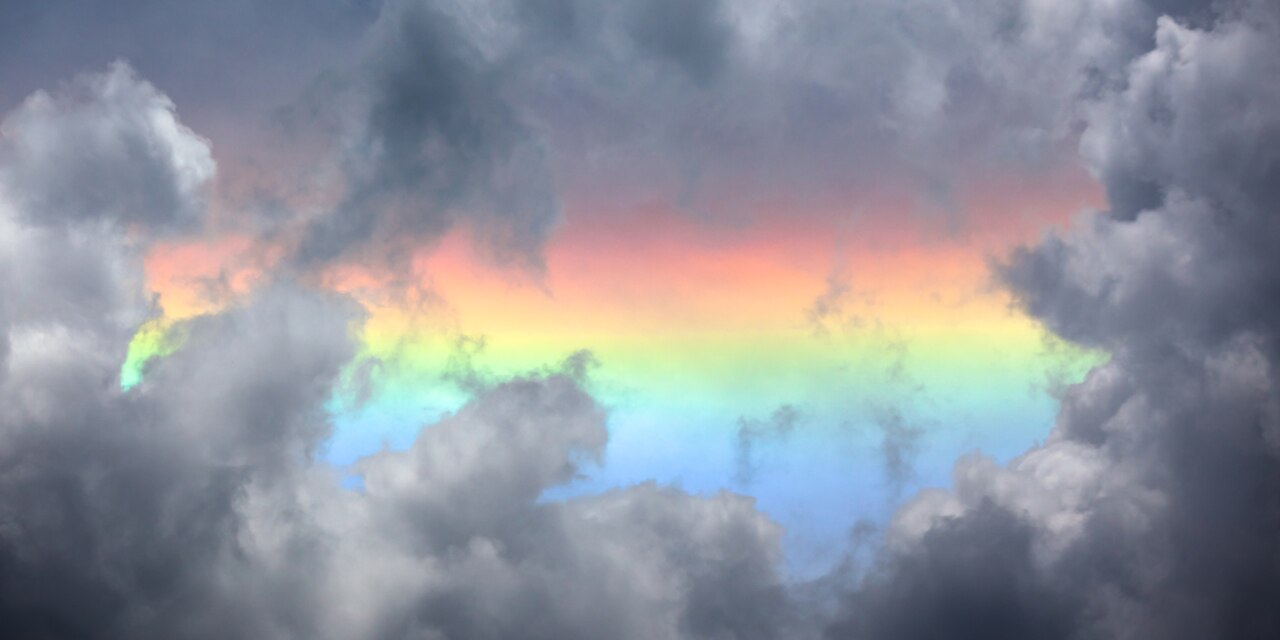
Neither fire nor rainbow
A real rainbow is made of raindrops — round little lenses that bend and bounce sunlight back at you in an arc centred on the shadow of your own head. This thing is different in every way. It is made of ice, not water. It runs in a long straight band parallel to the horizon, not a bow. And it sits far below the Sun, not opposite it.
The proper name is circumhorizontal arc, and it belongs to a big, strange family called ice halos — the same family as sun dogs and the bright ring you sometimes see around the Moon. The "fire rainbow" nickname is pure marketing. Atmospheric scientists tend to wince at it, because it gets two facts wrong in two words. But it stuck, because honestly, look at it.
The secret is flat, floating glass
High up where the air is around -30°C live the cirrus clouds — thin, wispy, the ones that look brushed on. They're not made of water droplets but of ice crystals, and some of those crystals grow as tiny hexagonal plates, like microscopic six-sided coffee tables. As they drift down, air resistance does something elegant: it makes them fall flat, broad face down, the way a leaf or a dropped sheet of paper settles. Millions of them, all lying horizontal, become a loose airborne sheet of glass.
Now sunlight arrives. For a circumhorizontal arc, a ray enters through a vertical side of a plate and leaves through the flat bottom. Those two faces meet at a 90-degree angle — the crystal behaves like a perfect glass prism — and a 90-degree prism splits white light into colours so cleanly that the bands barely overlap. That's why the arc is so saturated, so unapologetically loud. Red rides on top, violet underneath, every time.
Why you almost never catch it
Here's the cruel part. That tidy little light-path only works if the Sun is higher than 58 degrees above the horizon. Below that, the geometry collapses and the arc simply doesn't form. Fifty-eight degrees is high — near the top of the sky. From London (51.5°N) or Berlin (52.5°N) the Sun barely scrapes that height, so a true circumhorizontal arc is rare there — possible, but only for a short window near midsummer noon. Push further north, past about 55°N — Edinburgh, Copenhagen, Moscow — and the Sun never climbs that high at all, so the arc simply can't form. You'd have to travel south.
Even where it can appear, you need cirrus clouds present, the crystals well-behaved, and the Sun near midday in the warmer months. Miss the window by an hour and the show is gone. It's the meteorological equivalent of a planetary alignment that only happens at lunch.
Its quieter, upside-down cousin
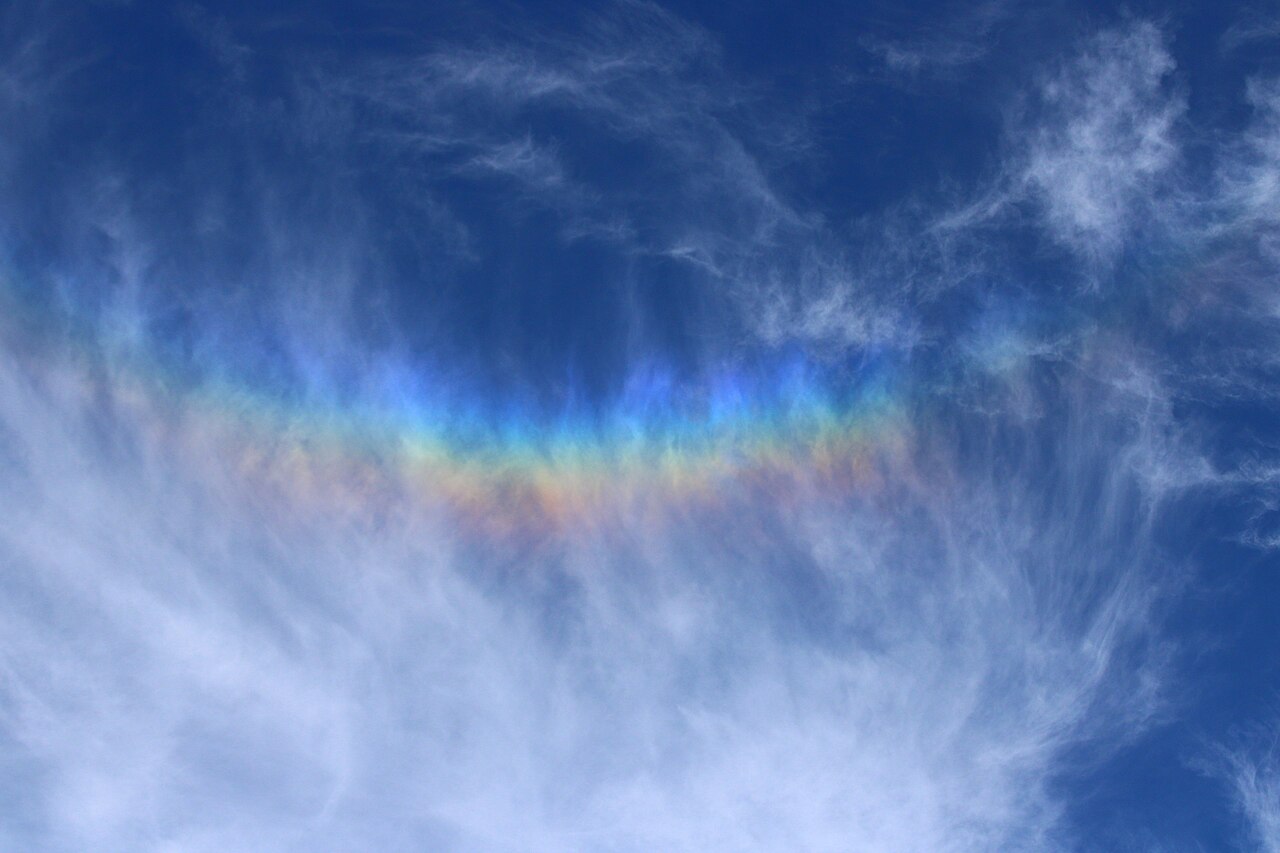
Now flip the whole thing over. Catch the same hexagonal plates when the Sun is low instead — below about 32 degrees, brightest around 22 — and a ray will enter through the flat top of the crystal and leave through a side. The result is the circumzenithal arc: the famous "upside-down rainbow," a brilliant smile of colour curving high overhead, roughly 46 degrees above the Sun, this time with violet on top and red on the bottom — the reverse of its fiery cousin.
Atmospheric scientists nicknamed it the "queen of halos," and its colours are even purer than a rainbow's, because the bands overlap less. Two arcs, opposite seasons of the day, born from the exact same crystals — the only thing that changes is whether the Sun is high or low, and therefore which door the light chooses to enter.
The kicker
So the next time someone shows you a "fire rainbow," you get to ruin it gently. It isn't fire, isn't a rainbow, and isn't even rare in the way people think — the ice is up there constantly. What's rare is you, standing in the one place on Earth, at the one hour of the one season, where the Sun is steep enough and the crystals are lying flat enough to send that particular colour straight into your eye. The light show was always running. You just had to be standing in the beam.