
I Took Twenty Famous Fortunes Apart to Write a Book. The Word Luck Survived None of Them.
Every time I ship something that works, someone tells me I got lucky.
Not maliciously. It's just what people say. The app got featured, lucky. The client came back, good timing. The book sold, good niche. I say it about other people too, and I eventually noticed exactly when I say it: when I can't name what they actually did. "Luck" is the word you reach for when the competence in front of you is a competence you don't have yet.
So I did something a bit obsessive. I took twenty of the most repeated success stories in business, the ones everyone knows a one-line version of, and pulled out the underlying record. Court filings where they existed. The founders' own accounts, labeled as such: their version, not the record. Dates, numbers, who actually did what. Then, for each story, I wrote down the one thing that was competence and not chance.
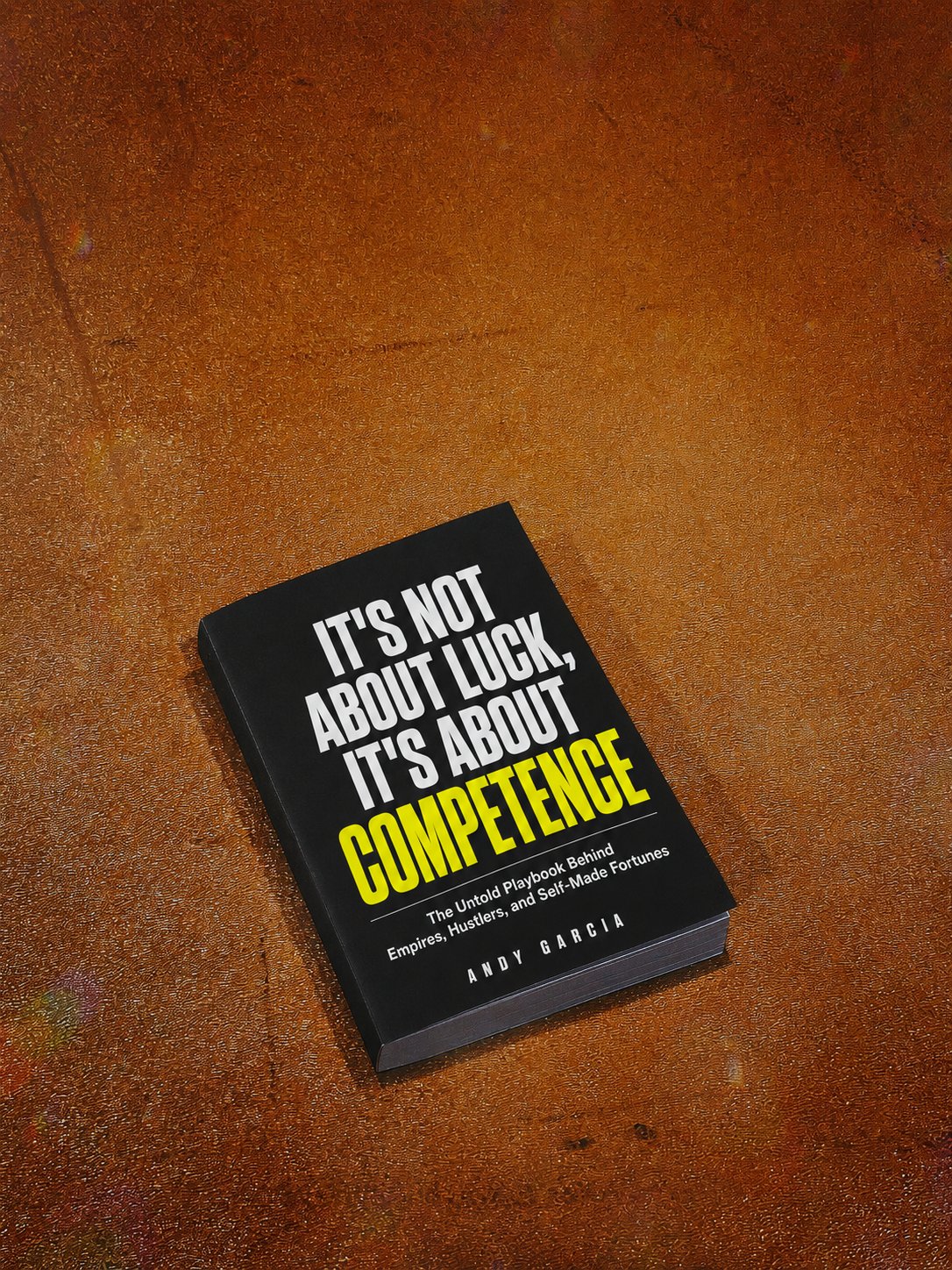
The result is a short book: It's Not About Luck, It's About Competence. Here's what I found in it, and how it was made.
The Stories Were Wrong About the One Fact That Matters
Not wrong in the details. Wrong at the center.
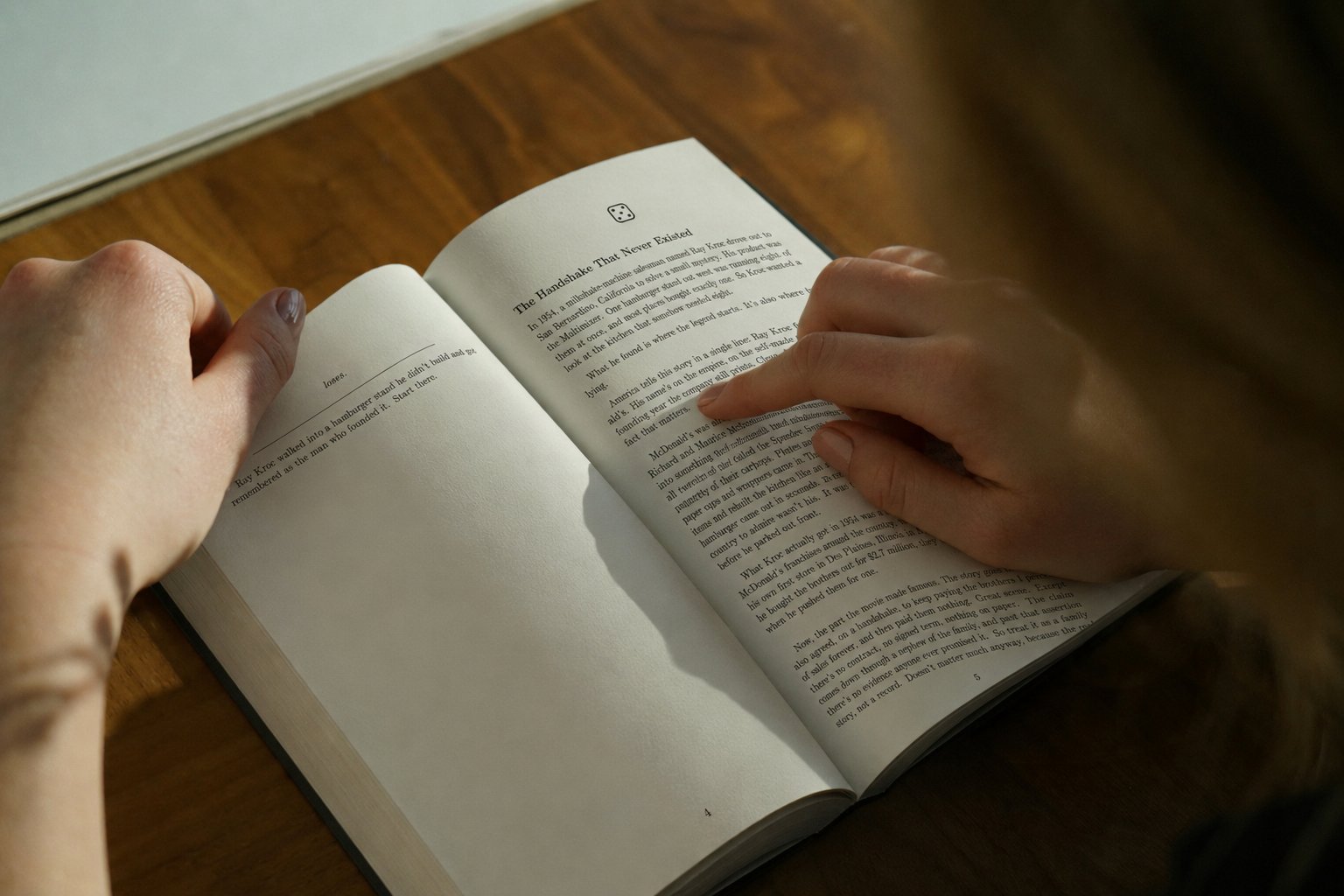
McDonald's. America tells it in one sentence: Ray Kroc founded McDonald's. Except the restaurant was already called McDonald's when Kroc pulled up in 1954. Richard and Maurice McDonald had already rebuilt their kitchen in 1948 into an assembly line: nine products, paper wrapping, a fifteen-cent hamburger in seconds. Kroc got a license to franchise it. What actually made the company take off arrived two years later with Harry Sonneborn, who set up a real estate company to buy the land and lease it to franchisees. McDonald's became the landlord. The burger was just how the tenant paid the rent. And it was the lease, not the brand, that let headquarters enforce standards: drop your quality, and you don't get a polite letter, you lose the location.
Standard Oil. The known version is the ruthless monopolist. The version from the account books is a former bookkeeper who tracked his costs down to the hundredth of a cent, so that when the 1872 crisis hit Cleveland, he knew what every barrel cost and his rivals didn't. He absorbed 22 of the city's 26 refineries in about six weeks. The 1911 breakup is the legal verdict on how he used that advantage. It says nothing about how he built it.
A hot sauce. Huy Fong Foods has never bought a single ad. Not one. The company was already making an estimated $12 million a year in 2001, a decade before the first hashtag, and more than $150 million in 2022. David Tran, who arrived as a refugee in 1979 and started out of a van in 1980, says he refuses to advertise because it would widen the gap between what people want and what he can actually produce. Demand he can't fill, he treats as a factory problem to solve, not a trophy to display.
The pattern repeats across twenty chapters: the popular story compresses two or three distinct competences into a single lucky person, and it's in that compression that the word "luck" moves in.
The Failures Taught Me More Than the Successes
Charlie Munger borrowed a rule from the mathematician Carl Jacobi: invert. Don't just study the ones who won. Study the ones who tried the same thing and lost, and check what the winner quietly sidestepped.
So a third of the book is wreckage, and it was the most useful third to write.
The Segway had every validator you could ask for. Steve Jobs reportedly said it could be as big as the PC. John Doerr called it bigger than the internet. About 140,000 units sold in nineteen years. Elite enthusiasm is not willingness to pay, and the gap between the two becomes the story people remember.
Three lottery winners. Jack Whittaker and his $314.9 million, Abraham Shakespeare and his $30 million, and Evelyn Adams, a two-time winner for $5.4 million. Broke, murdered, broke. Most winners don't end up like that, and the book says so plainly: these are documented, atypical cases, not a curse. What they have in common is that the money arrived and no structure was waiting for it. A jackpot is not a system.
Theranos ran on a demo that nobody outside the company could verify, in front of a board with no practicing scientist on it. Eventually, someone with subpoena power verified it for them.
The Honesty Clause
This is the clause that most self-help books leave out, and I put it in the introduction so nobody could miss it.
Luck exists. Nassim Taleb distinguishes "mild" domains, where outcomes track competence, from "wild" domains, where a handful of extreme outcomes take almost everything. Michael Mauboussin, in The Success Equation, adds the twist that stings: the better everyone gets at a domain, the more the last gap at the top comes down to variance, because competence stops separating people once everyone has it.

So competence doesn't guarantee the outcome. It moves the floor. And the floor is where almost everyone quietly loses. The median independent maker, across every self-reported survey of that world I could find, brings in less than $1,000 a month. Not from bad luck. Because they never built what makes an attempt survivable when the coin lands on the wrong side.
The whole argument fits in two lines. Luck decides the ceiling of any given attempt. Competence is what you do at the floor.
How the Book Was Made
This is a developer's blog, so here's the part the book's readers will never see.
The research. Three waves of agents running in parallel: one on the English-language KDP market for business self-help, one that sifted through about a hundred candidate stories, tagging each one with the line between what's documented and what's self-reported, one that dug into the twenty that made the cut. Every story arrives with its sources and its "myth flag": Kroc's handshake deal comes from a family nephew, not a contract; the Beatles' famous 10,000 hours in Hamburg are actually about 1,100 hours of stage time according to Mark Lewisohn.
The writing. Written with AI in the loop, directed end to end: the thesis, which stories to use, the voice, every lesson, every cut. The first complete draft sounded exactly like what it was, generated text, and that shows up most clearly on a reread. I ran a humanizing pass on a test chapter, three voice variants judged blind, then applied the winner to the other nineteen. Then an independent fact-checking pass: twelve corrections, including two dates and a revenue figure attributed to the wrong fiscal year.
The layout. A reader showed me a page from Rich Dad Poor Dad and told me my EPUB looked like a solid block. He was right. I added a code-drawn chapter emblem, a five-pip die in outline, each chapter's lesson set as an italic call-out bordered with rules, centered headings, and a page break per chapter. Production chain: Markdown, pandoc for the EPUB, pandoc plus XeLaTeX for the paperback interior at 6 by 9 inches, 80 pages, and full wraparound covers generated in Python, with the spine width computed from page count and paper weight.
The publishing. Ebook, paperback, and hardcover all submitted to KDP in one evening, forms filled in by script except for the category cascade, which React refuses to let anything else drive. And a lesson learned the hard way the next day: my quality check was reading the fields, not the rendered output. Two bracketed placeholder notes left at the end of the book, a link to add and a bio to personalize, went out as-is in all three files. Fixed, rebuilt, waiting on re-upload. You check the deliverable in your hands, never the source file.
Why It Ends With a Challenge, Not a Conclusion
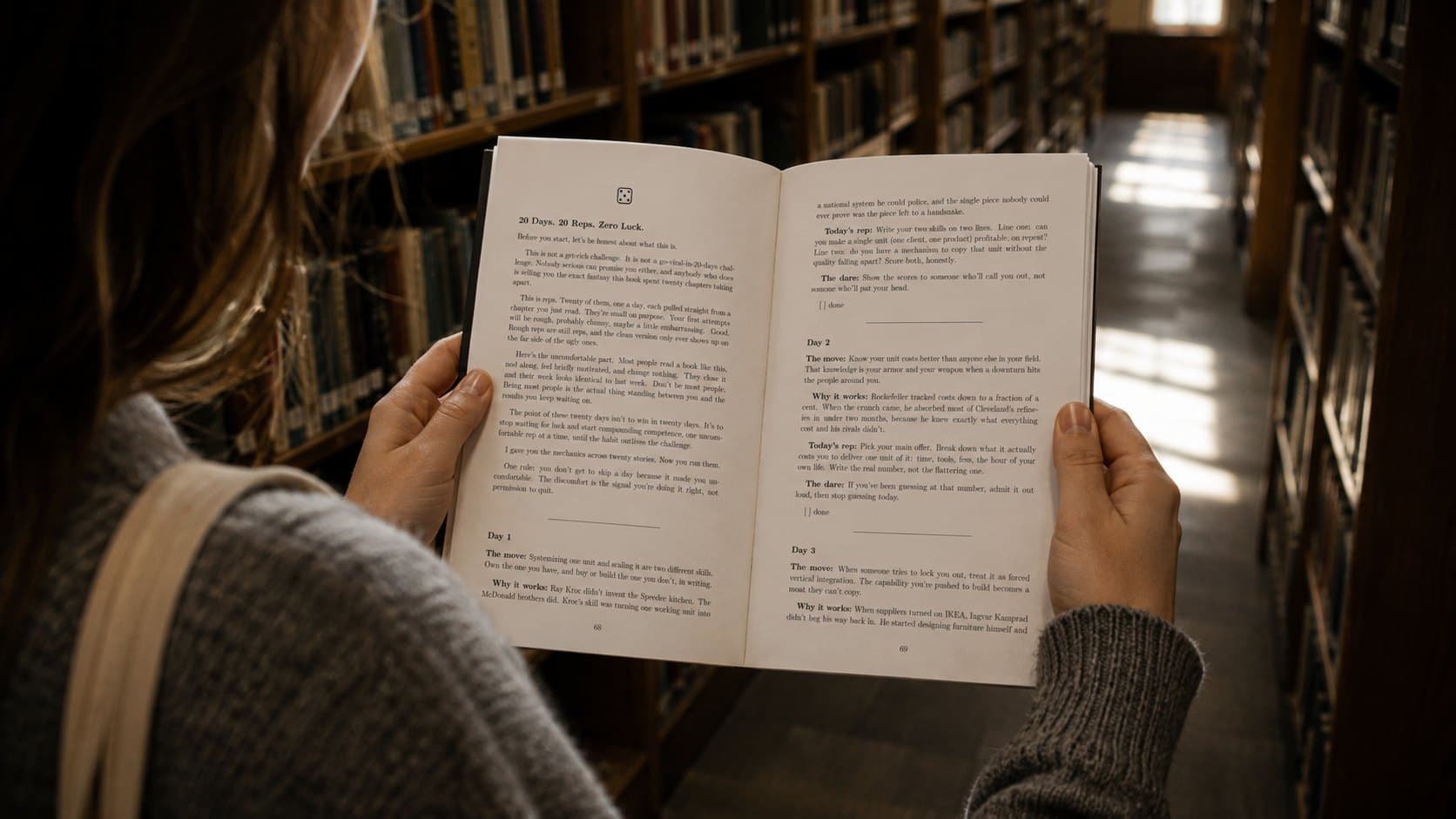
I've read a lot of these books. I finished most of them nodding along, and changed nothing. So the last part of mine isn't a summary. It's twenty days, one drill a day, each one pulled from a story. Day 1: write down your two competences on two lines, the unit and the system, and rate both honestly. Day 9: find the moment your product gets used in front of other people, and think about nothing else.
The one-page tracker is free here, no sign-up required. The book is on Amazon as an ebook, paperback, and hardcover, about two hours of reading.
If you only remember one thing, remember the McDonald's lease. Find your version of it. The single point of control that turns "please" into "or else." That's the part nobody calls luck anymore, once they've seen it.