
Roman's Main Camera Came In at 63 nm Against a 90 nm Requirement. A Mirror Moved 1/16 of a Hair.
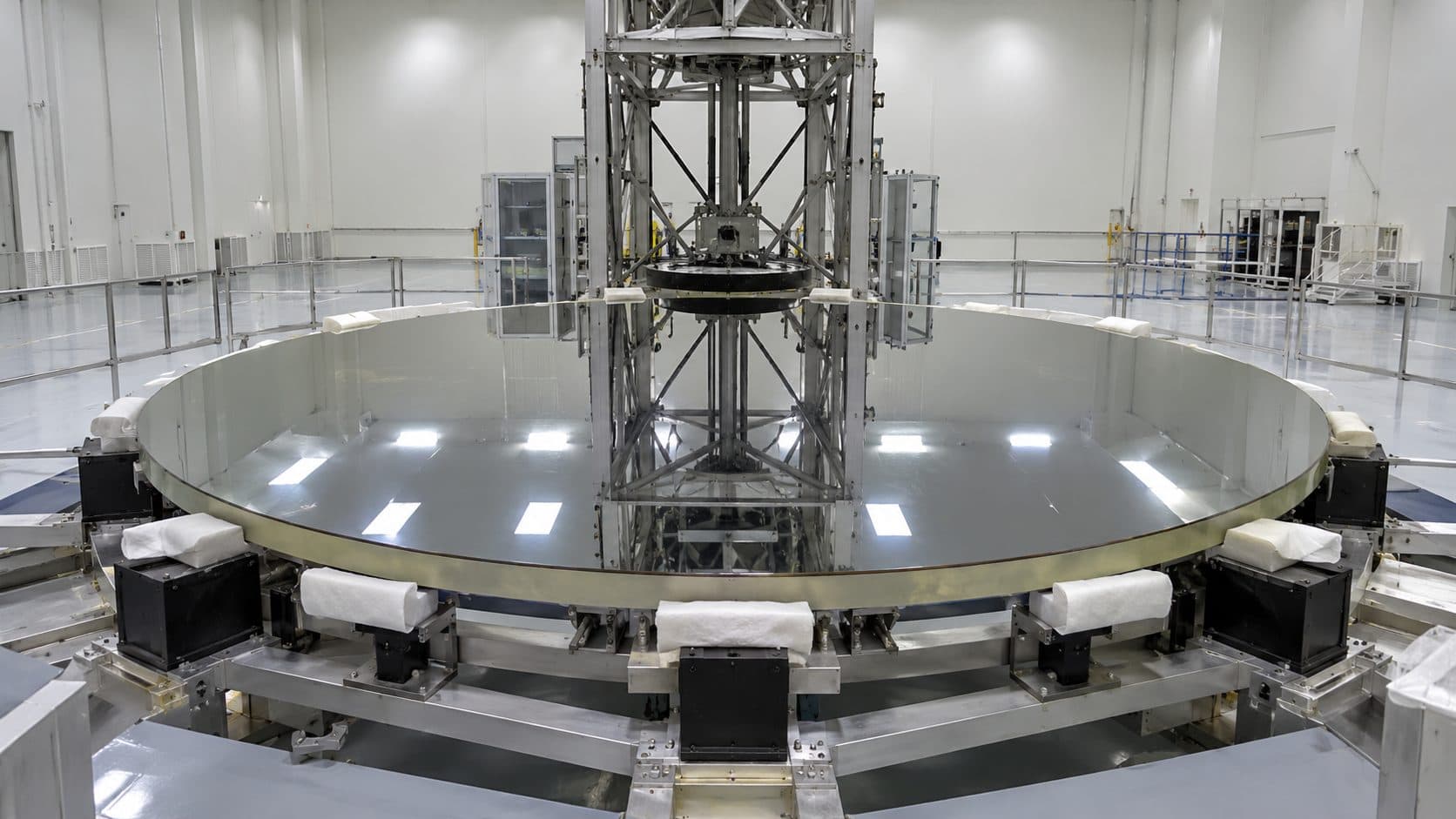
On October 14, NASA's Nancy Grace Roman Space Telescope team reported how its campaign to fine-tune the observatory's focus had gone. "We moved the secondary mirror by about one-sixteenth of the diameter of a human hair," said Alden Jurling, a senior optical engineer on Roman at NASA Goddard. The team also tuned the focus of the coronagraph, then gave the Wide Field Instrument, Roman's 300-megapixel infrared camera, its own round of adjustments. After corrections, the optics feeding that camera show an error of 63 nanometers RMS. The requirement was about 90.
Roman launched on August 30 on a Falcon Heavy. The camera came on in September: on the morning of September 11, the team turned off its heater, let it cool to minus 143 °C and activated its 18 detectors, which kept cooling toward their final temperature of about minus 183 °C.
The number is good news. The sentence that interests me most is Matthew Bolcar's, Roman's optical systems lead: "Our ground testing couldn't exactly reproduce the environment Roman would experience in space, such as the absence of gravity." I am not an optical engineer. I build software, as the CTO of a LegalTech product built on Claude and as an indie developer, and everything I ship was tested somewhere that is not production. Roman is a case where the test environment could never be the real one, and the real one, measured for the first time in orbit, asked for almost nothing.
What 63 nanometers measures
Light from a distant star reaches the telescope as a flat wavefront. A perfect telescope would bend it into a perfect converging one. NASA describes the figure as how far the optics "deviate from absolute perfection"; opticians measure that on the wavefront, and RMS (root mean square: the square root of the average squared departure) sums it up over the whole beam in one number. NASA's own comparison: 90 nm is around 1,000 times thinner than a human hair.
The arithmetic is short. 63 is 70% of 90, so the measured error sits 27 nm, or 30%, inside the requirement. NASA's post words it as "nearly 30% better than the Roman team predicted," but the only comparison it spells out is against the requirement, so that is how I read the 30%.
What does that buy? Optics has a textbook rule, the Maréchal criterion: a system counts as diffraction-limited, as sharp as its aperture allows, when its RMS wavefront error stays below about one-fourteenth of the wavelength. Fourteen times 90 nm is 1,260 nm. Fourteen times 63 is 882. Roman's eight imaging filters span 480 to 2,300 nm. So, by that rule of thumb and my own arithmetic, the requirement put the line for textbook sharpness at about 1.26 micrometers, and the measured value moves it down to about 0.88. NASA did not frame it this way, and one RMS number is not the whole picture: real image quality also depends on where in the field you look, on pointing jitter and on the pixels.
The mirror move is smaller still. If a hair is the roughly 90 micrometers implied by NASA's comparison, one-sixteenth of it is about 5 to 6 micrometers. Jurling scaled it differently: if the height of the secondary mirror above the primary were the height of the Empire State Building, the change would be "a little bit less" than one U.S. penny stacked on the tip of the tower.
Testing in gravity for a telescope that will never feel it
Bolcar listed what the ground could not reproduce: the absence of gravity, and "slight differences in temperature variations and moisture content." Two NASA presentations show how the team planned for that.
A March 2025 presentation at the IEEE Aerospace Conference splits Roman's wavefront error and alignment budget into three categories: production, fabrication, assembly, integration and test; "ground-to-orbit" (launch and commissioning), meaning cooldown, gravity release and moisture desorption; and on-orbit variations. For the Wide Field Instrument, a table on the same slide allocates 28.0 nm of wavefront error to the "Ground-to-Orbit Change," a "One time change." The gap between test and flight was not a surprise waiting at launch. It was a line in the budget.
The same slides list the mitigation: "Place optics at predicted 1g and warm positions to offset gravity and cold-shift effects." On Earth, the optics were set where the models said they had to be, under gravity and warm, so that weightlessness and cold would carry them into place. Requirements that cannot be fully verified by test are verified by integrated models coupling structural, thermal and optical analysis, with model uncertainty added on top. The analysis cases model a 90-day commissioning that "includes 3 alignment activities," and the list of ground-to-orbit mitigations ends with "Flight Alignment compensators."
An August 2024 NASA Goddard talk on integration and testing shows the measuring side. The primary mirror was measured against two different null references (an Offner null and a computer-generated hologram), with gravity offloaded, at ambient and cold temperatures; once in its assembly, it got a "0g x-check" in multiple orientations. The chart marks steps as completed or future: phase retrieval on the optics feeding the camera was done before vibration testing and scheduled again after it, at ambient and cold. The last box, still marked future, reads "Analysis of 0-g on-orbit performance."
The October 14 update shows the telescope's alignment in its real environment, after the models had done their work, and the corrections were small enough to describe in fractions of a hair. In Bolcar's words, the assessments showed "both instruments either matching or exceeding the performance we had predicted."
Hubble had the same mirror size and one reference
Roman's primary mirror is 2.4 meters across, the same size as Hubble's, at less than a quarter of the weight: 186 kilograms against 828. Hubble launched on April 24, 1990. About two months later, NASA announced the telescope was flawed.
The report of the investigation board chaired by Lew Allen, published in November 1990, reads like a lesson in testing. The mirror's final polishing was guided by a reflective null corrector, "the critical optics used as a template in shaping the mirror." Its lens was 1.3 mm out of place. Measured against it, the mirror showed a residual surface error of less than 0.014 wave RMS: near perfect, matching the wrong shape. The board estimated the real error at about 0.4 wave RMS of wavefront error at 632.8 nm, roughly 250 nm.
Two other instruments had shown the problem at the time. "Both indicators of error were discounted at the time as being themselves flawed," the board wrote, and the plan "placed complete reliance on the reflective null corrector as the only test." Astronauts installed corrective optics in December 1993.
These are different measurements on different telescopes, not a like-for-like comparison. The pattern still stands out: one plan relied on a single reference, the other lists two different references and a zero-gravity cross-check.
What this does not show yet
This is a NASA blog post, not a paper. It gives one number for the camera's optics, with no wavefront map and no list of field positions or filters. As of the October 14 post, the coronagraph team had yet to attempt its light-blocking demonstration, planned for "the coming weeks." NASA's stated target for Roman's first science images was early 2027, after a commissioning period it described at launch as about three months. And static focus is not stability: Roman has a separate requirement of 1.0 nm RMS of wavefront change over 180 seconds, which is a different question.
What I take from it
What follows are analogies. A web service is not a telescope, and nobody measures software to the nanometer. But the method transfers.
- Write the gap between test and production into the budget. A staging environment rarely has production's data volume, traffic or timing. Name each difference, estimate it, and keep margin for it.
- Pre-compensate for the differences you can predict, and ship a small, bounded adjustment mechanism for the ones you can't. Roman did not tune from scratch in orbit. It nudged a mirror that had been placed where the models said.
- Never let one reference be the final judge. I fact-check my own posts with Jev, a model used as a judge, and I still look for a second, independent source for each load-bearing fact. Hubble's mirror passed its main test. When an auxiliary check disagrees, investigate it before you discount it.
- Calibrate, then freeze. "You adjust everything until it's just how you want it and then leave the settings alone so it performs consistently while you use it," said Maxime Rizzo, a Wide Field Instrument systems engineer. In anything built on a language model, that means pinning the model version and parameters before you compare outputs across weeks.
Hubble's mirror passed its test against the wrong reference. Roman was measured so many ways on the ground that orbit had almost nothing left to correct.
Sources
- NASA Science, "NASA Roman Team Checks Out Main Instrument, Sharpens Telescope's Focus" (October 14, 2026)
- NASA Science, "NASA Activates Roman's Primary Instrument, Checks Out Coronagraph" (September 15, 2026)
- NASA, "NASA's Dark Universe-Seeking Nancy Grace Roman Space Telescope Launches" (August 30, 2026)
- NASA Science, "WFI Reference Information" (v1.4, March 2026)
- NASA Science, "Building Roman" (read October 20, 2026)
- Kuo-Chia (Alice) Liu et al. (NASA), "Achieving Stability: Systems Design and Analysis of the Roman Space Telescope", IEEE Aerospace Conference (March 3, 2025)
- Kaitlyn Summey (NASA Goddard), "Roman Space Telescope Integration and Testing" (August 5, 2024)
- NASA Science, "Hubble's Mirror Flaw" (read October 20, 2026)
- NASA, "The Hubble Space Telescope Optical Systems Failure Report", NASA-TM-103443 (November 1990)
- TU Delft, Advanced Optical Imaging, "Wavefield aberrations" (read October 20, 2026)