
MeerKAT Caught a Radio Burst From 3 Billion Years After the Big Bang. Keck Saw No Host, Webb Did.
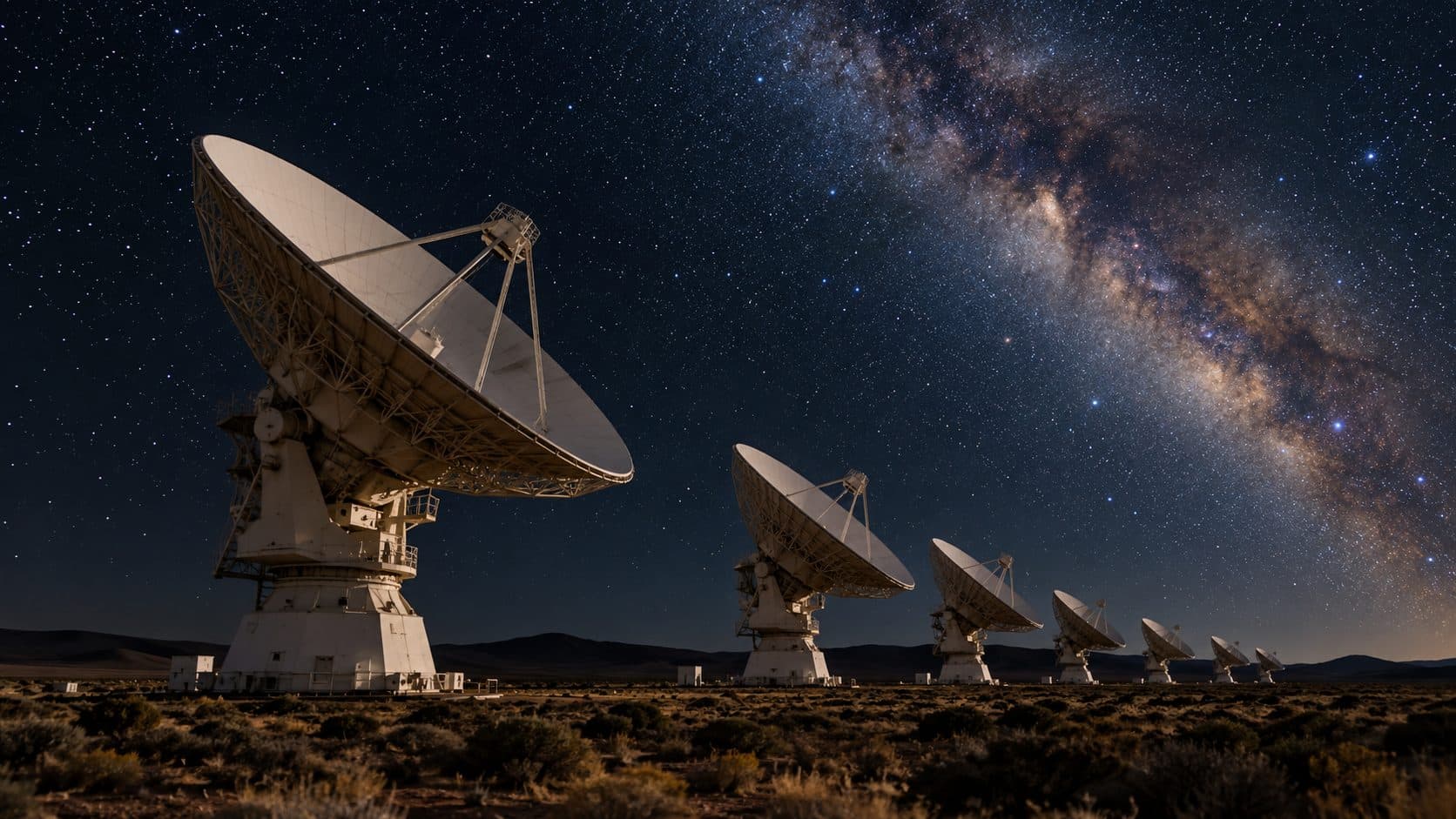
On October 8, 2026, the journal Science published a paper led by Manisha Caleb of the University of Sydney on FRB 20240304B, a fast radio burst detected on March 4, 2024, by the MeerTRAP team on South Africa's MeerKAT radio telescope. NASA's James Webb Space Telescope found the galaxy it came from and measured its redshift: 2.148, which NASA translates as about 3 billion years after the Big Bang. NASA called it the most distant fast radio burst seen to date.
The host was not what the team expected. NASA describes a small dwarf galaxy, actively forming stars, about 1,000 times less massive than they had expected. "Our work suggests that it's very unlikely that this FRB was produced by a merger," Caleb said in NASA's release, meaning a merger of two neutron stars.
I am not an astronomer. I am the CTO of a LegalTech built on Claude, and I read this paper the way I read any system that has to turn weak signals into a claim someone will rely on. What held my attention is not the record. It is the handoff. One instrument knew exactly where the burst came from and nothing about what was there. The other could see what was there, but only once it was told where to look.
A note on sources. The Science paper is paywalled, so I read its published abstract, the releases from NASA, the Paris Observatory and the University of Sydney, and the team's preprint (arXiv 2508.01648, posted August 3, 2025). The methods are in the preprint, but it may differ in details from the peer-reviewed version: it gives the redshift as 2.148 ± 0.001, the published abstract as 2.148 ± 0.0013. I say which numbers come from it.
A millisecond that arrives over ten seconds
Fast radio bursts were first discovered in 2007. NASA describes them as millisecond-long flashes of radio emission from the distant universe, and notes that most are seen once and never again. Their origin is still uncertain.
What they carry is a record of the road. Radio waves crossing ionized gas are slowed, lower frequencies more than higher ones. The delay is proportional to the dispersion measure, or DM: the total column of free electrons along the path. The preprint gives this burst a DM of 2,458.20, in the field's unit (electrons per cubic centimeter, times parsecs of path).
The arithmetic is worth doing once. NRAO's radio astronomy textbook gives the delay in seconds as about 4,149 × DM divided by the square of the frequency in MHz. At 1,712 MHz, the top of the band the burst was detected in, that is about 3.5 seconds. At 856 MHz, the bottom, about 13.9. A flash lasting milliseconds swept across the band over roughly 10.4 seconds.
More electrons usually means more distance, so the DM pointed to a very distant source. But it is a crude ruler, because everything along the way adds electrons. On this sightline, the preprint estimates that the Virgo Cluster adds about 235 units and a previously unknown galaxy group at redshift 0.31 about 33, likely a lower limit. From DM alone, the predicted redshift was 2.8, with a 95% range from 1.628 to 3.397. That is a factor of two. A distance record cannot rest on it.
The radio half: an alarm, then the evidence
MeerTRAP is commensal: it searches for pulsars and fast transients while piggy-backing on other teams' observations. This burst arrived during an open-time observation for another program (the preprint's reference for it is a radio survey of the Virgo galaxy cluster). The real-time system flagged it in one of up to 780 coherent beams, at a signal-to-noise ratio of 39.
The detection triggered a transient buffer. It saved 300 milliseconds of raw, channelized voltages from 62 antennas, timed to account for the dispersion delay. That buffer made the rest possible. From it the team made radio images, corrected their astrometry against the VLASS sky survey, and placed the burst with an uncertainty of 0.28 by 0.48 arcseconds (an arcsecond is 1/3,600 of a degree). Reprocessed from the same buffer, the burst reached a signal-to-noise ratio of 114.7, about three times the real-time detection.
The data were not clean. Only 56 of the 64 frequency subbands had been saved, and after removing those hit by radio interference, the final image used 31. The preprint says so plainly.
The infrared half: looking exactly there
At that position, nothing. Archival surveys showed no galaxy. An infrared image from the 6.5-meter MMT on May 27, 2024, and deep optical images from Keck on June 9, 2024, detected nothing (the Keck image reached a limiting R-band magnitude of 26.24).
The team got 12.7 hours of Webb's director's discretionary time, program 6779. First, about two hours of NIRCam imaging, including the F200W filter, chosen because at the redshift the DM suggested, strong emission lines should fall in it. Hydrogen's deep-red line sits at 656 nanometers at rest. Stretched by 1 + 2.148 = 3.148, it lands near 2.07 micrometers, inside F200W's 1.76 to 2.23 micrometer passband. NIRCam found a faint galaxy, magnitude 27.82 in that filter, about 0.3 arcseconds from the radio position.
Then about 6.5 hours of NIRSpec in its prism mode: the lowest spectral resolution, but the widest coverage, 0.6 to 5.3 micrometers. When you do not know exactly where a line will fall, you buy coverage first. Hydrogen and oxygen emission lines gave the redshift, 2.148.
How sure is the match? The preprint counts 340 candidate sources within 30 arcseconds in the NIRCam image and runs a Bayesian association method called PATH. The top candidate gets 97.5%. A host too faint to see, even for Webb, keeps 2.4%. The team's computed prior for such an unseen host was 3.5%, and they rounded it up to 5%.
What one host can and cannot say
The physics argument is about clocks. Two orbiting neutron stars are expected to take billions of years to spiral together, NASA notes, so bursts from mergers should favor older galaxies. A magnetar, a young and highly magnetic neutron star left behind by a supernova, can produce a burst soon after its star dies, so it fits young galaxies. NASA says the host's rate of star formation suggests most of its stars may have formed within just 30 million years.
The paper's claim is narrower than a headline. The preprint concludes that "at least some FRBs are not produced by formation channels involving significant delay times," and that the host's properties "favour a magnetar origin." Favor, from one burst.
It also names its own limit: "very few FRB host galaxies have been observed at such faint magnitudes at any redshift." Part of "atypical" may be "rarely looked for this deep." Of the roughly 100 bursts with redshifts from their host galaxies, the vast majority sit at a redshift of about 0.5 or less, and the preprint attributes that gap to the sensitivity of the surveys and to how hard it is to get host spectra from the ground at high redshift: among the surveys that localize bursts, it argues, only MeerKAT currently has the sensitivity to reach beyond redshift 2. The published abstract adds that the burst's heavily scattered emission implies a population of bursts that current surveys do not detect. A sample shaped by its detectors describes the detectors first.
Sky & Telescope quotes Joeri van Leeuwen of ASTRON, who was not involved: "Every large collection begins with just one specimen."
What I take from it
I build software, not telescopes, so what follows are analogies, and modest ones.
- Pair sources by what each is blind to. The radio array had position without identity. Webb had identity, but its image held 340 candidate sources within 30 arcseconds of the burst; the sub-arcsecond position is what singled one out. Neither alone produced a redshift of 2.148.
- Keep the raw data around the alarm. The real-time pipeline was a trigger at signal-to-noise 39; the buffered voltages gave 114.7 and the position. The software analogy is capturing the full request around an alert, not just the log line that fired it.
- Give a match a probability, and give "none of these" a share. I fact-check my own posts with Jev, a judge model that returns probabilities. PATH's 2.4% for an unseen host is the column I want in any such check: the chance that the right answer was never on the candidate list. The team even rounded that prior up, from 3.5% to 5%.
- Buy coverage before resolution when you do not know where the signal will land.
- Write the conclusion at the strength of the sample. One burst, one host: "favour", not "prove".
The radio array knew where and not what. Webb could see what, once told where. The record belongs to the handoff.
Sources
- Science, Manisha Caleb et al., "A fast radio burst at redshift 2, three billion years after the Big Bang" (October 8, 2026; published abstract read through Crossref, October 20, 2026)
- arXiv, Manisha Caleb et al., "A fast radio burst from the first 3 billion years of the Universe" (v1, August 3, 2025)
- NASA Science, "Webb Measures Distance to Farthest Fast Radio Burst, Suggesting Origin" (October 8, 2026)
- Observatoire de Paris-PSL, "Identification of the host galaxy of the most distant fast radio burst ever observed" (October 8, 2026)
- The University of Sydney, "Sydney astronomers pinpoint the most distant fast radio burst ever detected" (October 13, 2026)
- Sky & Telescope, Govert Schilling, "Fast Radio Burst Shatters Distance Record" (October 8, 2026)
- STScI, "JWST program information, DD 6779" (read October 20, 2026)
- STScI, JWST User Documentation, "NIRCam Filters" (read October 20, 2026)
- NRAO, Essential Radio Astronomy, "Chapter 6: Pulsars" (read October 20, 2026)
- Wikipedia, "Hydrogen-alpha" (read October 20, 2026)