
Why Woodpeckers Don't Get Concussions (and Why the Tongue Story Is Wrong)
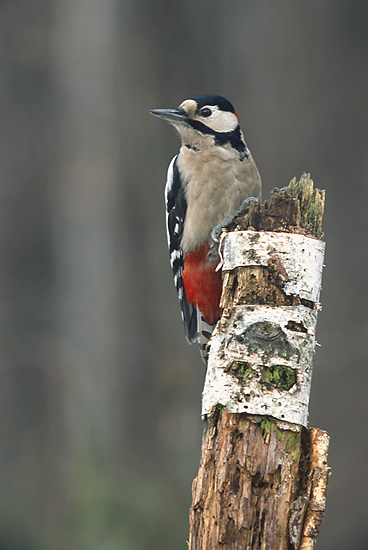
A woodpecker hammers its face into solid wood up to twenty times a second, thousands of times a day, and walks away to do it again tomorrow. So for decades, a tidy explanation went around: the bird's freakishly long tongue wraps all the way around the back of its skull, acting as a built-in seatbelt that cushions the brain on every blow. It's a lovely story. It's also wrong. In 2022, a team filmed woodpeckers frame by frame and found something far stranger — the skull doesn't cushion anything at all. It's a hammer. And the bird gets away with it for reasons that have almost nothing to do with clever engineering.

The tongue myth, debunked frame by frame
The wrap-around tongue is real. In many woodpeckers the hyoid apparatus — the bony, muscular structure that anchors the tongue — really does loop up and over the skull, sometimes curling behind the eye or into the nostril. It's a genuinely bizarre piece of anatomy. The leap people made was assuming that because it's there, it must be there to protect the brain.
So Sam Van Wassenbergh, a biomechanist at the University of Antwerp, did the unglamorous thing: he filmed three woodpecker species with high-speed cameras and tracked the eye and the bill tip across each impact, frame by frame. If the skull were absorbing shock, the bill would decelerate while the braincase kept moving, even slightly — the two would move differently. They didn't. Bill and head stopped at the same instant, with the same deceleration. There was no cushioning gap. The head behaves as one rigid block slamming to a halt.
The skull is a hammer, not a helmet
This is the part that flips intuition on its head. We tend to assume a creature built to smash its skull into trees would evolve the best possible shock absorber. The opposite is true — and the math is brutal.
A shock absorber works by soaking up energy. But a woodpecker needs that energy to go into the wood, not into a spongy skull. Van Wassenbergh's team ran a computer model adding shock-absorbing "springs" to the head, and the result was a worse woodpecker: the cushioning swallowed the impact, so the bird would have had to peck far harder, or far faster, to chisel out the same hole. As he put it, there's a huge energetic cost to absorbing the shock and still being a good pecker. Evolution didn't pad the hammer. It made it stiff, so almost every joule goes straight into excavation.
So the spongy bone, the long tongue, the longer upper beak — these are real features, but the headline job of the cranium isn't protection. It's efficient demolition.
So why isn't the brain scrambled?
If the skull is a rigid hammer, the obvious question is how the brain survives the blow at all. The answer turns out to be almost insultingly simple: the brain is tiny, and physics is kind to small things.
The recorded impacts are genuinely violent — the high-speed footage clocked decelerations of roughly 400 to 600 g during normal pecking, and excavation forces can spike far higher. A human brain starts risking concussion below about 100 g. By those numbers the bird should be knocked silly on its first peck. But brain injury doesn't depend on g-force alone; it depends on g-force and how long that force lasts, and on how much brain there is to slosh around. A woodpecker brain weighs around two grams against a human's roughly 1,300. It's smaller, it's packed snugly with very little fluid around it, and it's oriented so the impact loads it broadly rather than twisting it. Crunch all of that through the same equations doctors use for human concussion, and the worst pecks leave the bird's brain at under 60 percent of the pressure needed to concuss a person. The woodpecker isn't protected by a gadget. It's protected by being small.
A built-in safety margin
The team pushed the numbers one step further, and this is the detail I can't stop thinking about. To actually reach concussion territory, a woodpecker would have to do something it never normally does — drum roughly twice as fast as it ever does, or hit a surface far stiffer than wood.
Like, say, metal. Which is exactly why woodpeckers that bang on metal utility poles, road signs, and gutters — usually showing off and making noise rather than feeding — may be the only ones flirting with the danger zone their anatomy was never tuned for. On wood, the bird lives comfortably inside its safety margin. The tree gives just enough; the skull is just stiff enough; the brain is just small enough.
The myth got the conclusion right and the reason completely wrong. Woodpeckers really don't get concussions — not because evolution gave them a brilliant crash helmet, but because it gave them a head small and stiff enough that it never needed one.