
The Snow on Your Old TV Was an Echo of the Big Bang
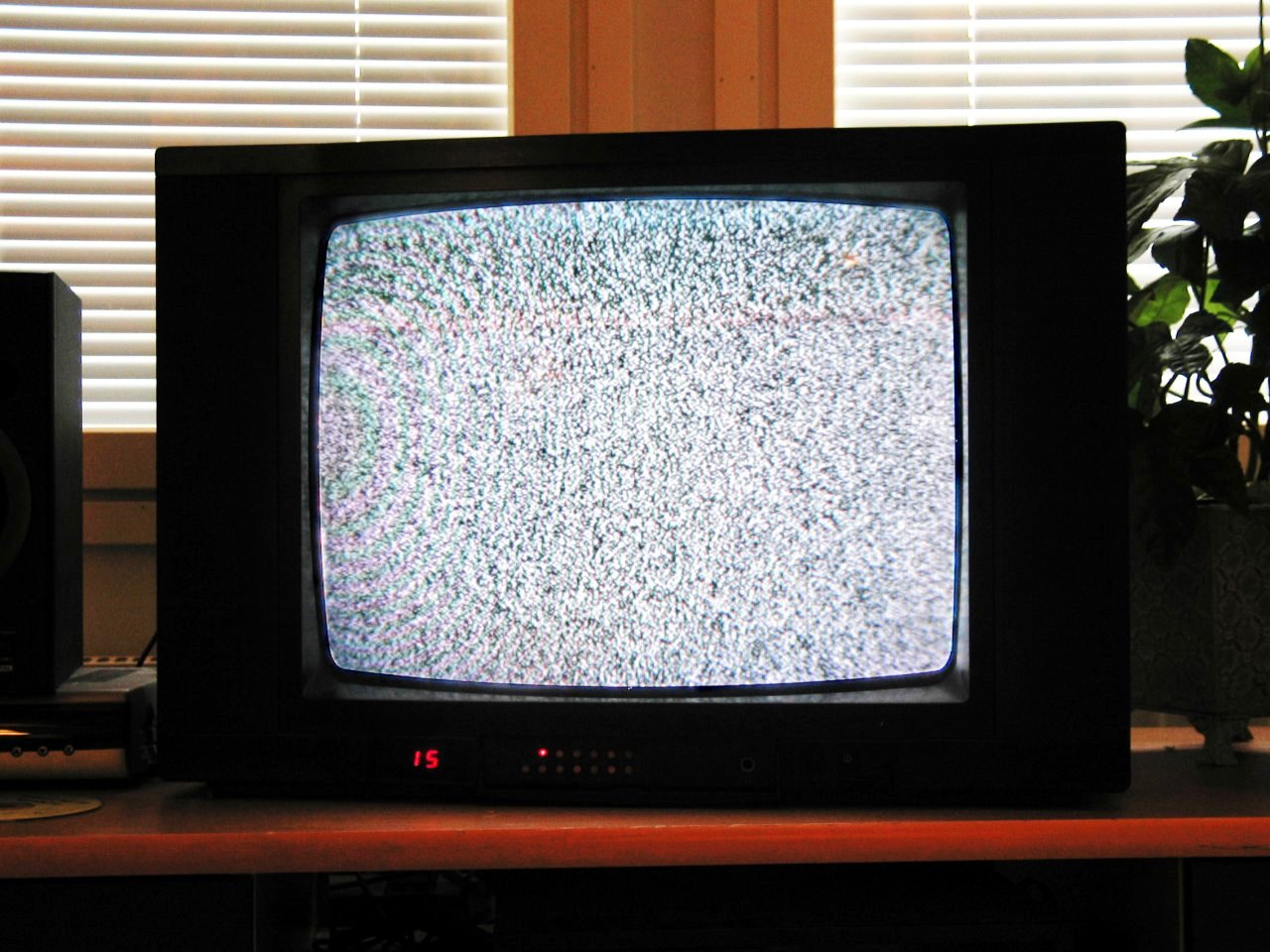
If you're old enough to remember analog TVs, you remember the snow. Spin the dial to a channel with no station and the screen erupts into a swarm of frantic grey dots, paired with that flat, restless hiss. It felt like nothing — the picture of no signal at all. But it wasn't nothing. Tangled into that storm of static was a faint whisper from the beginning of time: the afterglow of the Big Bang itself, light that traveled for roughly 13.8 billion years before ending its journey on your living-room screen. A small slice of the snow on a dead channel really was the universe being born.
The oldest light there is
To understand the static, you have to rewind almost all the way to the start. For its first 380,000 years, the universe was too hot and too crowded for light to travel. It was a blinding fog of charged particles — electrons and bare atomic nuclei that hadn't yet settled down — and any photon trying to cross it was scattered almost instantly, like a flashlight beam swallowed by thick mist.
Then the cosmos cooled to around 3,000 kelvin. Electrons finally paired up with nuclei into the first neutral atoms — an event physicists call recombination — the fog cleared, and for the first time light could fly freely across space. That first liberated flash has been streaming outward ever since. We call it the cosmic microwave background, or CMB, and it is the oldest light that exists: a baby photo of the universe, taken when it was just a few hundred thousand years old.
But the universe has been expanding the whole time, stretching those ancient light waves along with it. What set out as a fierce orange-white glow has been pulled out and out, redshifted across the spectrum over billions of years, until it now arrives as faint microwaves sitting at just 2.7 degrees above absolute zero — barely a breath of warmth. It fills all of space, coming at us evenly from every direction. And your old TV antenna, built to catch faint broadcast signals, was just sensitive enough to grab a sliver of it.
The accident of 1965
Nobody set out to find the dawn of the universe. In the mid-1960s, two radio astronomers at Bell Labs in Holmdel, New Jersey — Arno Penzias and Robert Wilson — were trying to use a giant horn-shaped antenna to study radio waves from the edges of our galaxy. There was just one problem: a faint, persistent hum of noise they couldn't get rid of. No matter where they pointed the antenna, day or night, summer or winter, the hiss was always there — an excess signal of about 3.5 degrees they simply could not explain.
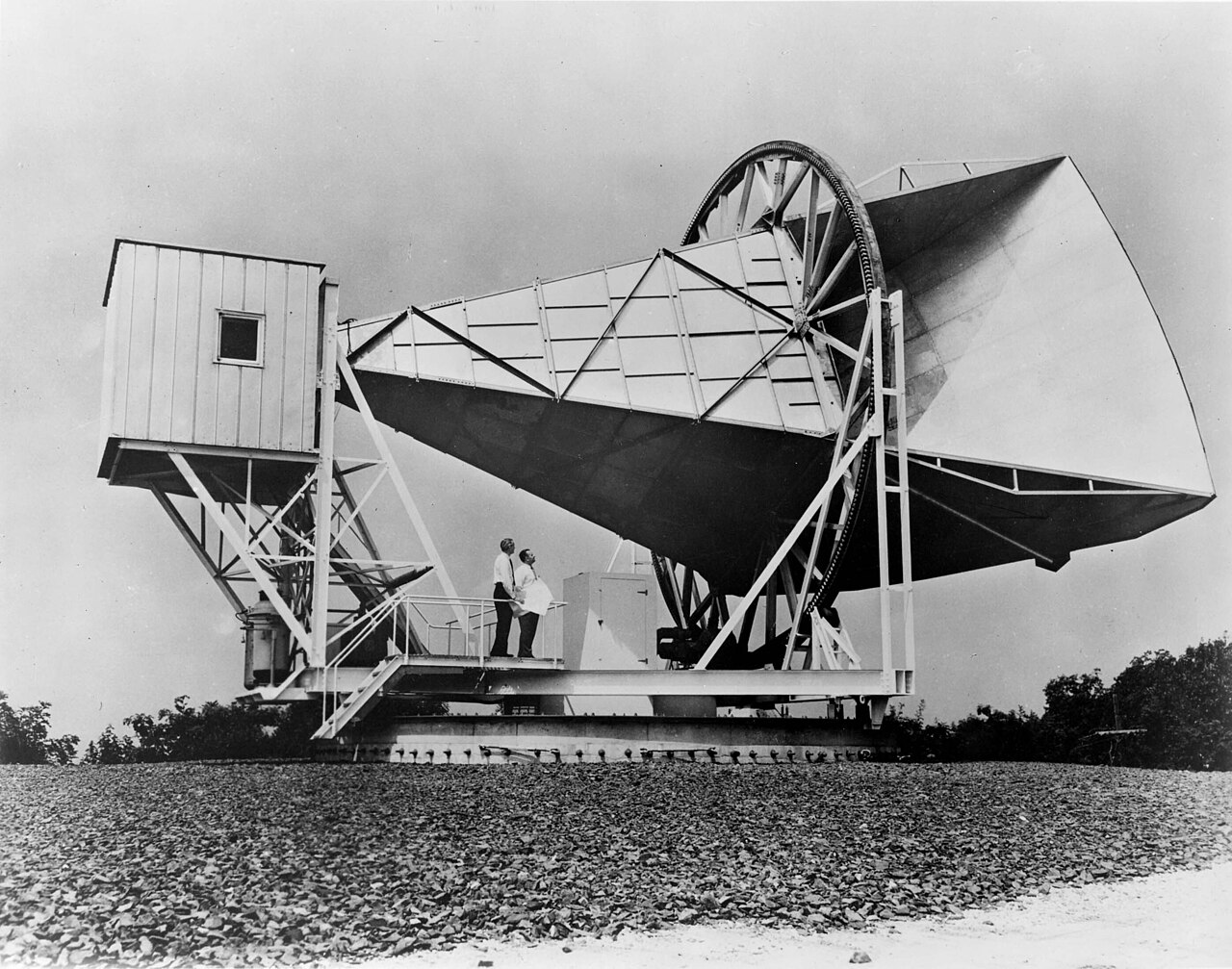
They hunted the source obsessively. They checked their wiring. They ruled out nearby New York City. They blamed, for a while, a pair of pigeons nesting inside the antenna — they trapped the birds and scrubbed out what Penzias delicately called "a white dielectric material" (pigeon droppings). The hiss stayed exactly where it was. It was coming from everywhere in the sky at once, which meant it couldn't be any single thing on Earth.
What they didn't know was that, barely 37 miles away at Princeton, a team led by physicist Robert Dicke had predicted this exact glow and was building an instrument to go looking for it. When the two groups finally compared notes, the answer clicked into place: Penzias and Wilson hadn't found a flaw in their equipment. They had stumbled onto the leftover heat of creation. The discovery handed cosmology its single strongest piece of evidence for the Big Bang — and in 1978, the two men won the Nobel Prize in Physics for a signal they had first tried to scrub away as dirt.
The ghost in your living room
Here is the part that lands closest to home. An analog television tuned to a dead channel is really just a microwave receiver with a screen. The antenna pulls in radio waves from everywhere — leftover broadcasts, the hum of nearby electronics, the Sun, the Milky Way, the random thermal jitter of the set's own circuits. The receiver turns all that chaos into the grey snow and white-noise hiss you remember. Most of it is mundane earthly and instrumental noise.
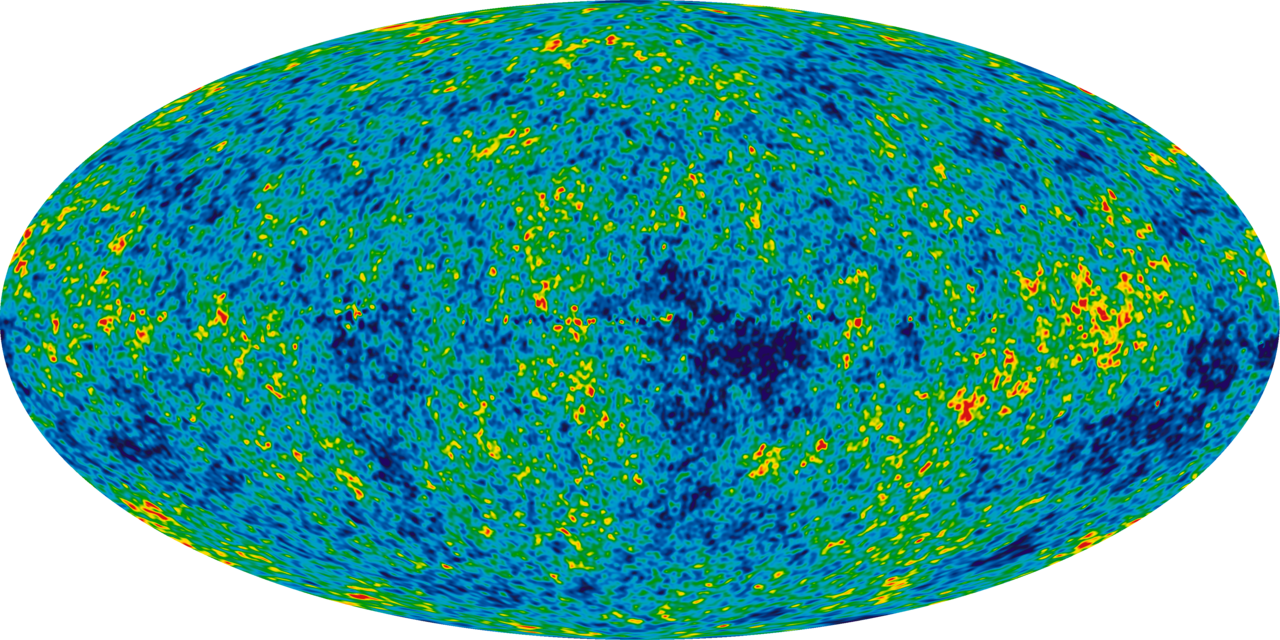
But not all of it. The usual estimate is that around 1 percent of that snowy static came from the CMB — the very same 2.7-kelvin photons Penzias and Wilson detected, the same light that broke free 13.8 billion years ago. Just one in a hundred dancing dots — but one in a hundred is not zero. It means anyone who ever flicked past a dead channel was, without knowing it, watching the early universe flicker on their screen. The same light that map above is made of — the temperature ripples NASA's satellites spent years measuring to chart the cosmos in its infancy — was reaching into living rooms and being mistaken for a busted signal.
Why this one stays with me
We tend to think of the deep past as unreachable, locked away behind impossible distances and billions of years. But the CMB makes it weirdly, almost insultingly ordinary. The oldest light in the universe isn't hiding in some far-off nebula you'd need a space telescope to glimpse. It was pressing against your window, leaking into the cheap antenna on top of the television, hissing softly in the background of a thousand boring evenings.
There's a quiet poetry to it. The end of the broadcast day — that moment when the programs stopped and the screen dissolved into snow — wasn't really an ending at all. It was the universe, exactly as old as it has ever been and exactly as new as it once was, gently introducing itself, and almost no one was paying attention. Digital TVs have erased the snow now; tune to a dead channel today and you just get a flat blue void. But for a few decades, the oldest thing in existence had a standing invitation into our homes — and we kept changing the channel.
Photos: Holmdel Horn Antenna and WMAP all-sky CMB map via NASA (public domain); analog TV static by Mysid via Wikimedia Commons (public domain). Science via Bell Labs, the 1978 Nobel Prize in Physics, and NASA's WMAP mission.