
Sagittarius A*: The Black Hole at the Heart of Our Galaxy
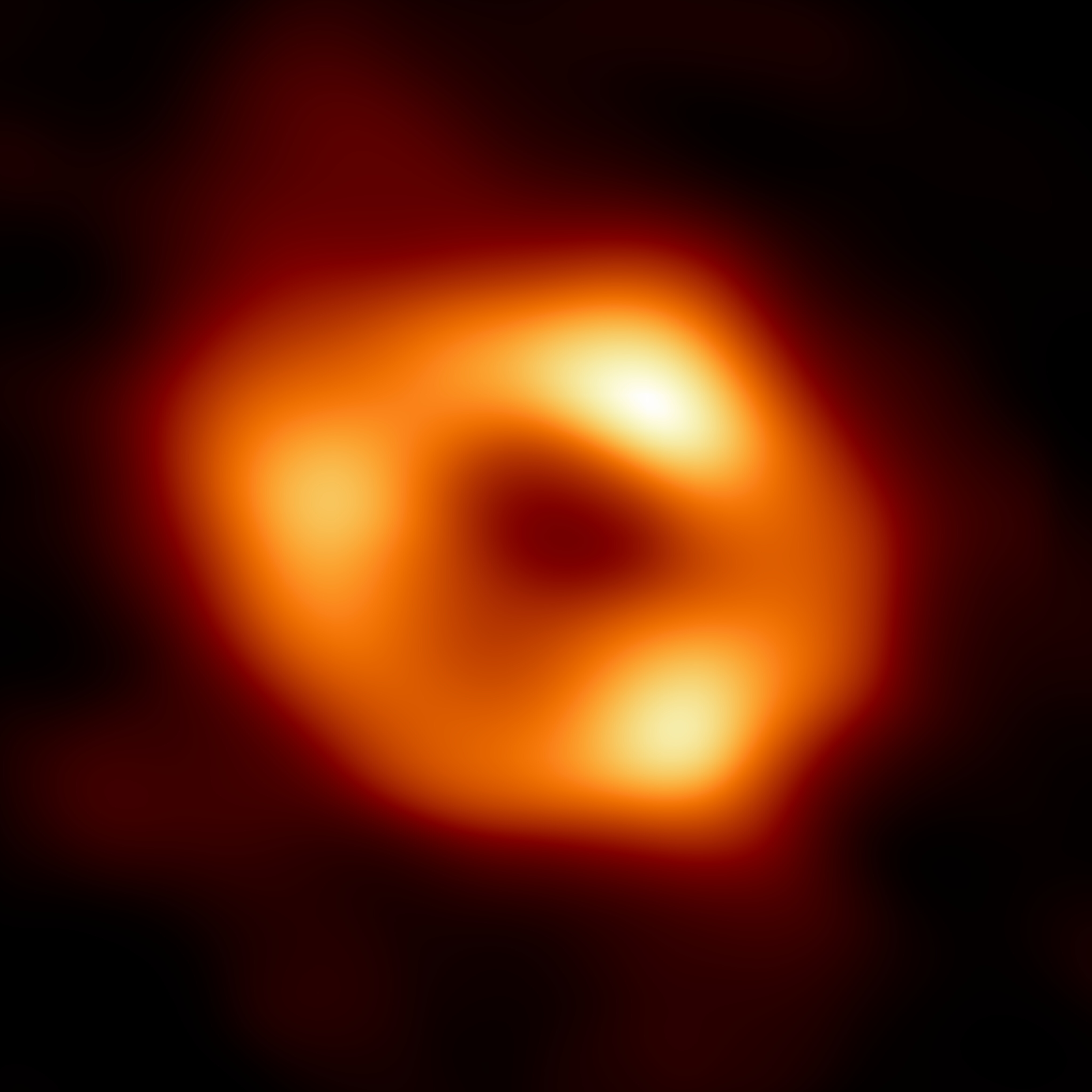
For your whole life, there has been a four-million-Sun monster hiding in plain sight. It sits at the very center of the Milky Way, 27,000 light-years away, in the direction of the constellation Sagittarius — a region so crowded with stars and dust that you cannot see it with the naked eye even though it has been there the entire time. It is a supermassive black hole called Sagittarius A* (pronounced "Sagittarius A-star"). And on 12 May 2022, after five years of computation, humanity finally got to look it in the eye.
A telescope the size of the Earth
You cannot photograph Sgr A* with a single telescope. The black hole's shadow is about 52 micro-arcseconds wide on the sky — the apparent size of a doughnut sitting on the surface of the Moon, seen from your backyard. No instrument on Earth has the resolution for that.
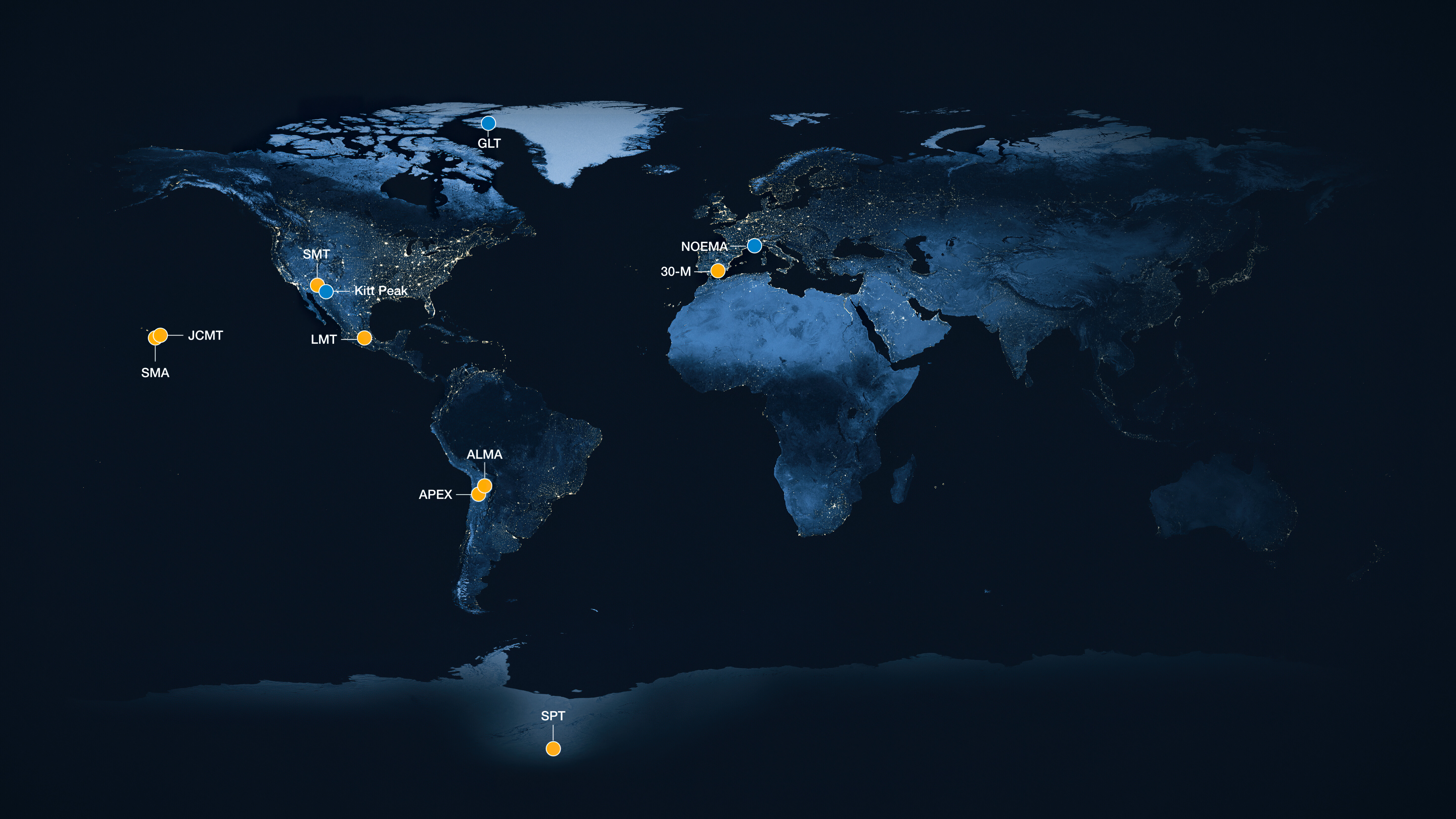
So astronomers built one out of the whole planet. The Event Horizon Telescope (EHT) linked eight radio observatories scattered from Hawai'i to the Spanish sierras to the South Pole, all staring at the galactic center on the same April nights in 2017. By recording the radio waves at each site with atomic-clock timestamps and combining them later, the array behaved like a single dish nearly as wide as the Earth itself. The bigger the "dish," the finer the detail — and an Earth-sized dish is exactly what it takes to resolve a doughnut on the Moon.
The catch: the eight sites generated so much data it could not be sent over the internet. Petabytes of recordings were flown across the world on stacks of physical hard drives. The drives from the South Pole had to wait for the Antarctic winter to end before a plane could even pick them up.
Why the easy black hole was the hard one
This was the second black hole ever imaged. The first, unveiled in 2019, was M87* — a true giant 1,500 times more massive, sitting in a galaxy 55 million light-years away. You would think the one in our own backyard would be easier. It was the opposite.
The trouble is speed. Gas swirls around a black hole at a rate that scales with its size, and Sgr A* is comparatively tiny. Gas whips around it in mere minutes, where M87*'s gas takes days or weeks. That means the picture was literally changing while the telescope watched it — like trying to take a sharp photo of a puppy chasing its own tail. The team had to develop new techniques and average thousands of images to pull a stable portrait out of the blur. Five years of work for a single frame.
What you are actually looking at
The famous image looks like a fuzzy orange doughnut, and almost everyone misreads it. The dark center is not the black hole. The black hole is far smaller and lives deep inside that darkness. What you see as the dark patch is the shadow — the region where the black hole's gravity is so extreme that light falling toward it can never escape to reach your eye.
The bright ring is light from hot gas swirling just outside the point of no return, bent around the black hole by its gravity. Some of that glow is light that looped behind the black hole and was lassoed back toward us — you are seeing the far side of the disk wrapped over the top, an image folded by spacetime itself. The size of that ring matched Einstein's general relativity almost perfectly, a century-old equation passing its sternest test at the edge of the abyss.
The quiet giant
Here is the part that should keep you up at night, in the best way. Sagittarius A* is not a roaring engine. By the standards of supermassive black holes it is remarkably calm — it sips gas rather than gorging on it, which is part of why it took so long to catch. Right now, as you read this, it is sitting there silently, anchoring 100 billion stars into the slow majestic pinwheel we call home.
Every star you have ever seen, every constellation you have ever named, is quietly orbiting that dark point in Sagittarius — including the Sun, which drags you and the entire Earth around it once every 230 million years. The last time we were on this exact side of the galaxy, dinosaurs had not yet appeared. You have been circling a black hole your whole life, at roughly 800,000 kilometers an hour (about 230 km/s), and never felt a thing.