
They Replayed Pink Floyd Read Straight From the Brain
In 2023, a roomful of neuroscientists at UC Berkeley did something that sounds like science fiction and is, in fact, peer-reviewed fact: they reached into recordings of the human brain and pulled out a Pink Floyd song. Not the idea of a song, not a description of one — the actual sound, warped and watery but unmistakable. Play their reconstruction and you can hear the lurching rhythm, the smear of a voice, and then, surfacing through the murk like a half-remembered dream, the line "All in all it was just a brick in the wall." No microphone recorded it. The only thing being recorded was electricity, crawling across the surface of people's brains while they listened.
Twenty-nine brains, one wall
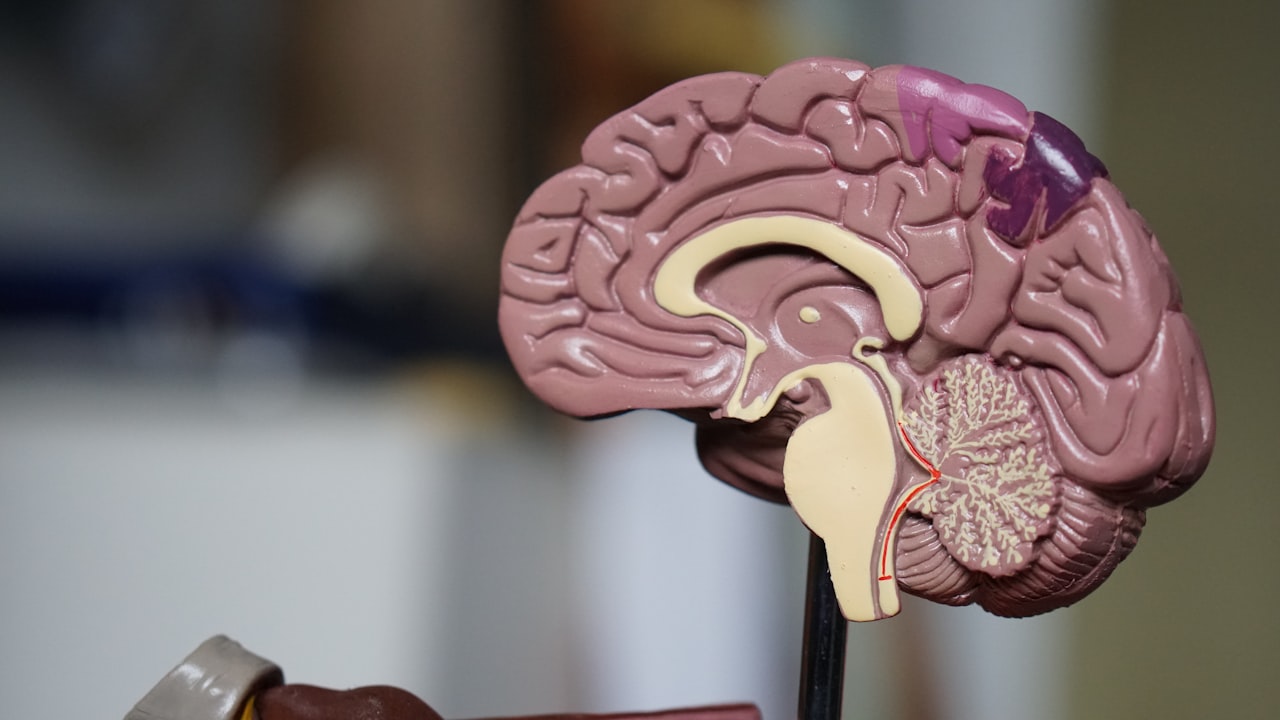
The story starts in hospital wards, not a lab. The brain data came from 29 patients being treated for severe epilepsy at Albany Medical Center in New York, with recordings made in 2008 and 2015. To find the source of their seizures, surgeons had temporarily placed grids of electrodes directly on the surface of their cortex — a technique called electrocorticography, or ECoG. While those electrodes sat in place, the patients agreed to a small, strange experiment: lie still and listen to a song. The song was "Another Brick in the Wall, Part 1," about three minutes of it, from Pink Floyd's 1979 album The Wall.
Across all 29 people, that came to a forest of 2,668 electrodes, each one eavesdropping on the chatter of the neurons just beneath it. Crucially, the listeners weren't doing anything — no tapping, no humming, no task. They were just hearing. Everything the researchers later reconstructed was scraped from the raw, passive act of a brain taking in music.
Teaching a machine to hear your brain
Raw brain signals are not music. They're a blizzard of voltage changes, and the leap from one to the other is where the cleverness lives. Led by researcher Ludovic Bellier in the lab of neuroscientist Robert Knight, the team trained machine-learning models to do a kind of reverse engineering: feed in the pattern of electrical activity, and predict the sound that must have caused it.
Because the patients heard the song while their brains were being recorded, the researchers had both halves of the puzzle — the input (the music) and the output (the neural response). The model's job was to learn the mapping between them so thoroughly that, handed only the brain activity, it could rebuild the audio from scratch. When they finally did, the result wasn't a transcript of lyrics or a tidy MIDI file. It was a spectrogram turned back into sound: a recognizable, if blurry, slice of the actual recording, rhythm and all.
Where the music lives
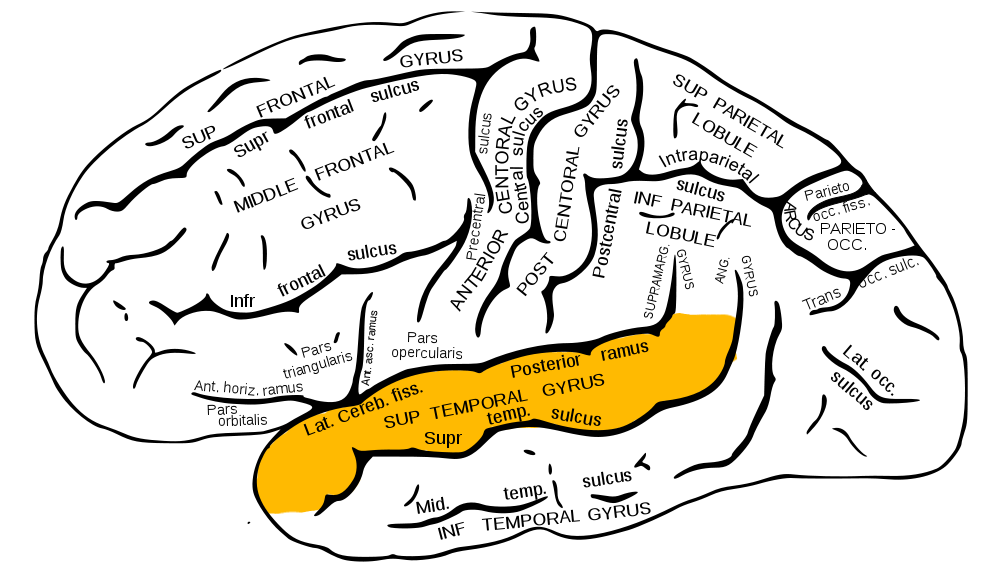
The map the brain drew was just as interesting as the song. When the team looked at which electrodes carried the most musical information, the signal clustered tightly. Of the nearly 2,700 electrodes, only 347 turned out to be significant for the music — and most of the action sat in a strip of cortex called the superior temporal gyrus, tucked just above and behind the ear, where sound first gets parsed into meaning.
Two details stood out. The right side of the brain was noticeably more attuned to the music than the left — a neat mirror of the old idea that language leans left while melody leans right. And within that region, the researchers spotted a sub-zone that lit up specifically for rhythm, firing in time with the song's guitar — a little metronome of neurons that hadn't been pinned down before.
Why a rock song, and not just words
This wasn't a stunt to make headlines (though it did). The real prize is something more human than music. Today's best speech brain-computer interfaces — the ones being built for people who can't speak after a stroke or with ALS — can recover words, but they tend to come out flat and robotic, stripped of everything that makes a voice a voice. What's missing is prosody: the rise and fall, the stress and timing, the melody hiding inside ordinary talk.
Music is prosody with the volume turned up. By proving the brain's musical signal can be decoded, the team showed where the machinery for that expressiveness lives and how to read it. As Knight put it, the goal is to decode "not only the linguistic content, but some of the prosodic content of speech, some of the affect." In other words, not just what you mean, but the tune of how you mean it.

The kicker
Here's the part worth sitting with. The patients were not asked to imagine the song, or to sing it, or to do anything at all. They simply listened — and a few centimeters of cortex, quietly responding to The Wall, held enough of the music that a machine could read it back out. Somewhere in the wet folds of every one of us, the songs we hear leave a faint, decodable echo. For now it takes brain surgery and a wall of electrodes to catch it. But the principle is settled: your favorite song, while you listen, is briefly written in your brain — and we have learned, just a little, how to read.