
The Octopus Is Colorblind — and the World's Best Color Camouflager
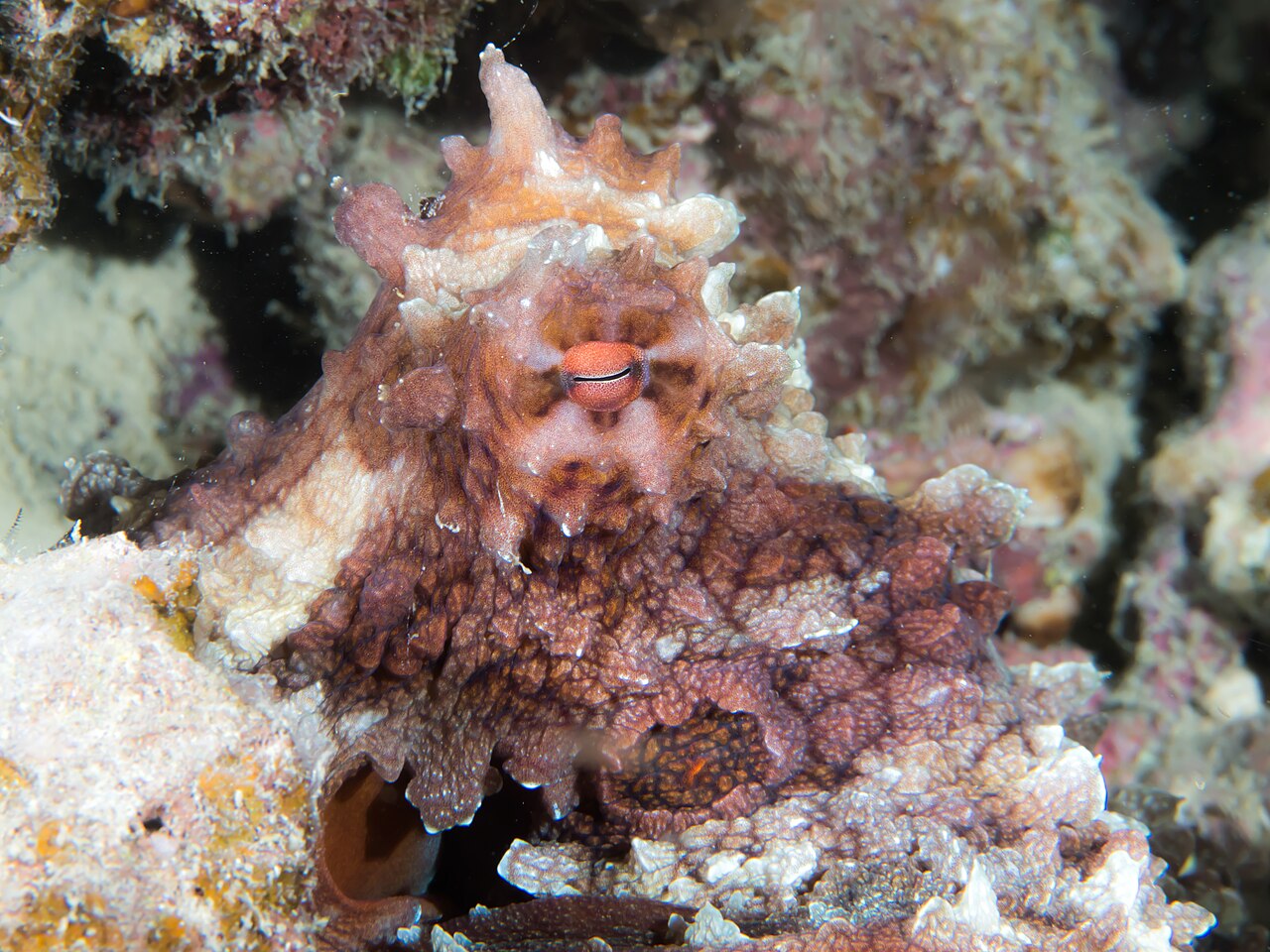
Drop an octopus onto a reef and it vanishes. Not metaphorically — in under a second its skin runs through browns, reds, mottled creams and the exact pebbled texture of the rock beside it, until the animal becomes a hole in your attention. It is the most sophisticated camouflage on Earth, a living screen that paints itself to match any background. And here is the part that should not make sense: the octopus pulling off this trick is, by every measurement we can make of its eyes, colorblind. One visual pigment. No way to tell red from green the way you do. The greatest color artist in the ocean cannot, it seems, see color at all.
One pigment, zero color
Your retina carries three kinds of cone, each tuned to a different band of light — roughly red, green and blue. Your brain compares their signals, and the ratios become color. Most cephalopods, octopuses included, carry just one type of photoreceptor pigment. With a single channel there are no ratios to compare; everything collapses to a grayscale of brighter and darker. By the standard rulebook of vision science, that makes the octopus a true monochromat. It should live in a black-and-white film while wearing a full-color costume.
This isn't a fringe claim. Researchers have probed octopus and cuttlefish eyes directly and keep finding the same single opsin. Behavioral tests back it up: in many color-discrimination experiments, cephalopods match brightness, not hue. A 2022 study that measured a gloomy octopus against its backgrounds with a spectroradiometer found it brilliant at matching how light or dark a surface was, while often missing the saturation — exactly the signature you'd expect from an animal solving the puzzle through brightness rather than color.
The skin paints faster than you can blink
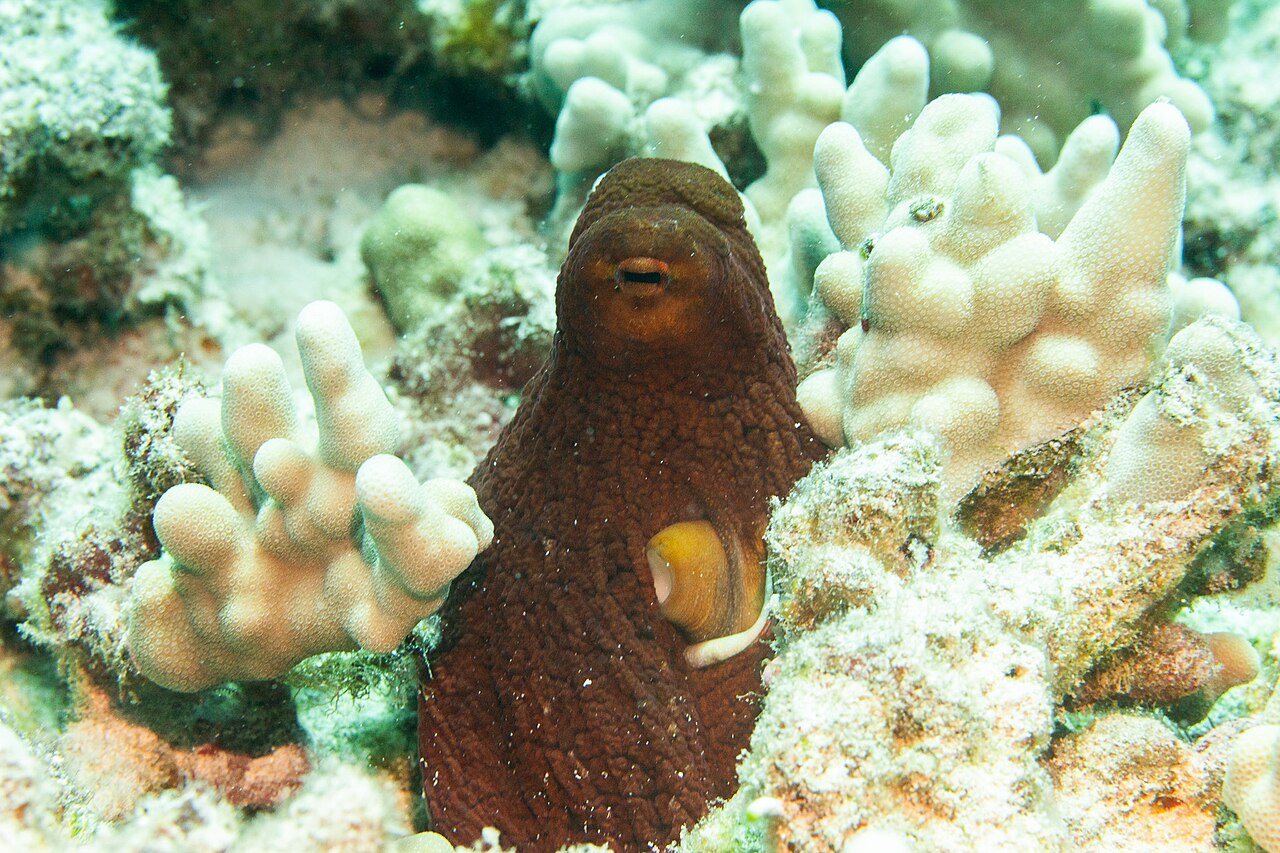
The camouflage itself runs on hardware packed into the skin. The headline players are chromatophores — tiny elastic sacs of pigment, each ringed by a halo of muscles. Relax the muscles and the sac shrinks to a near-invisible dot; contract them and the sac stretches flat into a wide disc of color. Because each chromatophore is wired directly to the nervous system, the octopus can fire them like pixels, snapping its whole surface to a new pattern in milliseconds.
Color cells are only the first layer. Beneath them sit iridophores and leucophores — structural cells that bounce and scatter ambient light to produce blues, greens, silvers and a neutral white that takes on whatever color is around it. Stack the painted layer over the mirror layer and you get a screen that doesn't just change color but borrows it from the surroundings. Octopuses can also throw up papillae, fleshy bumps that mimic the bumpy texture of coral or rock, so the disguise fools touch and shadow as well as sight.
So how does a colorblind animal match colors?
This is the paradox that keeps biologists up at night, and there are two leading ideas — not mutually exclusive.
The first is gorgeously sneaky. In 2016, father-and-son scientists Alexander and Christopher Stubbs proposed that cephalopods see color through a flaw — chromatic aberration. A lens bends short blue wavelengths more sharply than long red ones, so the colors of an image come into focus at slightly different distances behind the lens. In our eyes that smearing is an error to be corrected. The octopus, the Stubbs argue, may exploit it. Its bizarre slit- and dumbbell-shaped pupils spread incoming light across a wide off-axis area, which exaggerates the aberration. By changing the depth of its eyeball and shuffling its pupil around, the animal could hunt for the exact focus distance at which a scene snaps sharp — and that distance encodes the wavelength. Color read not as a hue, but as a focusing depth. A single-pigment eye, decoding color one wavelength at a time, by feel.
The second idea is even more radical: maybe the eyes aren't the whole story. Octopus skin is studded with the same light-sensitive opsin proteins found in the retina. In other words, the skin can detect light on its own. Whether it can resolve color, and whether that information ever guides the camouflage, is still being worked out — but it raises the dizzying possibility of an animal that, in some sense, sees with its whole body.
A masterpiece nobody can confirm it sees
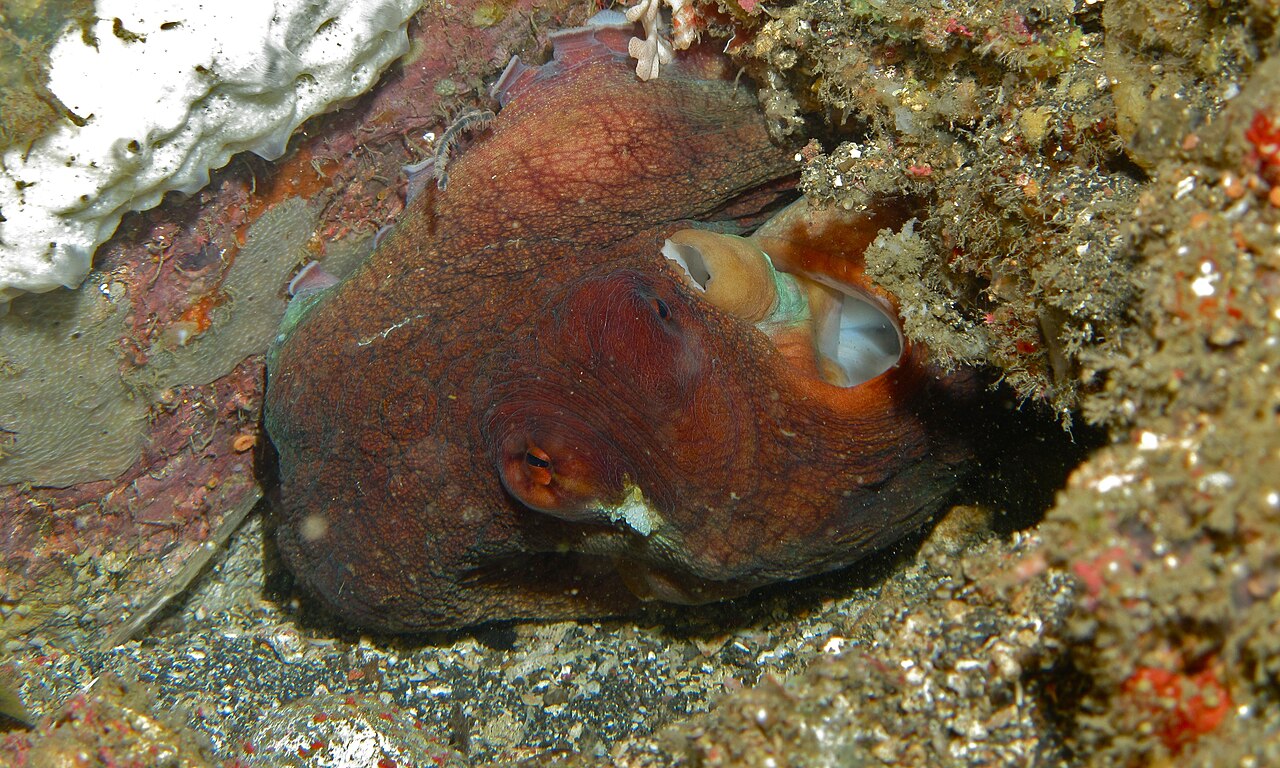
Step back and the strangeness sharpens. The octopus produces flawless color camouflage on backgrounds it may never perceive in color — and it does this for predators, like fish and birds, that do see in full color and would instantly spot a mismatch. The disguise is calibrated for an audience whose visual world the octopus might not share.
Which leaves a quietly humbling thought. We tend to assume that to copy something perfectly, you have to see it the way it really is. The octopus suggests otherwise: there may be more than one way to read a wavelength, and ours — three cones and a brain doing arithmetic — might just be the obvious one, not the only one. Somewhere on a reef right now, an animal that cannot see red is painting itself red, getting it exactly right, and not telling us how.