
The Haunted Frequency: How 19 Hz Makes You See Ghosts
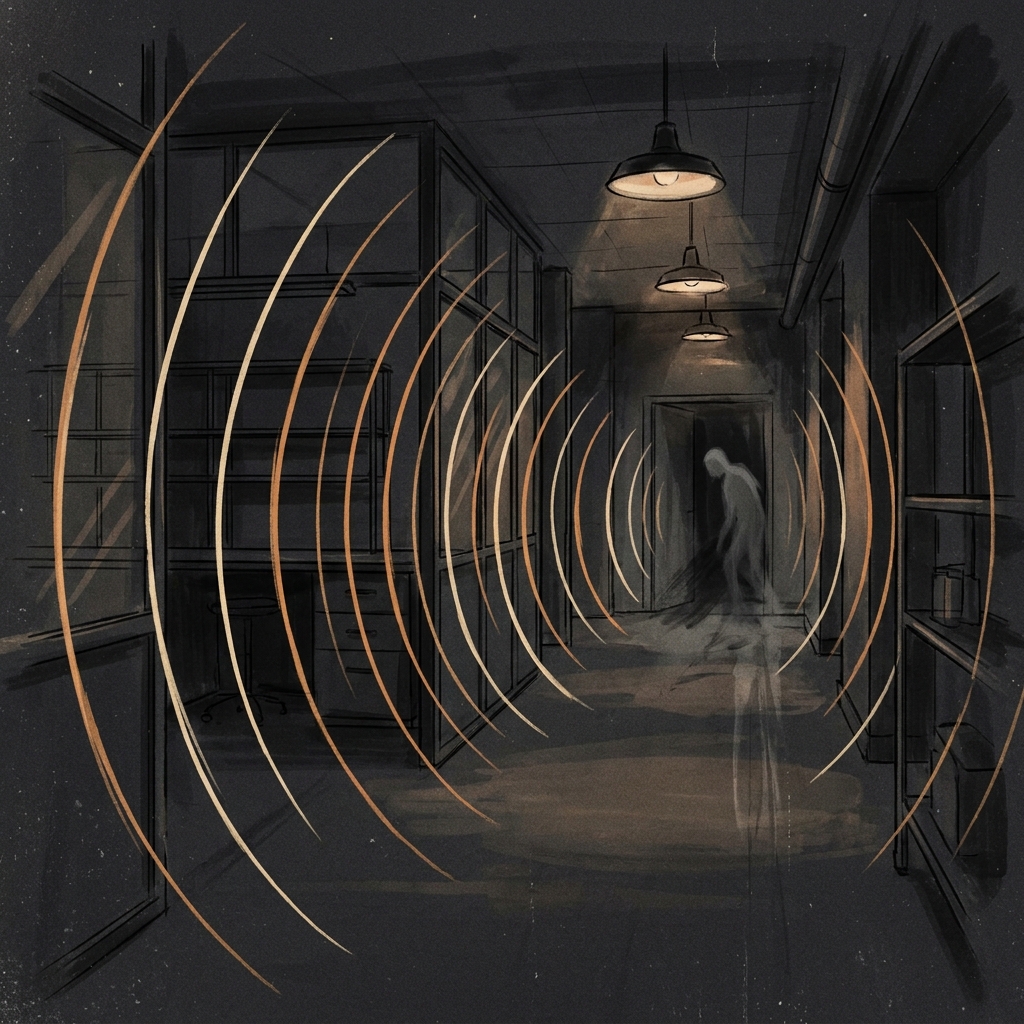
One night in the early hours, an engineer was working alone in a medical laboratory in Warwick when the air turned wrong. He felt cold and broke into a sweat. A grey, formless shape gathered at the very edge of his vision, hovering beside his desk with the unmistakable weight of a presence. His heart pounded. When he finally turned his head to look at it straight on — it was gone. Vic Tandy had just met the lab's resident ghost. And being an engineer, he refused to let it stay a ghost.
The clue in the vice
What makes this story delicious is that the haunting didn't end in a séance. It ended with a fencing foil.
Tandy was a keen fencer, and the next morning he brought his sword into the lab to work on it, clamping the blade in a vice. As he stepped away, he noticed the free end of the foil was vibrating on its own — twitching steadily in the still air, with nobody touching it. To most people that's a curiosity. To an engineer, it's a smoking gun: something in the room was pumping out energy at a frequency that matched the natural resonance of the blade.
He slid the vice along the bench and found a sweet spot where the vibration peaked, and a dead zone where it stopped. He was, in effect, mapping an invisible standing wave in the air of the room — a wave of sound far too low for any human ear to hear.
A brand-new fan, humming at 19 hertz
The source turned out to be mundane: a newly installed extractor fan. Its low drone was producing infrasound — sound below roughly 20 hertz, beneath the floor of human hearing. The lab's dimensions happened to let that low note bounce back and forth and reinforce itself into a standing wave, with a peak of pressure sitting right next to Tandy's desk. Exactly where he'd seen the figure.
The frequency clocked in at around 19 hertz. That number matters, because it lands on one of the body's most unsettling resonances. Decades earlier, NASA and US Air Force researchers had vibrated volunteers across a range of frequencies and watched their eyeballs through reflections off the cornea. The eye, it turned out, has a mechanical resonance in the same neighbourhood — close to 18 to 19 hertz. Drive the air at that pitch and the eyeball itself can begin to quiver in its socket.
When your eyes vibrate, your vision smears at the edges. Straight-ahead focus mostly holds, but the periphery — where the brain is already primed to detect motion and threat — fills with grey, shimmering, half-seen movement. A shape that's there when you don't look at it, and gone the instant you do. Tandy hadn't seen a spirit. He'd seen his own retinas trembling.
Fear you can feel but not hear
The eyes were only part of it. Infrasound around 19 hertz also rattles the chest and abdomen, where much of the human body resonates. Tandy linked his breathlessness, his cold sweat, and the creeping dread to that same vibration shaking him from the inside. Other researchers have since staged the effect on purpose: pipe inaudible low-frequency sound into a room or a concert and people report anxiety, chills, shivers down the spine, a vague sense that something is wrong — without ever knowing why, because there's nothing to hear.
It's a strangely complete recipe for a ghost. Dread, with no cause. Shivers, with no cold. A figure at the corner of your eye, with nothing standing there. Every symptom that centuries of people have filed under "haunted," produced by a fan you can't hear and can't feel — only suffer.

The engineer who debugged a phantom
Tandy and psychologist Tony Lawrence wrote the case up in 1998 in the Journal of the Society for Psychical Research, with the perfect title: "The Ghost in the Machine." A few years later he tracked the same signature into the cellar of a Coventry tourist information centre that had a reputation for being haunted, and again found the air thick with infrasound.
None of this proves every ghost is a fan. Plenty of hauntings have no convenient extractor humming nearby, and the eyeball-resonance explanation is still debated at the edges. But the lesson is hard to shake: a slice of the spookiest experiences humans have ever had may come down to a wave we can't hear, hitting an organ at exactly the wrong pitch.
The next time a quiet room makes the hair stand up on your arms for no reason, you might not be sensing the dead. You might just be standing in someone's standing wave. The truly unsettling part isn't that the ghost was fake — it's that your body felt it long before your mind invented a story to explain it.