
The Green Flash: the secret color hiding in every sunset
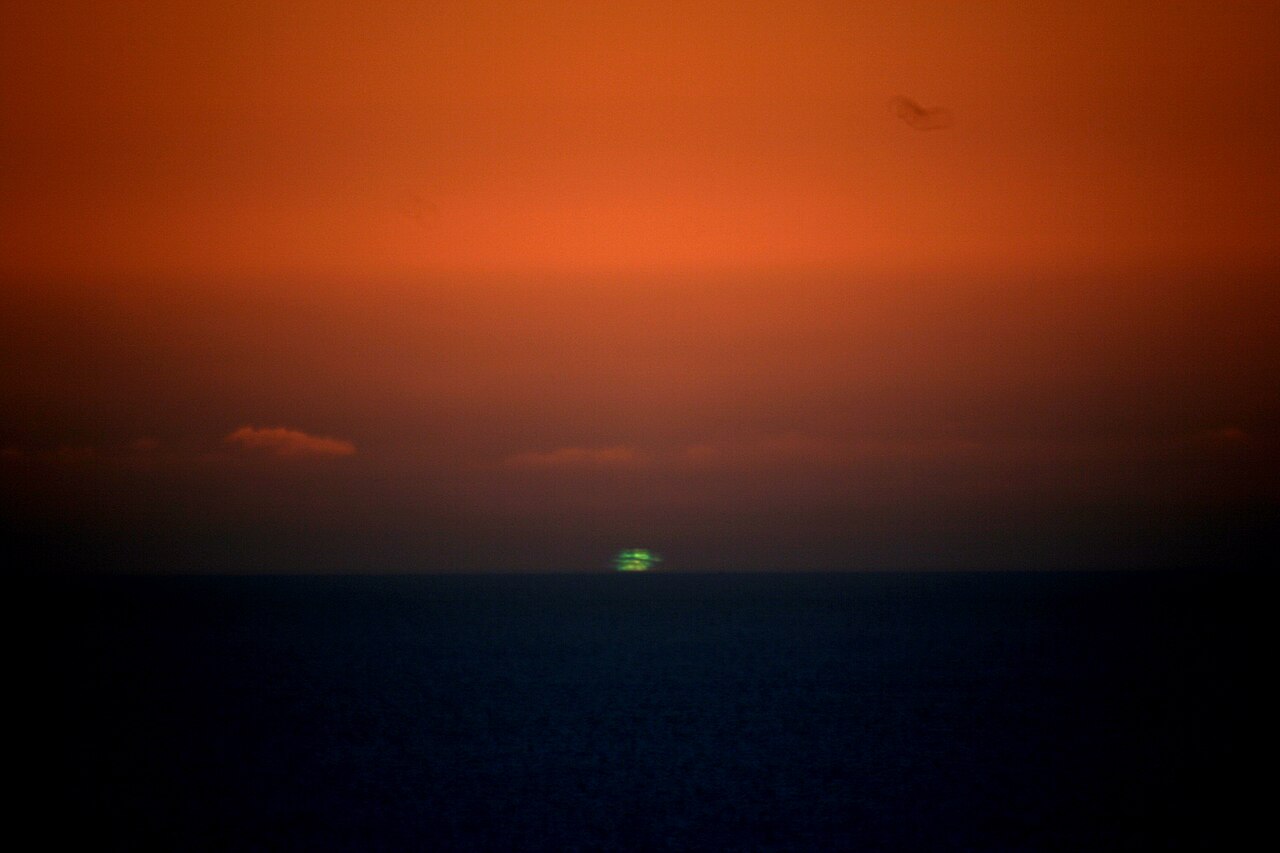
For most of my life I assumed the "green flash" was sailor folklore — the kind of thing people swore they saw after one too many on the deck. It isn't. It's a real, photographable optical event. On a clear evening over the ocean a thin green rim trims the Sun at virtually every sunset — but the true green flash, where that rim flares up bright enough to see, is uncommon: it needs the air layered just right (a temperature inversion that briefly magnifies the edge). The catch is that it lasts one or two seconds, and you have to know exactly where and when to look. Once you do, you can't un-see it. Here's what's actually going on.
A prism the size of the sky
The whole trick comes down to one thing: the atmosphere bends light. When the Sun sits high overhead, its rays punch almost straight down through a thin slice of air and nothing dramatic happens. But at sunset the light skims in sideways, plowing through a long, dense column of atmosphere near the horizon. That thick wedge of air acts like a giant, gentle prism — and like any prism, it bends short wavelengths (blue, green) a little more than long ones (red, orange).
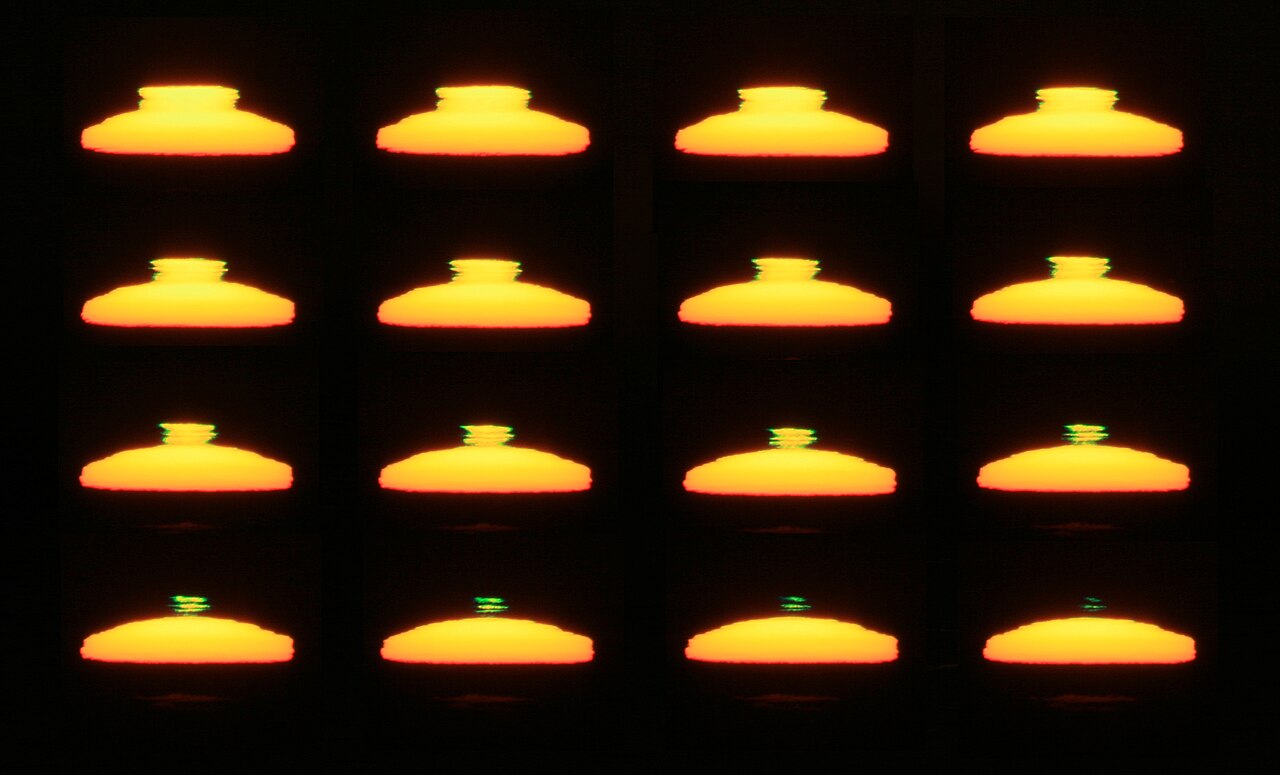
So the Sun you see at the horizon isn't really one disk. It's a stack of slightly offset colored disks — a red Sun, a green Sun, a blue Sun — almost perfectly overlapping, with their top edges pulled apart by a hair. The bluer images are lifted highest. Which means that as the Sun sinks, the colors don't vanish all at once: red goes first, then orange, then yellow, and the last sliver to disappear is green.
Wait — why green and not blue?
Here's the part I love, because it's a genuine twist. If bending alone decided the winner, the last color standing should be violet or blue, since those bend the most and ride highest of all. So the flash ought to be blue.
It almost never is. The reason is the same physics that paints the daytime sky blue and the sunset itself red: scattering. Blue and violet light get bounced around and stripped out of that long horizon-grazing beam long before it reaches your eye — the air simply throws them away. By the time the light arrives, the blue is gone, the red and yellow have already set, and green is the last color left standing. The atmosphere bends to make blue the winner, then scatters blue out of the race. Green takes the medal almost by default.
The green rim you've never noticed
Here's the quietly amazing bit: that green edge is there at every sunset. The atmosphere is always sorting the Sun's colors, so the upper rim of the setting Sun is always trimmed with a thin green line and the lower rim with red. You just can't see it. It's razor-thin — a fraction of the Sun's width — and your eye can't resolve something that fine against a blinding light.
A true green flash is what happens when nature briefly magnifies that rim. A layer of cool air over warmer air near the horizon — common over the sea — acts like a weak lens, stretching the green sliver tall enough and bright enough to register. That's why the ocean is the classic stage: an unobstructed, dead-flat horizon, and air layered just right. Deserts, big lakes, and high mountain horizons work too. What you need is distance, a sharp clean edge, and patience.

How to actually catch one
Three rules. One: protect your eyes. Never stare at a bright Sun — wait until it's a deep, dim orange-red you can look at comfortably, in the final seconds before the last edge drops below the line. Two: pick a clean horizon. Open ocean is ideal; any flat, distant, unobstructed edge will do. Three: watch the very top of the disk at the instant it disappears. That's where the green lives.
A small detail that helps: don't track the Sun on its way down. If you stare at it too long, your eyes adapt and wash the color out. Look away, then snap back to the upper rim right at the end — a fresh eye catches the green far better than a tired one. Binoculars (only once the Sun is safely dim) turn a "maybe" into an unmistakable emerald spark.
Why I love this one
Most beautiful things in the sky are rare accidents — a sprite firing once in a storm, an aurora when the Sun acts up. The green flash is the opposite. It is happening at every clear sunset, a perfect green line balanced on the rim of the Sun, completely faithful, completely there — and almost completely invisible. We miss it not because it's rare but because it's small and we look away a half-second too early.
Which is a strangely hopeful thought. The next emerald is already scheduled. It sets tonight, right on time, whether or not anyone bothers to look — and now you know exactly where it'll be.
Photos: Brocken Inaglory / Wikimedia Commons (CC BY-SA 3.0); Unsplash (free to use). Science via Wikipedia and atmospheric optics references (A. T. Young, SDSU).