
The Digital Bridge That Let a Paralyzed Man Walk by Thought
In 2011, a young Dutch man named Gert-Jan Oskam crashed his bicycle in China and broke his spine. The message his brain kept sending to his legs — stand, step, walk — still left the starting line every time he thought it. It just never arrived. The wiring downstream was severed, and for about a decade the command and the muscle lived in two separate countries with no road between them. Then a team of scientists built a bridge. Not a metaphorical one — a literal wireless link that streams his intention to walk straight over the gap in his spinal cord, in real time. In 2023 he stood up, leaned on a walker, and crossed a room using nothing but the thought.
The traffic jam in your spine
Walking feels like one smooth act, but it's really a relay. Your motor cortex — a strip across the top of your brain — fires the order. That order races down the spinal cord like a signal down a cable, hits the circuitry in your lower spine, and that circuitry handles the unglamorous choreography of firing the right leg muscles in the right sequence. A spinal cord injury usually doesn't kill the brain that wants to walk, nor the leg muscles ready to obey. It severs the cable in between. The will is intact at one end, the machinery is intact at the other, and the message dies in the gap.
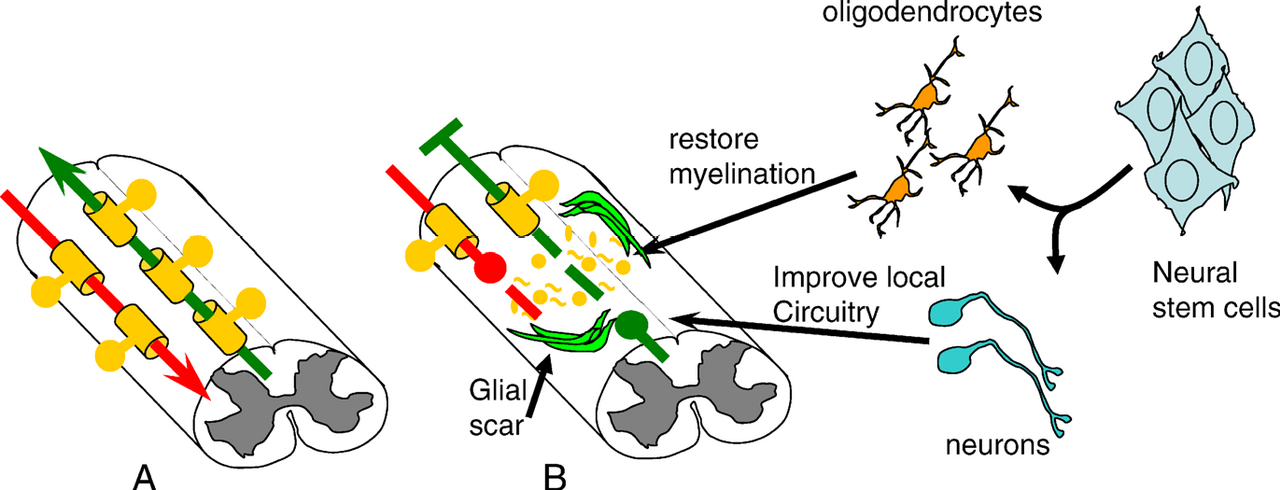
That's the crucial insight behind the whole project, led by neuroscientist Grégoire Courtine at EPFL and neurosurgeon Jocelyne Bloch at Lausanne University Hospital. They didn't try to regrow the cable. They decided to route the message around it.
Reading the thought before it can leave
To intercept the order, you have to read it at the source. So in July 2021 the surgeons opened Gert-Jan's skull and placed two implants — each a grid of 64 electrodes, 128 in total — directly over the patch of motor cortex that governs the legs.
That patch is bigger and stranger than you'd guess. If you map how much brain real estate is devoted to each body part, you don't get a tidy little human; you get a grotesque, lopsided creature with monstrous hands and a heavy presence for the legs and feet. Neuroscientists actually built sculptures of this "cortex man," and they are unforgettable.
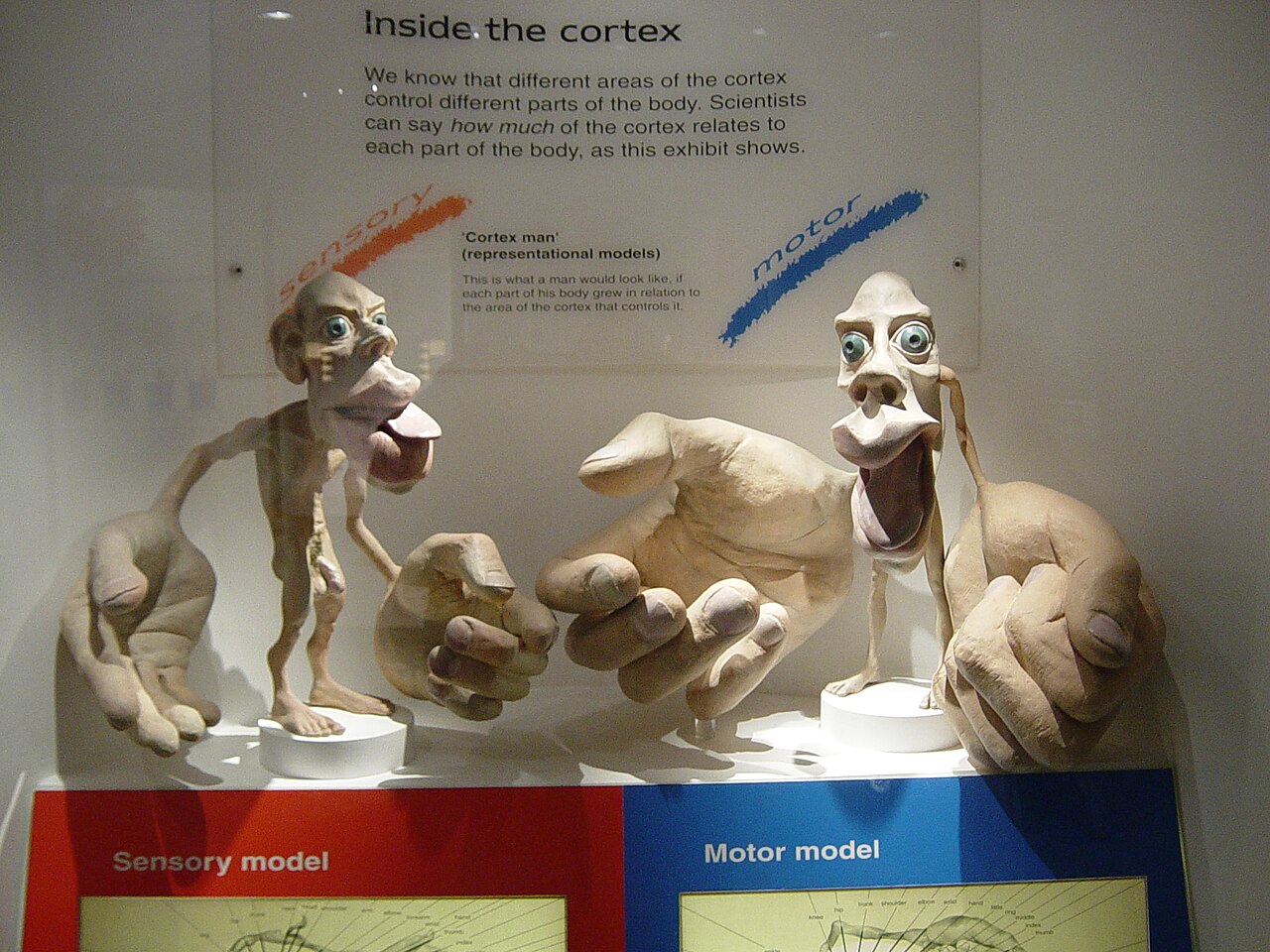
When Gert-Jan merely thinks about taking a step, those leg territories light up with a faint, specific electrical signature. The implants catch it. An AI decoder, trained on his own brain, learns to tell I want to step apart from the constant background chatter — and it does this fast enough to keep up with a walking human.
Closing the loop
Reading the thought is only half the bridge. The decoded intention is beamed wirelessly to a small computer Gert-Jan wears, which translates it into a precise pattern of pulses. Those pulses go to a second implant, this one sitting on his lower spinal cord — below the injury — wired to an electrode array over the leg-control circuitry. It nudges the right muscles, in the right order, exactly when he wants them.
The whole loop — think, decode, transmit, stimulate, step — refreshes about every 300 milliseconds, roughly three times a second. That speed is what makes it feel like his walking rather than a machine puppeteering his legs. He can adjust mid-stride, decide when to start and stop, shift his weight, change his mind. As he put it, the earlier purely-automatic stimulation "was controlling me, and now I am controlling the stimulation by my thought." He has stood at a bar with a beer. He has climbed stairs and gone up a ramp. One day he grabbed a walker and some paint and touched up his house himself, standing, because no one was around to help and he simply could.
The part nobody expected
Here is the detail that turns a good engineering story into a genuinely strange one. After months of walking with the bridge switched on, the researchers turned it off — and Gert-Jan could still move his legs better than before. He could take steps with crutches and no active stimulation at all.
That shouldn't happen if the device were just a clever puppet string. It strongly suggests the bridge did more than carry signals: by routinely firing the dormant pathway between brain and muscle, it seems to have coaxed the spinal cord into forming new connections of its own. The crutch became a kind of physiotherapist. The repair was partly digital and partly, quietly, biological.
Gert-Jan is one man, the equipment is bulky, and this is a proof of concept, not a cure you can pick up at a pharmacy. But the principle is now demonstrated: a thought that has nowhere to go can be caught, read, and delivered across a wound — and in being delivered often enough, it may help the body remember how to carry it on its own. The bridge was built to reroute traffic. It quietly started repairing the road.