
The Brocken Spectre: That Giant in the Fog Is You
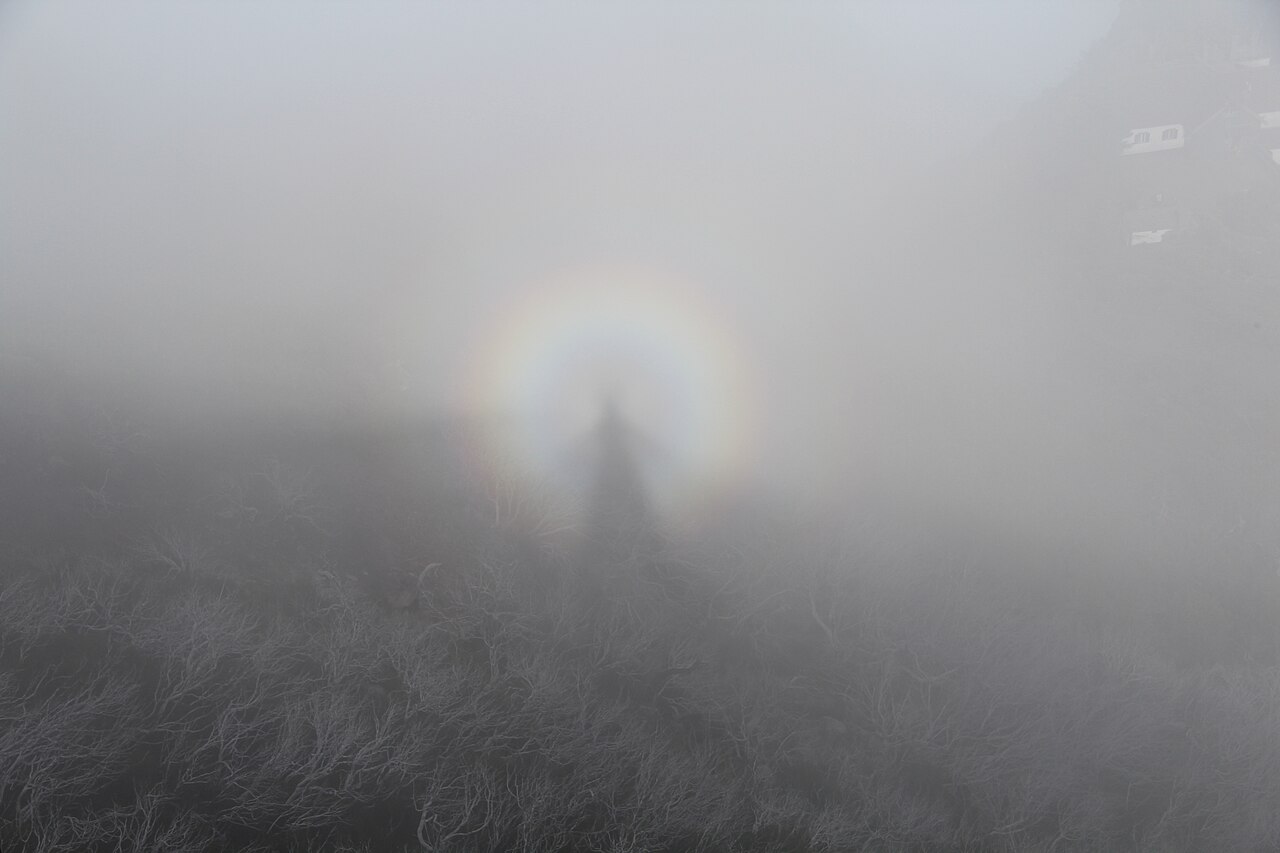
You climb before dawn, reach a misty summit, and turn your back to the rising sun. And there, projected onto the fog below you, stands a giant. A colossal humanoid silhouette, looming in the clouds, ringed by a halo of rainbow light. It raises an arm when you raise yours. It is, of course, you — but for centuries hikers swore they had met a ghost, a god, or the devil himself. Welcome to the Brocken spectre, one of the most theatrical tricks the atmosphere will ever play on you.
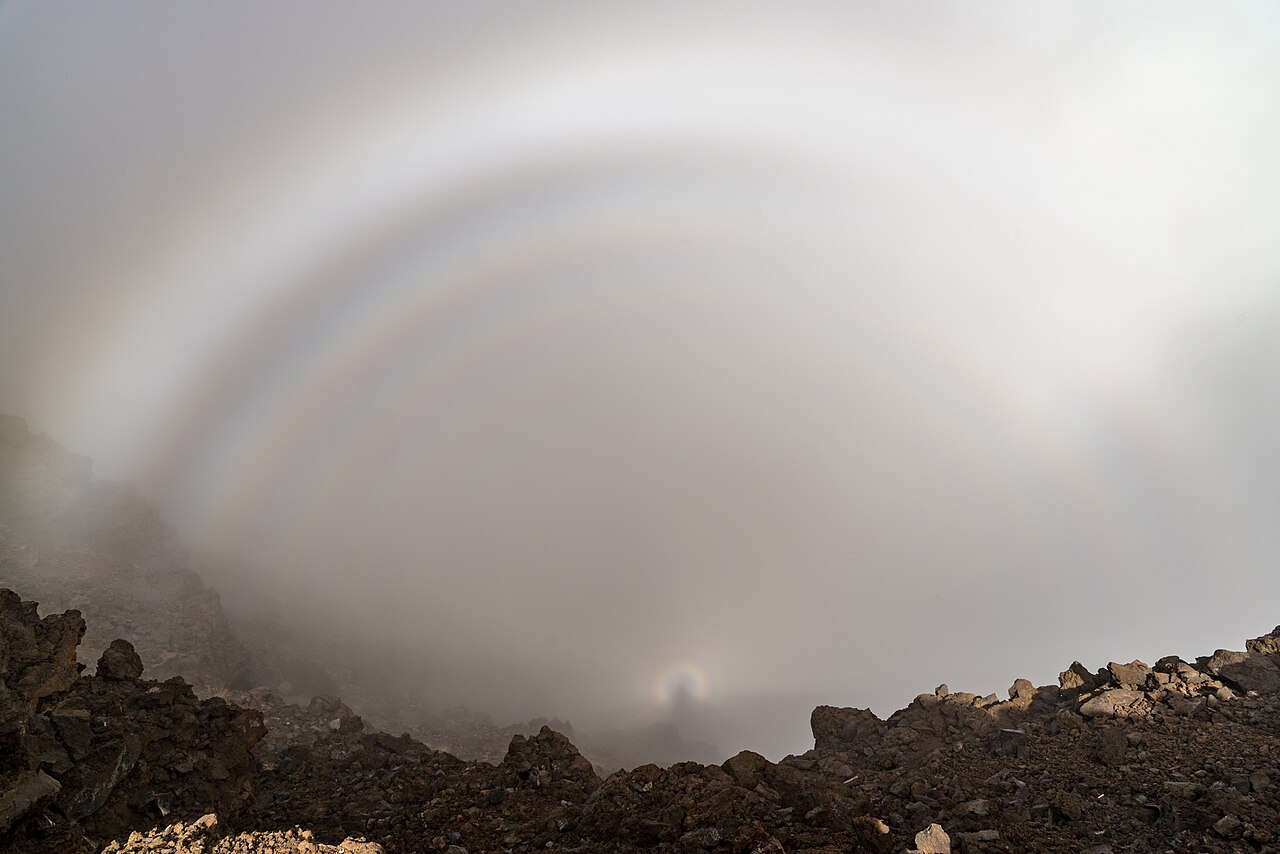
A ghost named after a mountain
The phenomenon takes its name from the Brocken, the highest peak of the Harz mountains in central Germany. It isn't special physics that earned it the title — it's geography. The Brocken is low enough to climb easily and famously wrapped in fog for much of the year, so for generations it offered the perfect stage for spooked travelers to watch their own shadows balloon into apparitions. The mountain already had a reputation: local legend made it the gathering place for witches on Walpurgis Night, a story Goethe folded into Faust.
The first careful description came in 1780, when the German pastor and naturalist Johann Silberschlag wrote it up properly. Eighty years later the British physicist John Tyndall, an early investigator of how particles scatter light, gave a clean optical analysis of it in his 1860 book The Glaciers of the Alps. (The definitive explanation of why the sky is blue would come from Lord Rayleigh, who refined and corrected Tyndall's scattering work.) Slowly the demon became a diagram.
Why the giant is a giant
Here is the deflating truth: your shadow on the fog is not actually big. It's the same shadow you cast on any wall. What sells the illusion is the complete absence of distance cues.
Your brain estimates an object's true size by combining how large it looks with how far away it seems. On a featureless bank of cloud there is nothing to anchor that judgment — no trees, no rocks, no skyline. Worse, you often glimpse distant land through gaps in the mist, and your brain wrongly places the shadow at that far distance. A shadow that big, that far away, must be enormous. So you perceive a giant. The figure also looks like it's standing because the cloud surface is roughly horizontal, and tiny shifts in the fog make it shimmer and move, which only deepens the sense that something alive is out there.
The halo is the real magic
The shadow is a parlor trick of perception. The rainbow rings around its head — the part called the glory — are genuine, hard physics, and far stranger than they look.
A glory is not a rainbow. A rainbow comes from sunlight refracting and reflecting inside raindrops, and it sits at about 42 degrees from the point opposite the sun. A glory huddles right around that opposite point — your head's shadow, the antisolar point — in a tight set of colored rings. It's produced by light backscattering off tiny cloud droplets, typically just 10 to 30 micrometres across, and bending back almost exactly the way it came. Crucially the droplets must be small and uniform in size, which is why glories form on fine fog and cloud tops rather than fat rain.
The colors come from diffraction: each wavelength of light gets nudged back at a slightly different angle, so the ring's radius depends on color. As with a rainbow, red ends up on the outside and blue toward the center, and if conditions are clean you can see the pattern repeat in faint outer rings.
A theory that took most of a century
What makes the glory a beautiful problem is that it sits at the awkward edge where light is neither a simple ray nor a simple wave you can wave away. Geometric optics — the bouncing-ray picture that explains rainbows so well — fails to predict a glory at all.
The honest answer needed the full wave theory of how light scatters off a sphere. Gustav Mie's famous 1908 paper, derived straight from Maxwell's equations, was actually about the colors of colloidal metal particles, not the glory — but the Mie scattering framework it gave us is the right starting point. Turning that framework into a real account of the glory's tight, colored, backward-pointing rings took decades more: van de Hulst proposed the key mechanism around 1947 and developed it through the 1950s, and a fully rigorous explanation only arrived with the work of physicists like Nussenzveig in the early 2000s. So the apparition that medieval climbers fled as a demon turned out to demand some of the most sophisticated optics of the twentieth century to fully describe.

You can only ever see your own
The loneliest detail in all of this: a glory is strictly personal. Because it forms exactly around the antisolar point — the shadow of your head — every person on that ridge sees the rings centered on their own shadow and no one else's. Stand beside a friend in the fog and each of you will watch a giant crowned in light, and each of you will be utterly convinced the halo belongs to you alone.
You're both right. The mountain made each of you a private god, and handed you the physics to prove it.