
The Bird That Sees Earth's Magnetic Field (With a Quantum Effect)
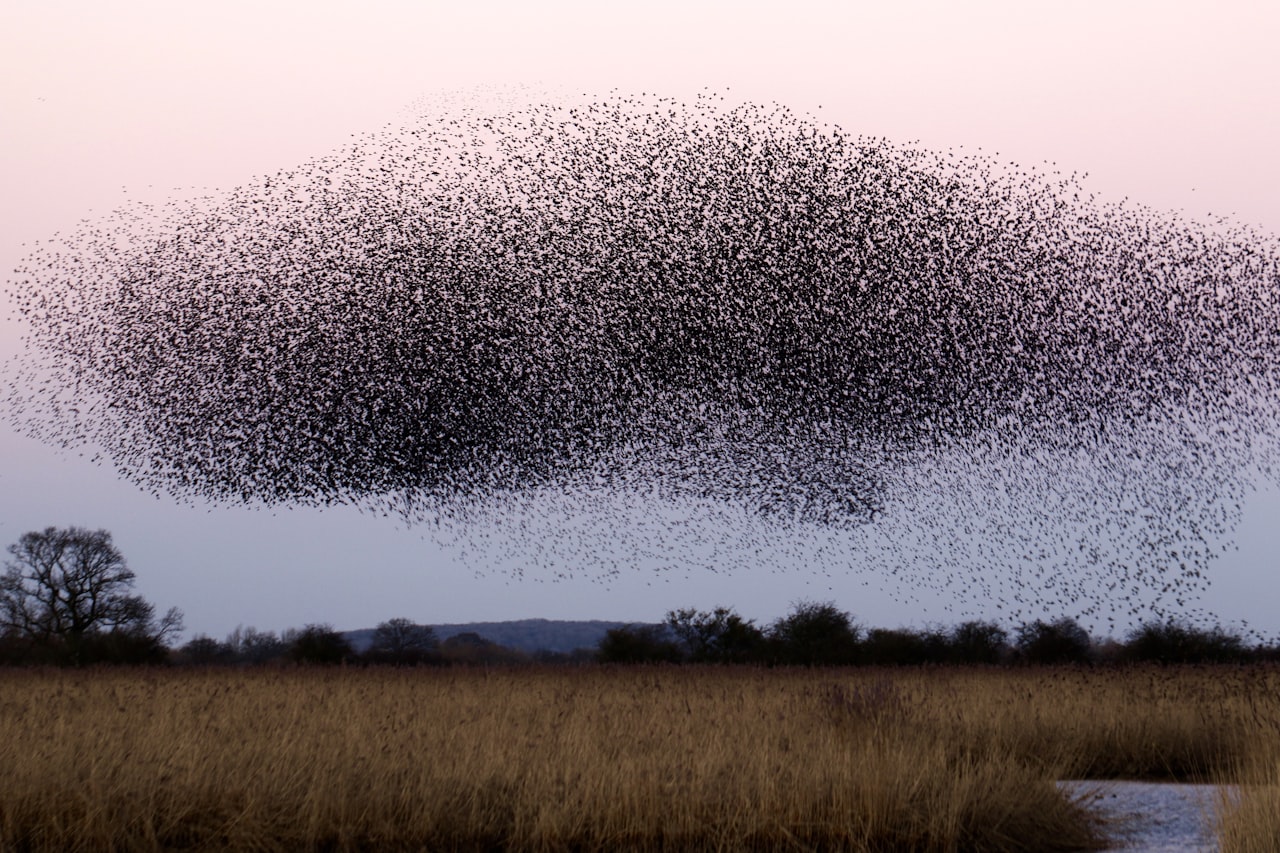
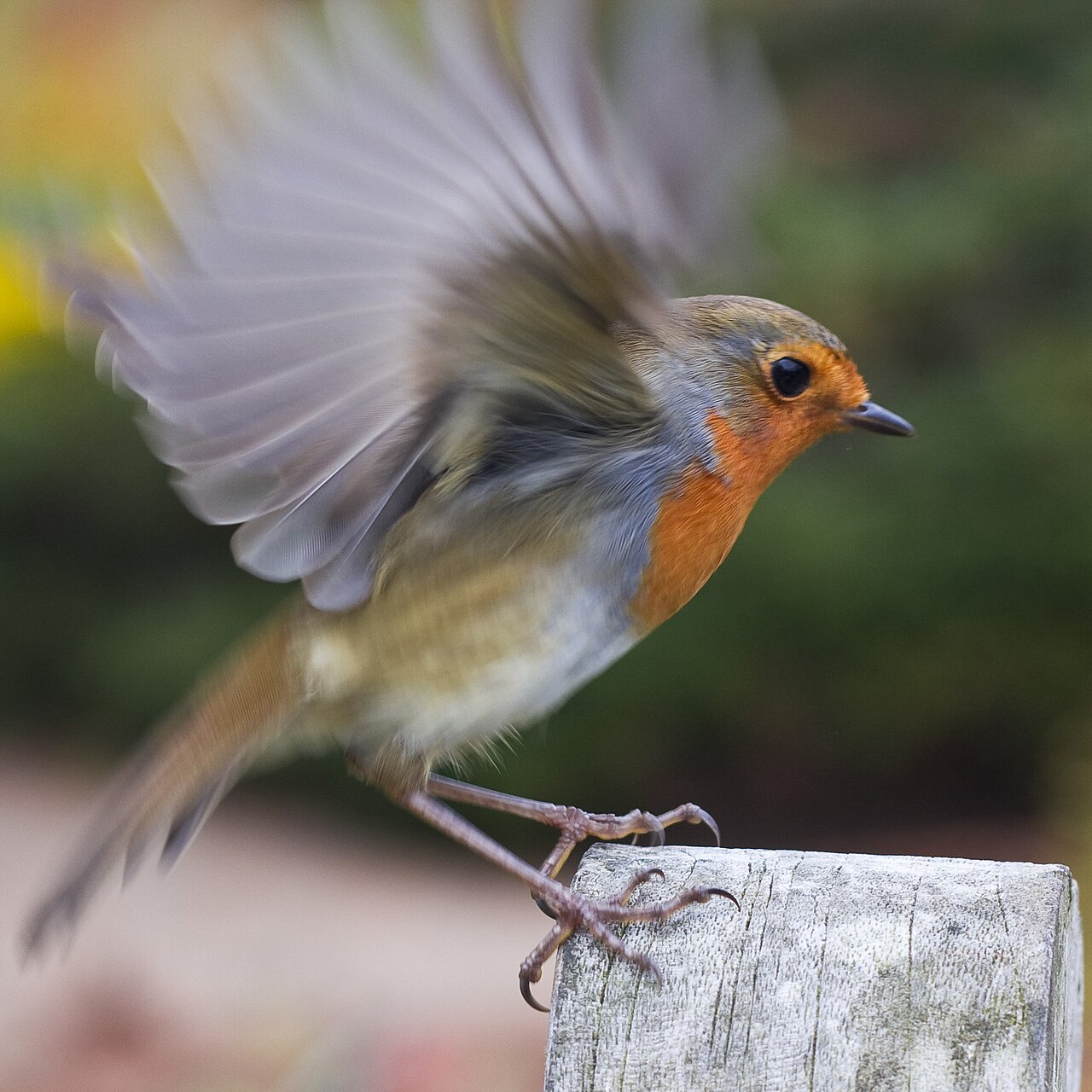
Every autumn, a European robin the size of your fist leaves northern Europe and flies, alone and at night, to a wintering ground it has never seen. No GPS, no map, no leader to follow. And yet it arrives — often on a heading accurate to within a few degrees. For a long time, how it pulled this off was a genuine mystery. The answer, when it finally came, turned out to be one of the strangest sentences in all of biology: the bird may literally see the Earth's magnetic field, using a quantum effect in its own eye.
A compass made of light
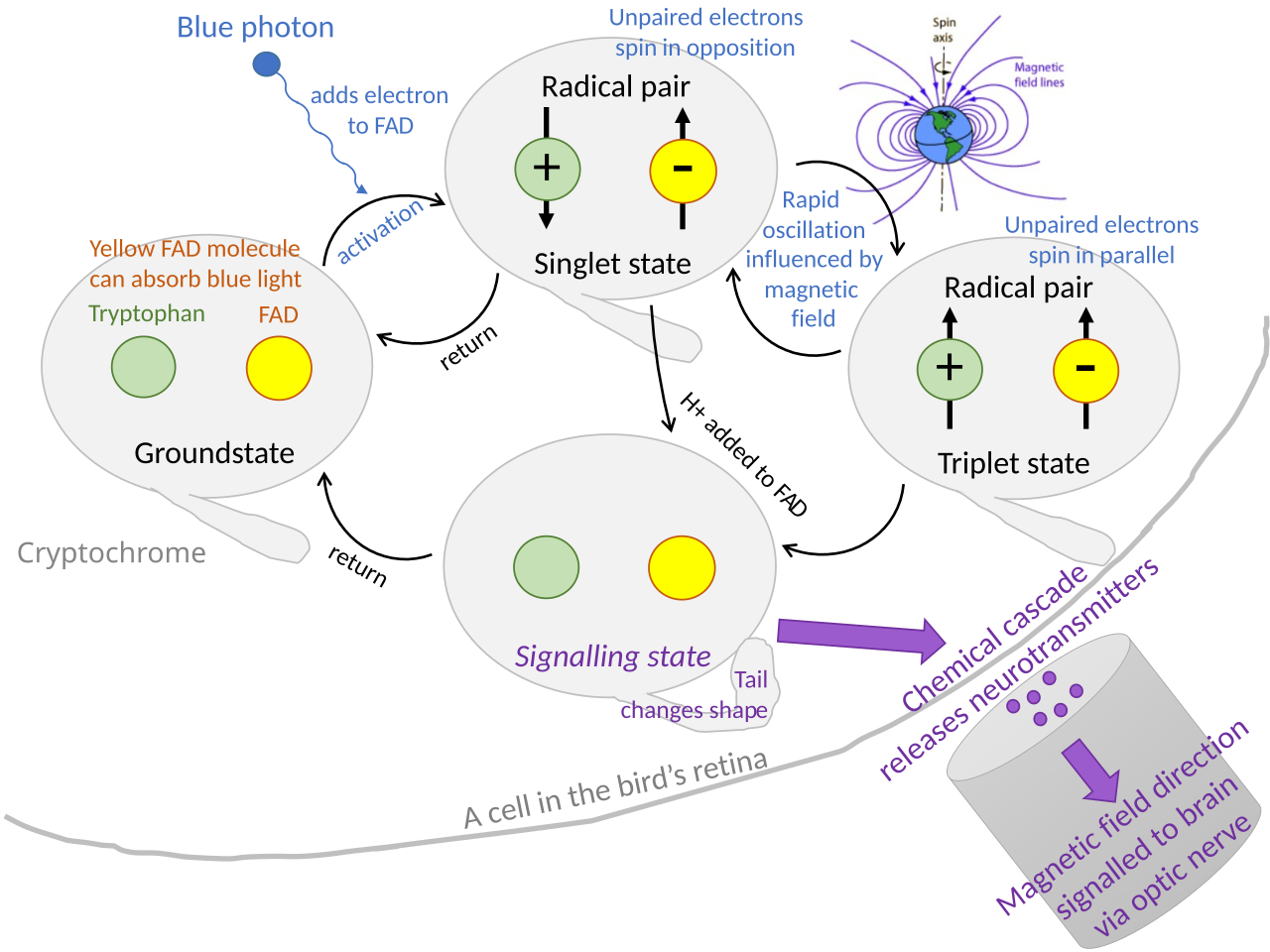
The trick starts with light hitting the retina — specifically blue light. Inside photoreceptor cells in the bird's eye sits a protein called cryptochrome (the leading candidate is a version called Cry4a). When a photon of blue light strikes it, it kicks an electron loose, and that electron jumps down a chain of building blocks inside the protein. The result is a radical pair: two molecules, each left holding a single unpaired electron.
Here's where it stops being ordinary chemistry. Those two electrons are quantum-entangled — their spins are linked, flickering together between two states (physicists call them singlet and triplet) millions of times a second. And that flickering is exquisitely sensitive to one thing: the angle of the surrounding magnetic field.
How a magnetic field becomes a picture
The Earth's field is fantastically weak — far too faint to push molecules around by brute force. But it doesn't have to. It only has to tip the balance between those two quantum states, nudging the radical pair to spend a little more time as a singlet or a triplet depending on which way the bird's head is turned relative to the field lines.
That subtle shift changes how the cryptochrome reaction ends, and therefore the signal it sends to the brain. Now multiply it: the eye holds millions of these molecules, each one oriented slightly differently. Together they paint a pattern across the retina — most likely a faint smear of light and shade, a kind of shimmering haze laid over whatever the bird is already looking at. Scientists describe it as a literal heads-up display: a magnetic overlay on ordinary vision that brightens or dims as the bird swings its gaze.
A compass that doesn't know north
Here's a lovely wrinkle. The bird's compass isn't like the one in your pocket. A human compass reads polarity — it points to the magnetic north pole. The bird's reads inclination: the tilt of the field lines relative to the ground. It can tell "toward the pole" from "toward the equator," but it genuinely can't tell north from south.
We know this from beautifully simple experiments. Put a migratory blackcap in an artificial field tilted at the natural angle and it orients perfectly. Flatten the field to horizontal — zero inclination — and the bird is suddenly lost, hopping in random directions. Drop the tilt to just 5 degrees and the compass switches back on. It's reading the slope of the planet's field, not its direction.
How we know it's really quantum
This could all be a nice story — except for one telltale experiment. The singlet-triplet flickering happens at a specific rhythm, a frequency you can interfere with using a faint radio wave. So researchers bathed migratory birds in a radio field tuned to exactly that frequency, far too weak to affect anything else in the body. The birds' compass broke — they could no longer find their direction. Switch off the radio, and the compass came back.
That's the fingerprint of a quantum effect. A radio wave that quietly disrupts orientation, at precisely the frequency where entangled electron spins should be vibrating, is hard to explain any other way. It's also why the sense is light-dependent: no blue light, no radical pair, no compass.
Why I love this one
We tend to file quantum mechanics under "weird stuff that happens in physics labs, near absolute zero, behind a lot of shielding." And here it is, running warm and wet inside a songbird's eyeball, evolved and refined over millions of years — apparently the most sensitive magnetic sensor of its kind we've ever found, and we didn't build it.
A creature lighter than a slice of bread is, in a real sense, doing quantum sensing on its commute. It looks up at a night sky that to us is just dark, and sees a glowing compass drawn in light — then flies a thousand miles by it. The next time a small brown bird vanishes south for the winter, remember: it may be navigating by something we can barely measure with a lab full of equipment, painted gently across its view of the stars.