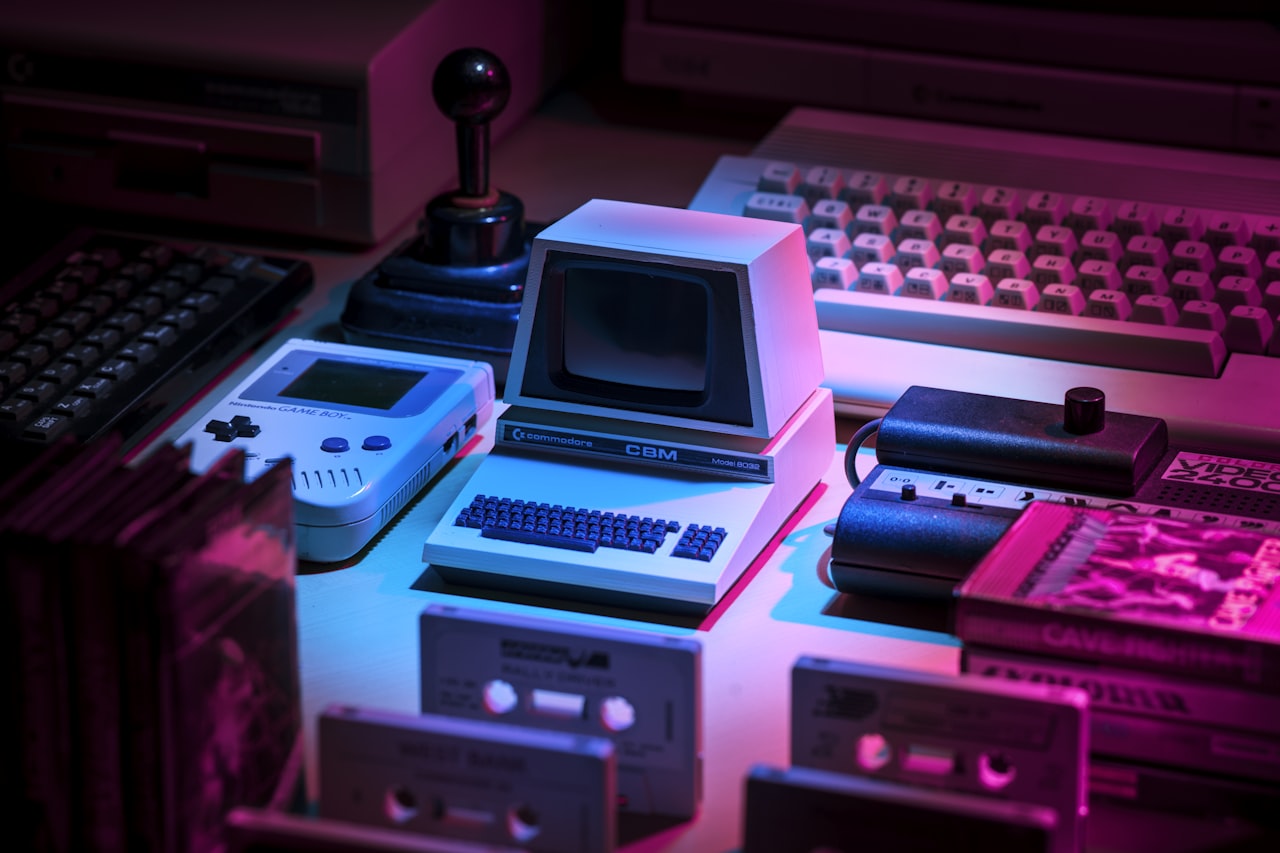
Racing the Beam: The Atari That Couldn't Hold a Picture
Imagine writing a program that has to keep perfect time with a beam of electrons flying across a glass tube at thousands of miles an hour. Fall a few millionths of a second behind and your spaceship smears into garbage. Get ahead and it vanishes. This wasn't a stunt — it was just how you made a video game on the Atari 2600, the wood-grained box that landed in living rooms in 1977 and taught a generation what "Pong, but at home" could become. The catch nobody mentions on the cartridge label: the console had no memory for a picture at all.
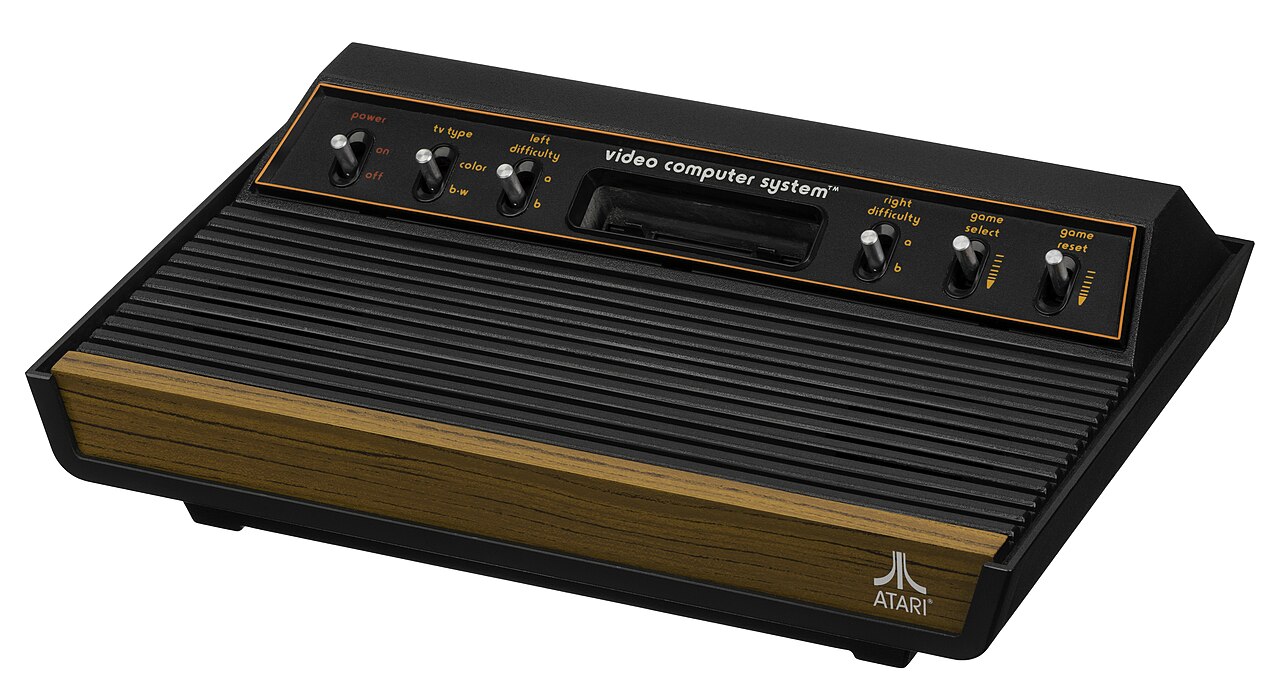
A console with nowhere to put the picture
Most machines that draw to a screen keep a framebuffer: a chunk of memory holding every pixel, which the video hardware reads and paints, over and over, while the program quietly edits it in the background. It's the obvious way to do it. It's also expensive. In 1977, memory cost a fortune, and Atari's engineers were ruthless about price. So they simply left the framebuffer out.
The result is almost absurd. The Atari 2600 has 128 bytes of RAM. Not kilobytes — bytes. That's barely enough to remember a high score and where the ball is. There is nowhere to store an image, because there is no image. The picture you see on the TV does not exist anywhere inside the machine. It exists only in the roughly 63 microseconds it takes the electron beam to sweep across one line of the screen — and then it's gone, and the program has to conjure the next line from scratch.
Racing the beam
Here's how a 1970s television draws: an electron gun fires at the back of the glass, sweeping left to right to light up one horizontal line, then snapping back to start the line below. Top to bottom, sixty times a second. On the Atari, the chip that talks to the TV — the TIA, the Television Interface Adaptor — has no patience and no memory. It paints whatever its registers say right now, at the exact pixel the beam is touching.
So the programmer's job is to feed those registers in lockstep with the beam. Want the spaceship's middle to be wider than its top? You change the shape register between scanlines, in the sliver of time when the beam is dark and flying back to the left edge. Atari folks call this the horizontal blank, and it's brutally short. Each line gives the processor roughly 76 machine cycles total; only about 22 of those fall in the blank, and 160 visible pixels' worth of beam are already drawing while you scramble to set up the next line. Programmers literally counted cycles by hand, the way a drummer counts beats, because being one tick late meant the wrong color in the wrong place. They named this tightrope walk racing the beam, and it's where the whole console's reputation for impossible craftsmanship was forged.
Why everything came in stripes
Two truths shaped the look of nearly every Atari game. First, since the TIA only holds one line's worth of graphics at a time, the natural unit of design was the horizontal band. Change the colors line by line and you got those gorgeous gradient skies; leave them alone and you got flat blocks. The console practically wanted you to think in stripes.
Second — and this is the detail engineers still wince at — you couldn't just tell a sprite where to go. To move a player horizontally, you strobed a register, and when you strobed it, relative to the beam's position, decided the column. But the beam moves in coarse jumps, so the placement snapped to one of fifteen chunky zones across the screen. To nudge a sprite to an in-between pixel, you had to feed it a separate fine-adjustment value. Forget that step and your hero teleports across the screen in clumsy fifteen-pixel hops. That awkward, stuttery movement in early games wasn't sloppy code — it was the hardware showing through.
The art of having nothing
What's wonderful is what programmers did anyway. With 128 bytes, no framebuffer, and a chip that forgot everything every line, they delivered Pitfall!, Space Invaders, and racing games that genuinely felt like racing. Pitfall!'s designer fit a jungle of 255 scrolling rooms into a four-kilobyte cartridge by generating the world from a single number run through a math trick, because there was no room to store it. The limitation didn't crush the creativity; it became the medium, the way a sonnet's fourteen lines push poets to be sharper, not quieter.
And here's the kicker. Decades later, hardware got generous: gigabytes of memory, framebuffers everywhere, GPUs that shrug at billions of pixels. Then a curious thing happened — modern indie developers started adding back the stripes, the chunky sprites, the scanline shimmer, paying good money for shaders that fake the glow of a CRT. The constraints that once forced programmers to fight the beam for every dot are now an aesthetic people chase on purpose. The machine that couldn't hold a picture ended up holding something more durable: a look we never quite stopped loving.