
3I/ATLAS: The Interstellar Fossil Older Than the Sun
On July 1, 2025, a robotic telescope perched in the dry hills of Río Hurtado, Chile, took a routine sweep of the night sky and caught a faint smudge of light crawling against the stars. Within a day, astronomers realized this was not a local comet doing its usual loop around the Sun. It was moving too fast, on too steep a path, to belong to us at all. They named it 3I/ATLAS — the third confirmed interstellar object ever seen — a traveler that formed around another star, drifted across the galaxy for billions of years, and just happened to pass through our cosmic neighborhood on our watch.
A visitor that was never ours
Almost everything in the solar system moves in tidy, closed loops. Planets, asteroids, ordinary comets — they all trace ellipses, bound to the Sun like stones on invisible strings. 3I/ATLAS broke that rule the moment it was tracked. Its orbit is hyperbolic: an open curve that swings in once, rounds the Sun, and leaves forever. That single geometric fact is the smoking gun. Nothing born here moves like that. The comet was sprinting through the inner solar system far too fast for the Sun's gravity to ever capture it, which means it came from outside — from the dark stretches between the stars.
It is only the third such object we have ever caught. The first was 1I/'Oumuamua in 2017, a strange elongated sliver that left more questions than answers. The second was comet 2I/Borisov in 2019. 3I/ATLAS is the biggest and brightest of the trio, and the most cometary of them all — a genuine dirty snowball from somewhere else.
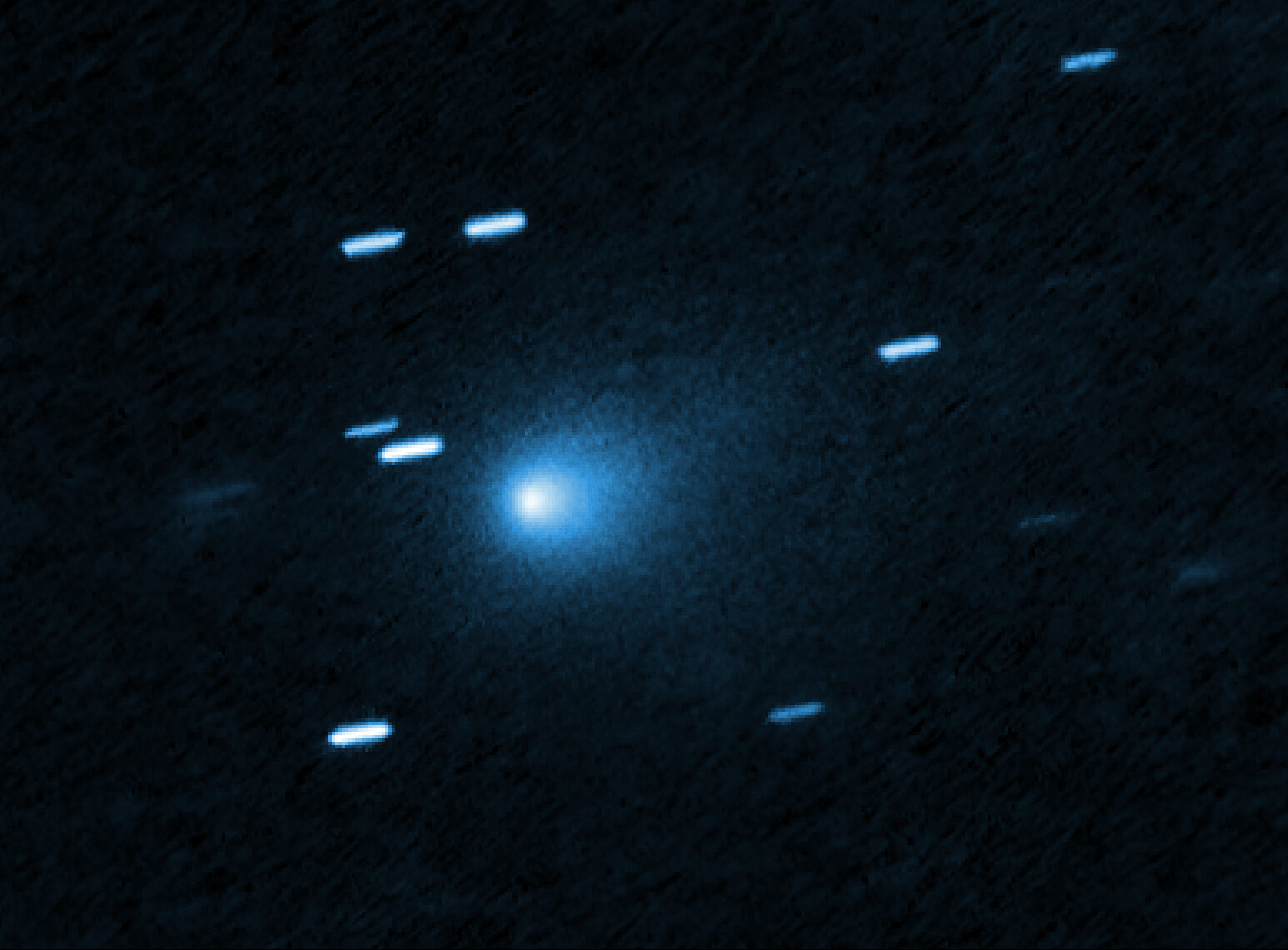
Older than the Sun itself
Here is the detail that gives astronomers chills. A team at the University of Oxford, led by Matthew Hopkins, ran the numbers on where 3I/ATLAS likely came from and concluded it is staggeringly old — a best estimate of roughly 7 billion years, possibly more. For comparison, our Sun and everything orbiting it is about 4.6 billion years old.
Let that sink in. This chunk of ancient ice was already wandering the Milky Way for nearly three billion years before the Sun ignited, before Earth existed, before there was anyone to look up. It appears to have formed in the galaxy's "thick disk," a population of stars far older than almost anything else we have ever studied. When it streaked past our telescopes, we weren't just photographing a comet — we were photographing a fossil from the early universe, briefly lit by our own star.
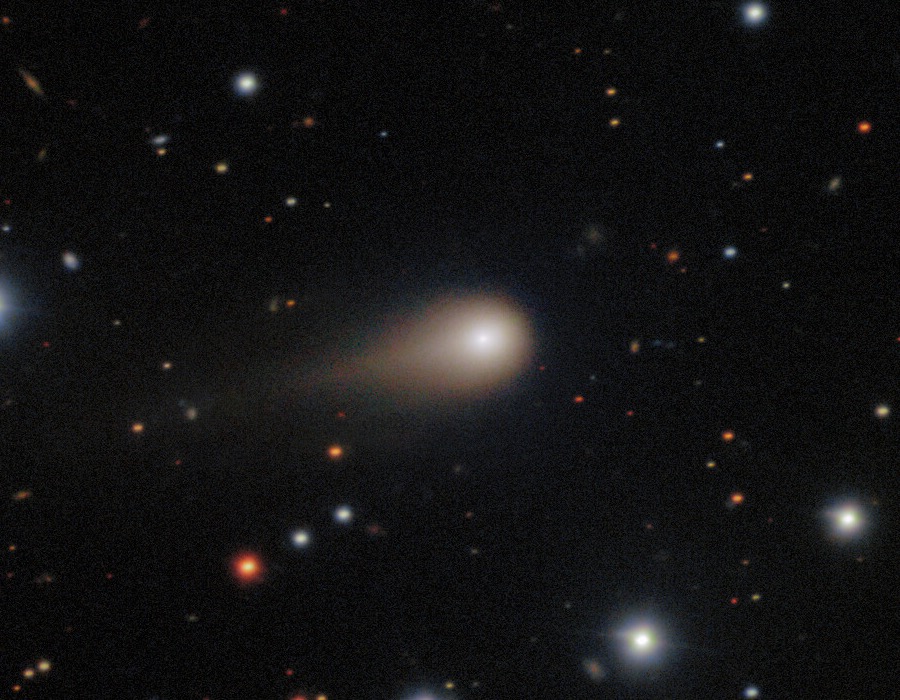
No danger, just a spectacle
If your instinct on hearing "interstellar object hurtling through the solar system" is mild panic, relax. 3I/ATLAS never came anywhere near us. Its closest approach to Earth, in December 2025, was about 270 million kilometers away — roughly 1.8 times the distance between Earth and the Sun. That's a comfortable cosmic arm's length. Earth was actually on the far side of the Sun when the comet rounded our star at the end of October 2025, so there was never the faintest possibility of an impact.
What it lacked in menace it made up for in raw motion. At perihelion — its closest pass to the Sun — 3I/ATLAS was clocked at roughly 246,000 kilometers per hour — about 4,100 kilometers a minute. At that speed you could cross an ocean in a couple of minutes. As the Sun warmed it, the comet did exactly what comets do: it cooked. Spacecraft and telescopes watched it vent gas and dust, its coma swelling into a glowing cocoon rich in carbon dioxide, with water ice detected underneath. It even threw out jets and a faint tail, painting a little smear of the interstellar deep across our sky.
A one-way goodbye
The most poignant thing about 3I/ATLAS is that we will never see it again. There is no return trip. In March 2026 it is expected to cross Jupiter's orbit on its way out — still deep inside the solar system, with a long climb ahead before it fully escapes, picking up exactly the speed it arrived with, bound for the open galaxy. It will keep going for billions more years, indifferent to the brief flurry of attention from a species that only learned to spot such things a decade ago.
We got one look. A few months to point our best instruments at a messenger older than our Sun, decode a little of its chemistry, and watch it glow. Somewhere out there, around some other star, this comet's siblings are still in orbit — and the galaxy, it turns out, has been quietly mailing us postcards from its oldest neighborhoods all along. We've only just learned how to read the postmark.