
Norway Wants a Temporary Ban on AI Glasses in Parks, Schools and Gyms. It Has Not Decided What Counts as AI Glasses.
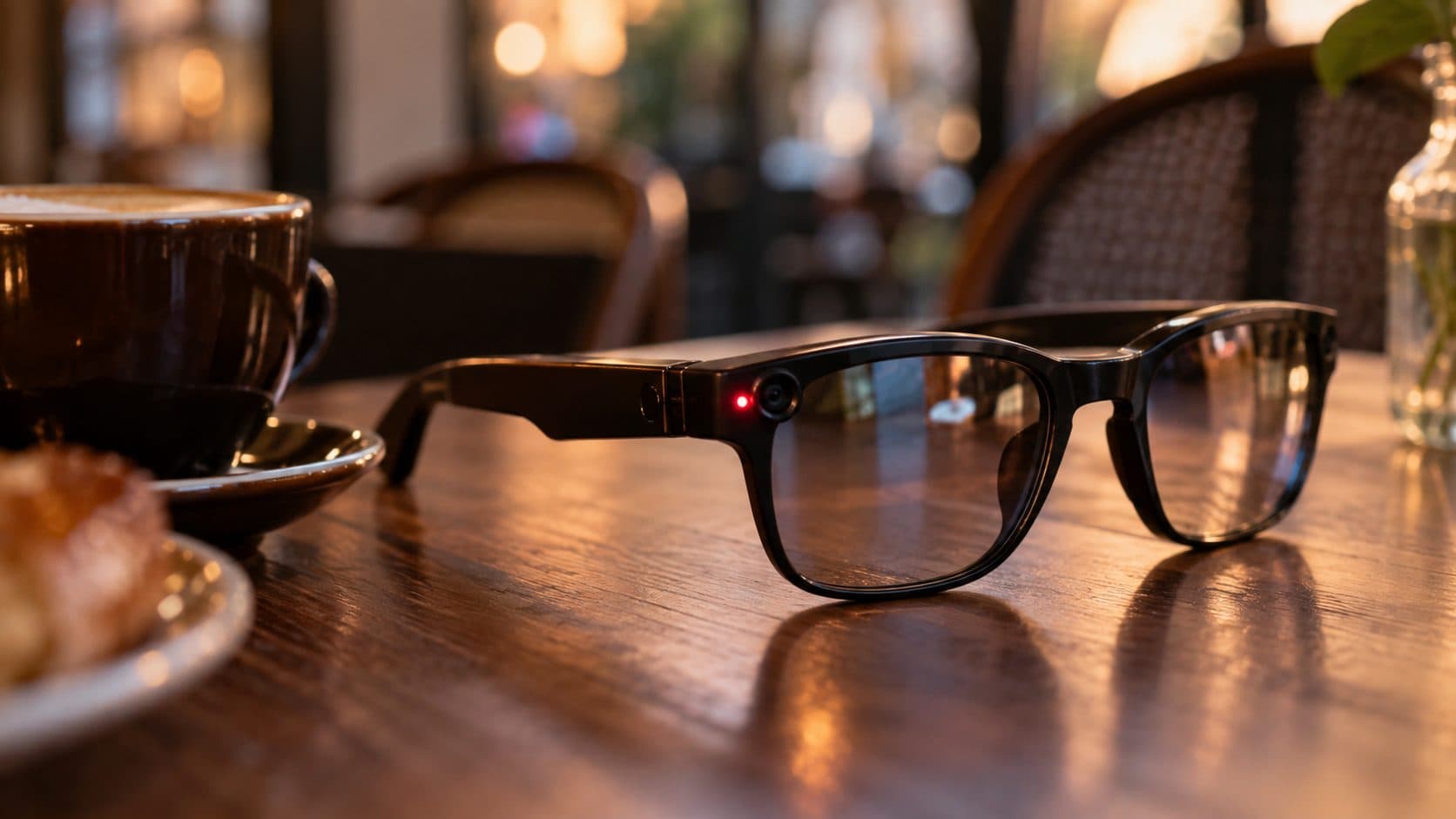
On Monday, October 5, Norway's Ministry of Digitalisation and Public Governance announced that it will propose a temporary ban on the use of AI glasses in selected places. The minister, Torgeir Micaelsen, had been in the job for four weeks, according to the news agency NTB. His reason, in my translation: powerful new technology is arriving with which people risk being photographed, filmed or audio-recorded without knowing it.
It sounds like a crackdown. The release is narrower, and for people who build software, more interesting.
What Norway actually announced
There is no law yet. The government says it will bring a bill to the Storting, the parliament, "as quickly as possible", and calls the work a high priority. No date, no penalty, no legal text.
What it does list is places. The ban could cover places the public regularly passes through: parks, beaches, museums, shopping centres, amusement parks, sports, music and cultural events. It could cover places for children: schools, kindergartens, playgrounds, youth clubs. And places where privacy matters most: health institutions including doctors' offices, swimming pools, gyms, anywhere with changing rooms and showers. Universities are under consideration.
It is explicitly not a total ban. Purely private use would stay allowed, and so would use where you do not risk filming people without their consent. The government promises exemptions for vulnerable groups and for socially beneficial use in limited cases. In parallel, an expert group will advise on permanent rules for what the ministry calls body-worn technology.
Six weeks earlier, on August 25, the previous minister, Karianne Tung, had taken a different line: stricter rules, possibly a ban on features such as facial recognition of other people in public spaces, but no ban on the device itself. Norway moved from regulating a feature to regulating the act of wearing the thing in a place.
The sentence that matters is in the fact box
In the release's fact box, the government admits the core question is still open. It will study which technology the ban should cover: glasses with a camera and audio recording, glasses with a camera and AI functionality, or also other body-worn technology with a camera, audio recording and/or AI.
Those are three very different products. The third one covers a ring with a microphone and an assistant.
California hit the same wall five days earlier. On September 30, Governor Gavin Newsom vetoed SB 1130. The bill defined a "wearable recording device" as any device worn on or attached to the body, rather than held, that can make sound or video recordings or transmit sound or video to another device or to the internet. From January 1, 2028, it would have barred making or selling such devices without a light, sound or other indicator prominent enough that "a reasonable person in the vicinity would be alerted to the capturing activity." According to AP, Newsom wrote that the definition was too broad.
Two governments, one week, the same problem: nobody agrees on what recording means for a device that sees and hears in order to answer questions.
The light covers half of what the camera does
Meta's own documents show why the definition is hard. In a July 2025 paper on bystander privacy, Meta splits its camera into two uses. Active capture is photos and videos you save or stream. AI features are the camera looking so the assistant can answer, like translating a menu. The capture LED signals the first. For the second, the LED stays off, except on the first-generation Ray-Ban Meta, and Meta says it takes steps such as removing key identifiable information. The stated reason is fair: a light that blinked at every AI query would teach people to ignore it.
Its July 2026 Q&A says the white LED blinks whenever content is captured "for your gallery", that it has no off switch, and that covering or tampering with it disables the camera.
So a bystander who sees no light has learned one thing: nothing is going to the wearer's gallery. They have not learned that the camera is off.
Victoria Song sharpened this point in The Verge on October 6. Companies building AI hardware, she writes, want devices that process and summarise but keep no footage to fall outside the meaning of recording. She cites Google's head of wearables, Sandeep Waraich, wondering aloud whether a camera that saves nothing could be just an image sensor. Her objection: a transcript or a summary is also preserved, and also reviewable.
Meta's latest product move goes around the problem. Ray-Ban Meta Audio, announced September 23, has speakers, microphones and Meta AI but no camera, as Nettavisen reported. It costs $349 and ships October 13. Under Norway's third option, a microphone plus an assistant could still be in scope.
What a regulator can actually check
A ban on use in places is enforced by a lifeguard, a teacher, a security guard. They can see the frame, and maybe a light. They cannot see whether frames go to a cloud model, whether a transcript is kept for a day or a year, or whether a face was blurred before upload.
What a data protection authority can check is the builder's side: data flows, retention, logs. EU builders already have obligations there. Under Article 2(2)(c) of the GDPR, processing by a natural person in the course of a purely personal or household activity is outside the regulation. Recital 18 adds the line that matters for us: the regulation "applies to controllers or processors which provide the means for processing personal data for such personal or household activities." The wearer may be exempt. Your endpoint is not. And in Ryneš (C-212/13, 2014), under the directive that preceded the GDPR, the Court of Justice held that a camera on a family home that stores video continuously and "also monitors a public space" does not amount to processing "in the course of a purely personal or household activity".
Article 25 then asks for data protection by design and by default: only the personal data necessary for each specific purpose, including how long you keep it.
What I would design on Monday
I build on Claude, and in the LegalTech I run, the first question about any client document is not whether we store it but where it is processed, and by whom. Camera and microphone features deserve the same question, with a harder twist: the person in the frame never accepted your terms.
Four things, for any camera or always-on feature.
First, write your own definition of recording, one sentence per feature: is the sensor output saved, transmitted or discarded, where, and for how long. If you cannot write that sentence, someone else will write it for you, and Norway's fact box shows how wide it can get.
Second, signal what leaves the device, not only what is saved. If you decide, as Meta did, not to signal some uses, write down that decision and the reason. That record is what you show an auditor.
Third, send the cloud as little as possible. Process on the device when you can, send derived text rather than frames, blur faces before upload, and set retention for bystander frames to zero by default.
Fourth, make every sensor switchable by configuration, per country and per feature. Norway is legislating by place, with exemptions. When a rule like that lands, you want to ship a configuration change, not an app release, and still keep an assistive mode for the users those exemptions are written for.
The meaning of recording for AI devices will be fixed in the next year or two, by a parliament or a court. Teams that already have an honest one-sentence answer for every feature will barely notice. The others will learn what their product does from a statute.
Sources
- Norwegian Ministry of Digitalisation and Public Governance, "Vil innføre midlertidig forbud mot KI-briller" (5 de octubre de 2026)
- Norwegian Ministry of Digitalisation and Public Governance, "Tung vil ha strengere regulering av smartbriller" (25 de agosto de 2026)
- Aftenposten (NTB), "Regjeringen vil ha midlertidig forbud mot KI-briller på utvalgte steder" (5 de octubre de 2026)
- California Legislative Information, "SB-1130 Invasion of privacy: wearable recording devices" (enrolled septiembre de 2026, vetoed 30 de septiembre de 2026)
- ABC News (AP), "Newsom vetoes measure that would have penalized the use of smart glasses to secretly record people" (30 de septiembre de 2026)
- Meta, "Bystander Privacy: Evolving with the AI Glasses Landscape" (julio de 2025)
- Meta, "Meta's AI Glasses: Your Questions Answered" (7 de julio de 2026, updated 23 de julio de 2026)
- Meta, "Introducing Ray-Ban Meta Audio and More AI Glasses Styles" (23 de septiembre de 2026)
- Nettavisen, "Meta fjerner kameraet på KI-brillene" (24 de septiembre de 2026)
- The Verge, "We can't just change the definition of 'recording'" (6 de octubre de 2026)
- Official Journal of the EU, "Regulation (EU) 2016/679 (GDPR)" (27 de abril de 2016)
- Court of Justice of the EU, "Judgment in Case C-212/13, Ryneš" (11 de diciembre de 2014)